المحتويات
مقال
Why Bitcoin struggles at $90K while Gold and Oil power higher
January 29, 2026
مقال
Why Bitcoin struggles at $90K while Gold and Oil power higher
January 29, 2026
مقال
Why Bitcoin struggles at $90K while Gold and Oil power higher
January 29, 2026

Bitcoin has pushed back above $90,000 several times in recent months, but each recovery has proved short-lived. Instead of igniting a fresh rally, the moves have faded as attention has shifted elsewhere. Gold has surged to new record highs above $5,500 an ounce, while oil prices have climbed to their strongest levels since September, reshaping inflation expectations and redirecting capital flows.
That divergence has become harder to ignore. Bitcoin, long marketed as protection against monetary instability, is now trading roughly 30% below its October peak near $126,000, even as commodities thrive. The failure to hold $90,000 is less about crypto-specific weakness and more about the macro backdrop currently setting the tone for global markets.
What’s driving Bitcoin’s weakness?
Bitcoin’s recent struggles are closely tied to changing expectations around monetary policy. The Federal Reserve kept interest rates unchanged this week in the 3.5%–3.75% range, signalling it wants firmer evidence that inflation is easing before considering further cuts. While markets anticipated the decision, the messaging was more cautious than some investors had hoped, dampening expectations for rapid liquidity support.
That caution has helped stabilise the US dollar after a volatile spell. A firmer dollar has removed an important tailwind for bitcoin, which had benefited from earlier currency weakness. The dollar index’s strongest daily gain since November coincided with bitcoin briefly reclaiming $90,000 before slipping back, highlighting how sensitive the asset remains to broader macro shifts.
Why Gold and Oil are winning the capital battle
Gold continues to attract steady inflows as investors seek shelter from inflation risk and geopolitical uncertainty. Prices have risen by more than 60% over the past year and extended gains into 2026, supported by declining confidence in fiat currencies and growing concern over central bank independence.
Institutional behaviour reflects that shift. Tether, the issuer of the world’s largest stablecoin, has expanded its gold holdings to around 130 metric tons and indicated plans to allocate up to 15% of its portfolio to bullion. At the same time, oil has added pressure across markets. West Texas Intermediate crude has climbed about 12% this month to above $64 a barrel, with Brent following closely behind. Rising energy costs feed directly into inflation, complicating the case for near-term rate cuts and weighing on assets that thrive on looser financial conditions.
Why it matters for Bitcoin
Bitcoin’s underperformance relative to gold highlights a persistent identity issue. Despite its “digital gold” label, the asset continues to trade more like a high-beta risk instrument than a defensive hedge. When inflation concerns rise, capital has flowed into bullion. When the dollar strengthens, bitcoin tends to retreat.
David Morrison, senior market analyst at Trade Nation, said bitcoin needs a decisive break and hold above $90,000 to rebuild confidence. “That would open the door to $100,000 as the next bullish target,” he said, while cautioning that without stronger support, a pullback towards $85,000 remains a real possibility. For now, the market lacks the conviction needed to sustain a breakout.
Impact on the broader crypto market
Bitcoin’s consolidation has spilled over into the wider crypto market. Ether has drifted back towards the $2,950 area, while Solana, XRP and Dogecoin have posted steeper intraday declines. Even during brief periods of dollar weakness earlier this month, crypto failed to mount a convincing response.
That lag reinforces the sense that digital assets are currently sidelined. As metals and energy dominate global trading flows, crypto has struggled to carve out an independent narrative. Price action across the sector suggests traders are reacting to external macro signals rather than positioning for a crypto-led recovery.
Expert outlook
Market watchers say bitcoin’s next meaningful move will depend far more on macro developments than on internal adoption stories. Alex Kuptsikevich, chief market analyst at FxPro, noted that previous bitcoin rallies coincided with sharp declines in the dollar. This time, however, much of the benefit from recent currency weakness has been absorbed by gold and silver instead.
From a technical perspective, bitcoin remains stuck in a consolidation phase. Resistance around $89,000–$90,000 is reinforced by the 50-day moving average, while support near $85,000 has so far held firm. Until inflation pressures ease, oil prices retreat, or the Federal Reserve signals a clearer shift towards easing, bitcoin is likely to remain range-bound.
Key takeaway
Bitcoin’s inability to hold above $90,000 reflects a macro-driven market rather than a breakdown in crypto fundamentals. Surging gold and oil prices have lifted inflation concerns and reduced expectations for swift rate cuts, drawing capital away from speculative assets. Until those pressures ease, bitcoin is likely to remain in consolidation mode. The next decisive move will hinge on inflation data, energy prices and changes in central bank guidance.
Bitcoin technical outlook
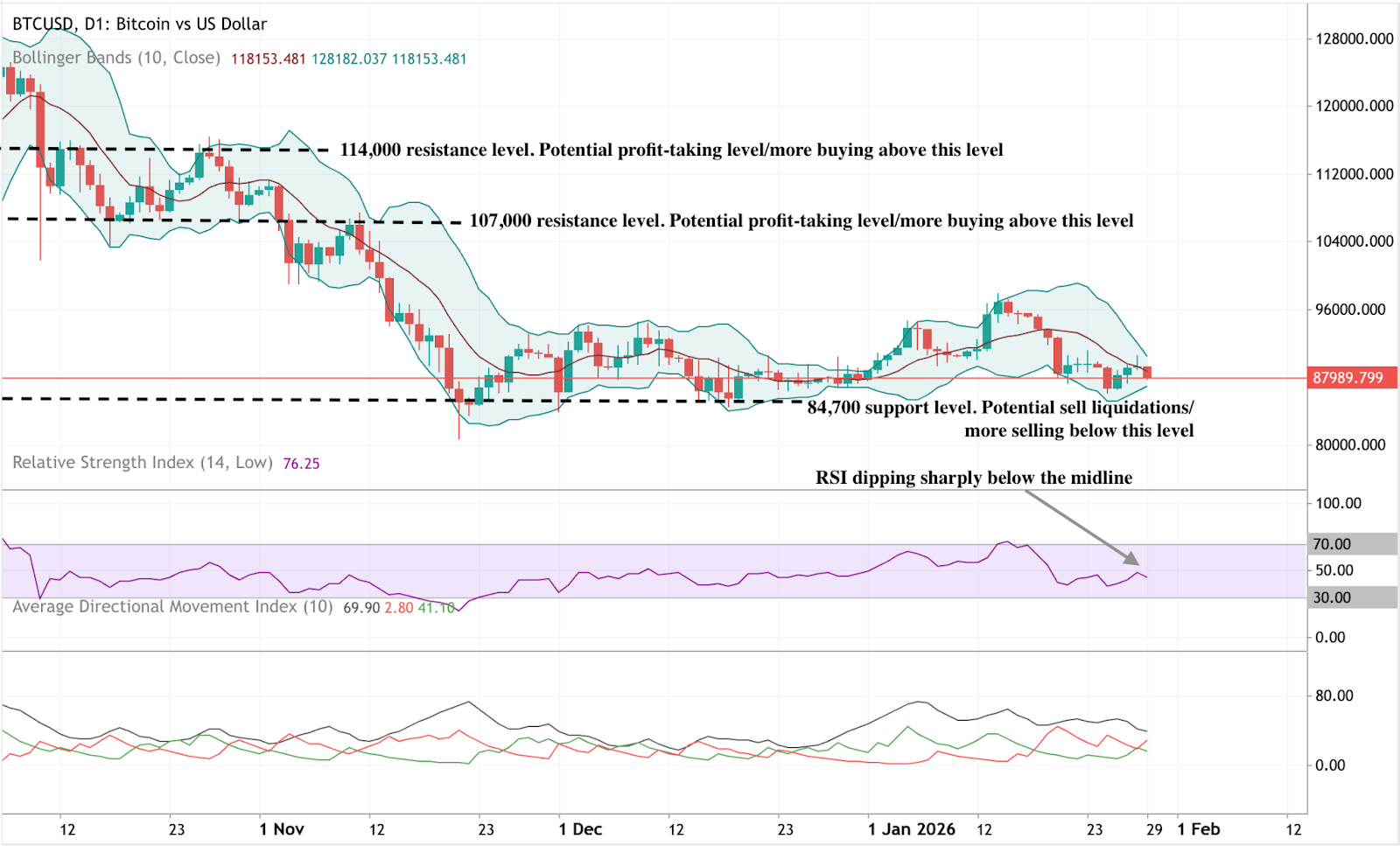
Bitcoin continues to trade within a consolidation range following its earlier correction from record highs, with price holding above the $84,700 area and hovering in the lower half of its recent range. Bollinger Bands have narrowed since the previous expansion phase, signalling reduced volatility and a pause in directional momentum.
Momentum indicators point to a softening bias. The RSI has slipped below the midpoint, suggesting fading upside momentum after a brief rebound, while elevated ADX readings indicate that trend strength remains present even as directional conviction weakens. Structurally, price remains capped below former resistance zones around $107,000 and $114,000, reinforcing the view that the market is consolidating rather than entering a fresh phase of price discovery.
إخلاء مسؤولية:
The information contained on the Deriv Market News is for educational purposes only and is not intended as financial or investment advice. The information may become outdated, and some products or platforms mentioned may no longer be offered. We recommend you do your own research before making any trading decisions. The performance figures quoted refer to the past, and past performance is not a guarantee of future performance or a reliable guide to future performance.
الأسئلة الشائعة
Why can’t Bitcoin hold $90,000?
Why is gold outperforming bitcoin?
How do rising oil prices affect Bitcoin?
Is Bitcoin still an inflation hedge?
What levels matter next for Bitcoin?


