المحتويات
مقال
Does Gold still have room to rise after Trump’s Davos shift?
January 22, 2026
مقال
Does Gold still have room to rise after Trump’s Davos shift?
January 22, 2026
مقال
Does Gold still have room to rise after Trump’s Davos shift?
January 22, 2026

Yes, gold may still have further upside even after President Donald Trump softened his stance on Greenland during the Davos forum. Although prices have edged lower from record levels near $4,900 per ounce, the move appears to reflect reduced geopolitical tension rather than waning investor conviction. Spot gold briefly touched $4,887.82 before pulling back, yet the metal remains up more than 11% so far in 2026, building on last year’s powerful 64% rally.
Trump’s more conciliatory tone dampened short-term safe-haven demand, but it has not dismantled the broader forces supporting gold prices. Central bank accumulation, growing private-sector participation, and unresolved macroeconomic risks continue to underpin the market. With the immediate headlines fading, investors are now reassessing whether these longer-term drivers can sustain gold’s advance even as geopolitical pressure eases.
What’s driving Gold?
Gold’s recent dip followed a sharp upswing sparked by rising geopolitical uncertainty. Earlier threats of tariffs linked to tensions between the US and Europe over Greenland prompted investors to rotate into defensive assets. The issue resonated beyond trade, given Greenland’s strategic importance for security and critical minerals, fuelling concerns about wider diplomatic and economic fallout.
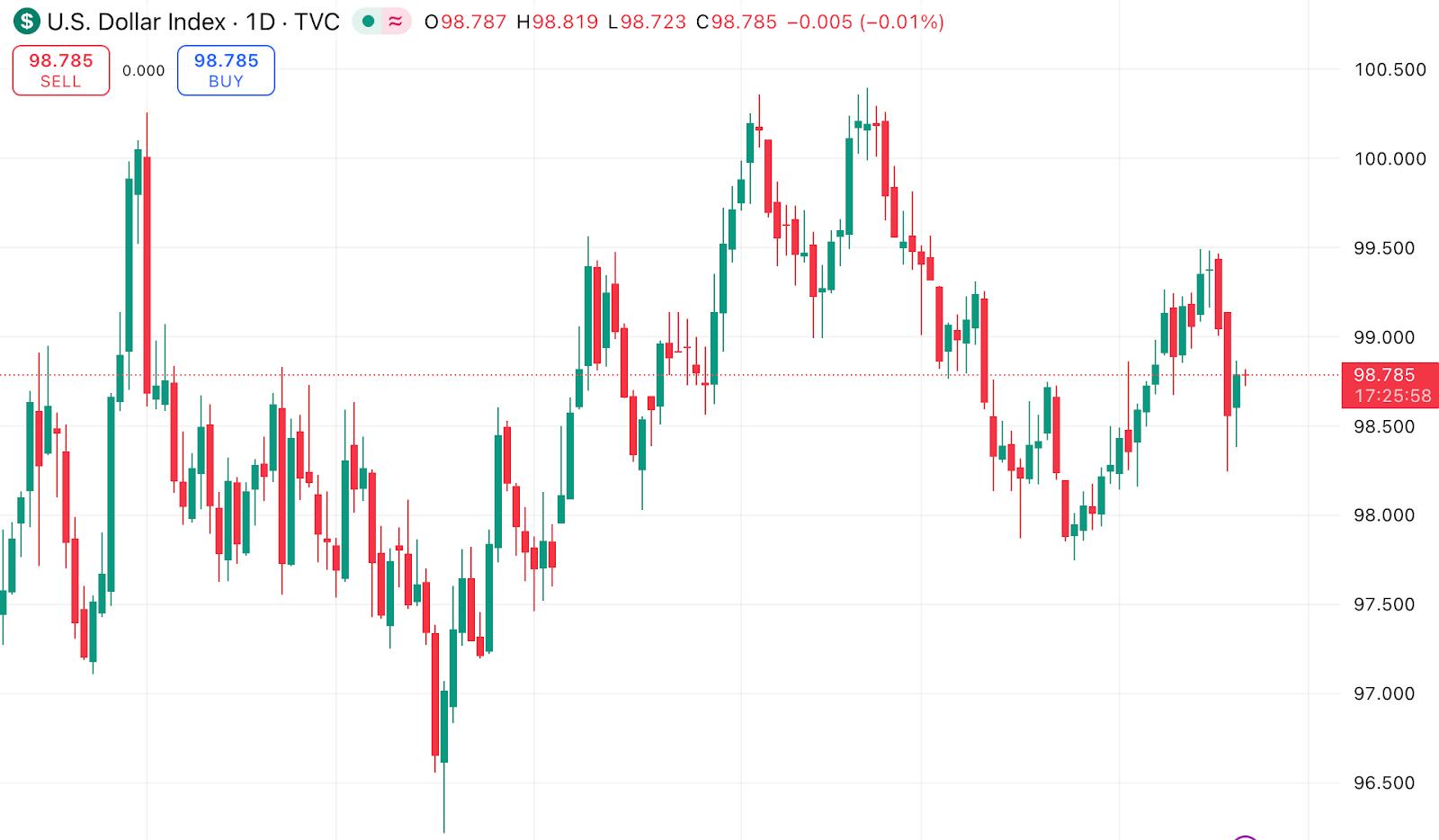
That sense of urgency cooled after Trump adopted a softer stance in Davos. He dismissed the prospect of military action, stepped back from tariff threats, and pointed towards progress on a broader agreement with NATO partners. As those risks receded, gold prices eased, a move reinforced by a mild recovery in the US dollar, with the Dollar Index ticking higher after a 0.1% gain in the previous session.
Why it matters
Gold’s price action highlights how strongly markets are responding to political messaging rather than concrete policy changes. Speculation alone was enough to push bullion close to $5,000, while reassurance quickly prompted profit-taking. This pattern underlines gold’s growing role as a hedge against policy and geopolitical uncertainty, not just inflation or interest-rate shifts.
More importantly, there is little evidence that long-term buyers are retreating. Goldman Sachs has lifted its gold price outlook, now projecting $5,400 per ounce by year-end, up from a previous target of $4,900. The bank argues that rising private-sector demand is increasingly complementing central bank purchases, reinforcing the metal’s underlying support.
Impact on markets and investors
For investors, the recent pullback feels more like a pause than a turning point. Gold was trading near $4,800 per ounce after retreating from its peak, yet it has more than doubled since early 2023, when prices hovered around $1,865.
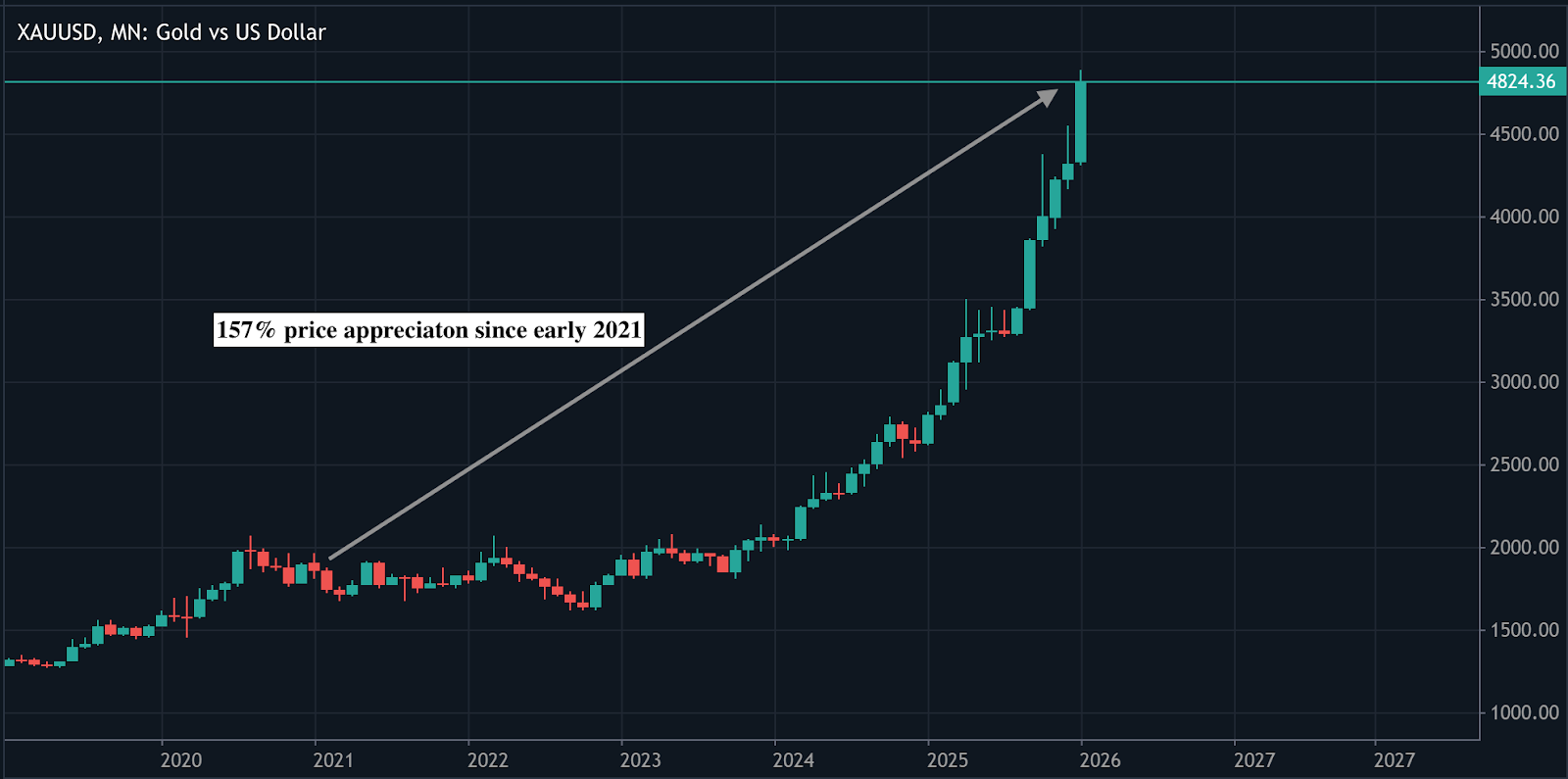
That longer-term rise was initially driven by heavy official-sector buying in 2023 and 2024, before being reinforced by a broadening wave of private demand. The influence of shifting risk sentiment is also evident across other precious metals. Silver fell back from a daily high of $95.56 following Trump’s Davos remarks, moving in step with gold as geopolitical premiums eased.
Gold’s strength is also drawing attention to other hard assets. Platinum, often sidelined during gold-led rallies, is attracting renewed interest as investors look to diversify within the precious metals complex. Although platinum remains more closely tied to industrial cycles, its tight supply and strategic use in autocatalysts and clean-energy technologies are supporting its appeal as an additional hedge against macro and policy uncertainty.
Expert outlook
According to Goldman Sachs, gold’s rally has gathered pace since 2025 because central banks are no longer acting alone. Analysts Daan Struyven and Lina Thomas note that official buyers are now competing with private investors for a relatively fixed pool of bullion, increasing upward pressure on prices. This dynamic builds on several years of sustained central bank accumulation that laid the foundation for the current trend.
Private-sector participation has also broadened beyond traditional exchange-traded fund flows. Goldman highlights rising physical gold purchases by high-net-worth investors, increased use of call options, and a growing range of products designed to hedge global macroeconomic risks. The bank expects these trends to be supported by potential Federal Reserve rate cuts and continued central bank buying, averaging around 60 tonnes per month in 2026, as emerging markets diversify their reserves.
A key factor underpinning this outlook is gold’s limited supply response. Unlike most commodities, higher prices do not quickly bring new output to market. The vast majority of gold already exists and is simply traded between holders, while annual mine production accounts for only about 1% of global supply. As a result, gold prices tend to peak only when demand fades meaningfully - whether through sustained geopolitical calm, reduced reserve diversification, or a shift by the Federal Reserve towards tighter policy.
Key takeaway
Gold’s retreat following Trump’s Davos comments reflects a cooling of immediate geopolitical fears rather than a breakdown in its broader bullish narrative. Central bank demand, expanding private investment, and rigid supply dynamics continue to support elevated prices. While short-term volatility is likely as political signals evolve, the underlying forces driving gold higher remain largely intact. Markets will be watching policy developments, currency moves, and central bank behaviour for the next decisive signal.
Technical outlook
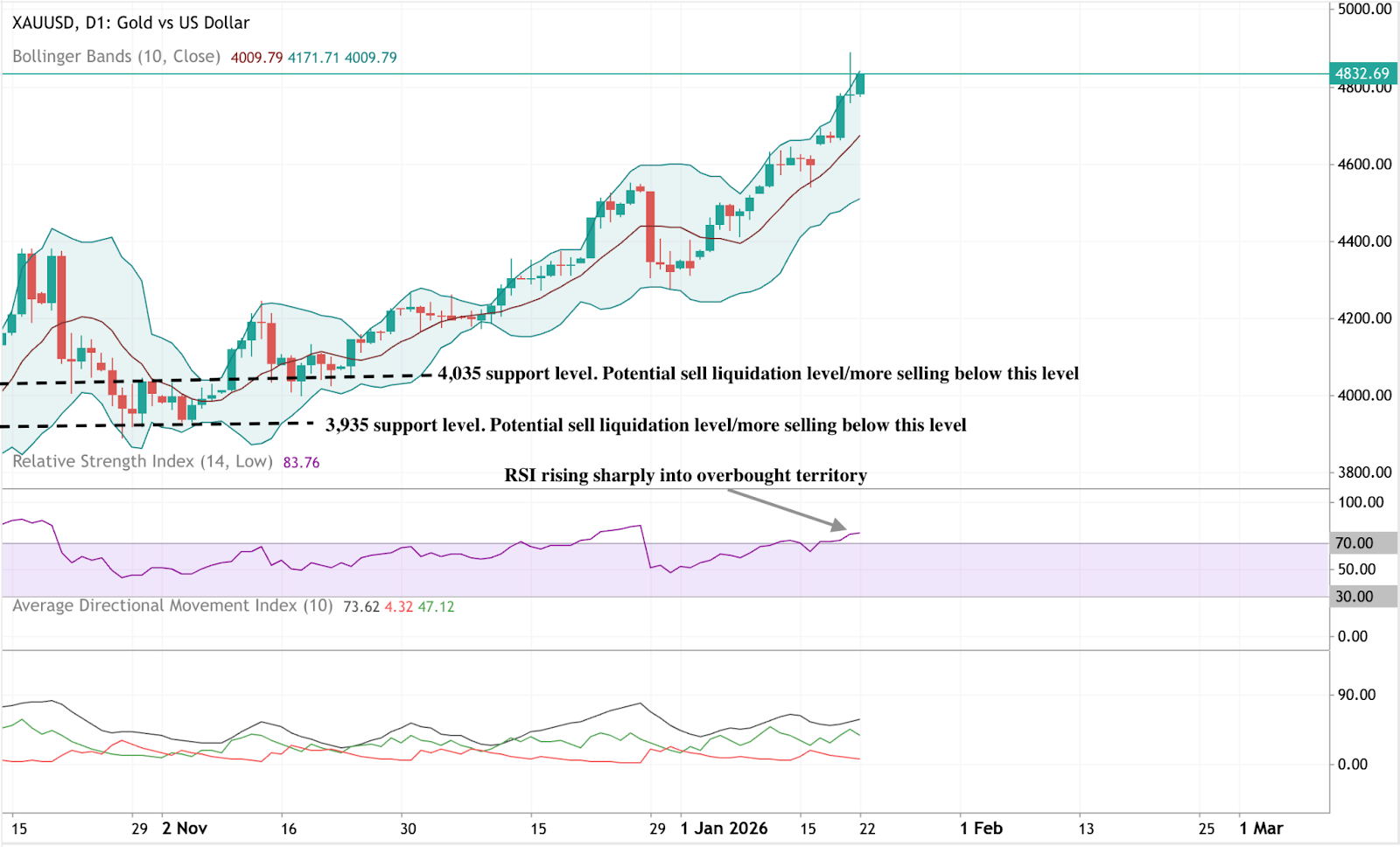
Gold has pushed into new all-time highs above $4,800, trading well beyond the upper Bollinger Band and signalling an extended momentum phase. Volatility remains elevated, with widely spread bands pointing to strong directional pressure rather than consolidation.
Momentum indicators are stretched, with the RSI firmly overbought across several timeframes and the monthly reading near extreme territory. Meanwhile, an ADX reading above 30 indicates a powerful, mature trend. Overall, price action suggests gold is in an active price-discovery phase, with strong trend persistence and the risk of near-term exhaustion.
إخلاء مسؤولية:
The information contained on the Deriv Market News is for educational purposes only and is not intended as financial or investment advice. The information may become outdated, and some products or platforms mentioned may no longer be offered. We recommend you do your own research before making any trading decisions. The performance figures quoted refer to the past, and past performance is not a guarantee of future performance or a reliable guide to future performance.
الأسئلة الشائعة
Why did gold prices fall after Trump’s Davos speech?
Is gold still in an uptrend despite the pullback?
Why did Goldman Sachs raise its gold forecast?
What role does supply play in gold prices?
What could stop gold’s rally?


