المحتويات
مقال
What Microsoft’s Azure miss reveals about the AI trade
January 30, 2026
مقال
What Microsoft’s Azure miss reveals about the AI trade
January 30, 2026
مقال
What Microsoft’s Azure miss reveals about the AI trade
January 30, 2026

Microsoft’s Azure “miss” delivered a clear message to markets: expectations around the AI trade have shifted. Cloud growth of 39%, only marginally below forecasts, was enough to spark a 10% share price drop and wipe around $360 billion from Microsoft’s market capitalisation, even as the company exceeded revenue and earnings estimates.
The scale of the reaction signals a broader change in investor mindset. AI optimism is giving way to tougher scrutiny, where scale alone no longer satisfies. For Microsoft and its peers, the debate has moved beyond demand strength and towards whether sustained AI investment can generate dependable, profitable growth.
What’s drove Microsoft’s Azure miss?
Taken on its own, Azure’s performance was far from weak. Growth of 39% year-on-year remains enviable by most software standards. The issue lay in the comparison. Growth eased from the prior quarter’s 40%, and for hyperscalers operating under intense investor focus, even a slight deceleration can undermine confidence.
Microsoft was quick to frame the outcome as an execution constraint rather than a demand issue. CFO Amy Hood explained that newly deployed GPUs were prioritised for internal AI workloads and first-party services rather than for external Azure clients. Strategically, that may strengthen Microsoft’s ecosystem over time, but in the near term, it limited reported cloud growth and exposed how infrastructure pacing can delay visible returns from AI spending.
Why it matters for the AI trade
Azure has become the market’s preferred proxy for judging Microsoft’s ability to monetise AI at scale. When cloud growth softens, questions quickly surface around capital efficiency. During the quarter, Microsoft reported $37.5 billion in capital expenditure, much of it tied to AI and data centre buildouts, with management indicating spending will remain elevated.
That dynamic unsettled investors. KeyBanc’s Jackson Ader described Azure’s constant-currency growth as underwhelming relative to expectations, while UBS highlighted limited signs that Microsoft 365 Copilot is meaningfully accelerating revenue growth. The underlying concern is straightforward: AI must begin contributing tangibly to earnings, not just reinforcing long-term strategic positioning.
Impact on big tech and market sentiment
Microsoft’s sell-off weighed on the wider technology complex. Software stocks broadly retreated, pulling the iShares Expanded Tech-Software ETF down 5%, while the Nasdaq ended the session lower.
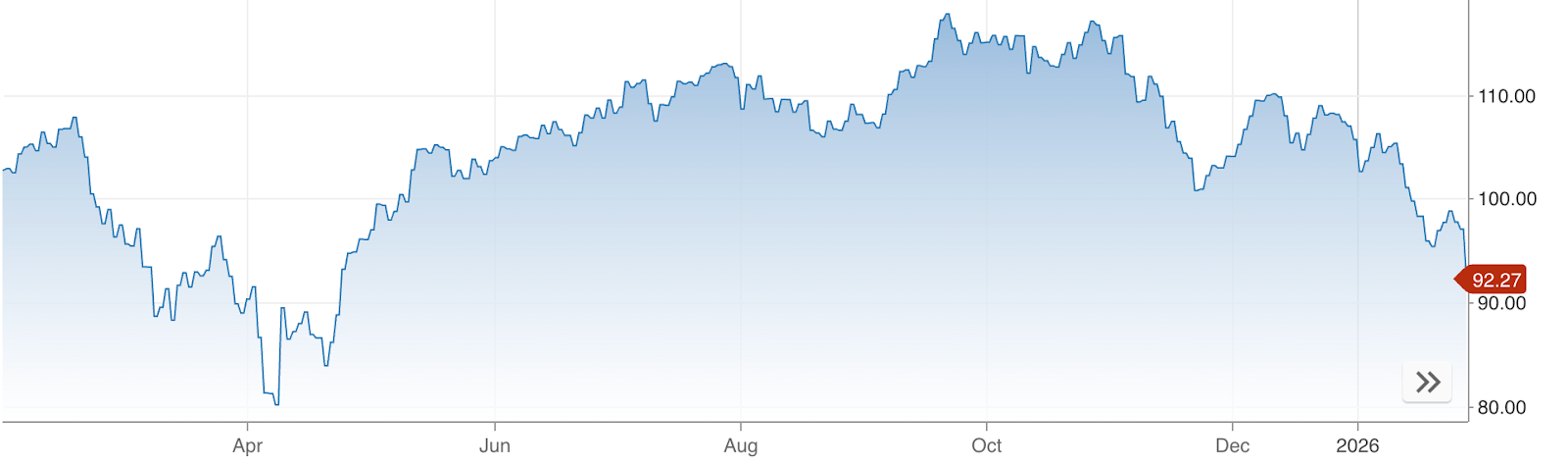
The divergence within Big Tech became more pronounced. While Microsoft came under pressure, Meta’s earlier earnings-driven rally highlighted how markets are increasingly rewarding companies showing near-term margin leverage rather than heavy reinvestment. The episode reinforced a more selective tone across the sector.
Attention now turns to upcoming results from Amazon and Alphabet. Investors are expected to scrutinise AWS and Google Cloud performance against Azure’s numbers, searching for clues on whether slower cloud momentum reflects company-specific execution or broader industry strain linked to AI infrastructure demands.
Expert outlook: Reset, not collapse
Despite the sharp repricing, analyst conviction around Microsoft remains largely intact. More than 95% of analysts continue to rate the stock a buy, with consensus price targets still pointing to over 40% upside from current levels. Bernstein argued that management has deliberately prioritised long-term platform resilience over short-term cloud optics, a choice that may only pay off over several reporting cycles.
What has clearly shifted is investor tolerance. Markets are less inclined to extend trust without evidence of improving margins and monetisation. For Microsoft, the focus now rests on Azure capacity expansion, uptake of AI-driven products like Copilot, and whether capital expenditure begins to level off. The AI trade remains intact, but the easy optimism phase has passed.
Key takeaway
Microsoft’s Azure miss did not derail the AI trade - it sharpened it. Investors are recalibrating their valuation of AI leadership, placing greater weight on execution, cost discipline, and earnings impact. Microsoft remains a cornerstone of the AI narrative, but expectations are tighter. The next phase will favour companies that convert scale into sustainable returns.
Microsoft technical outlook
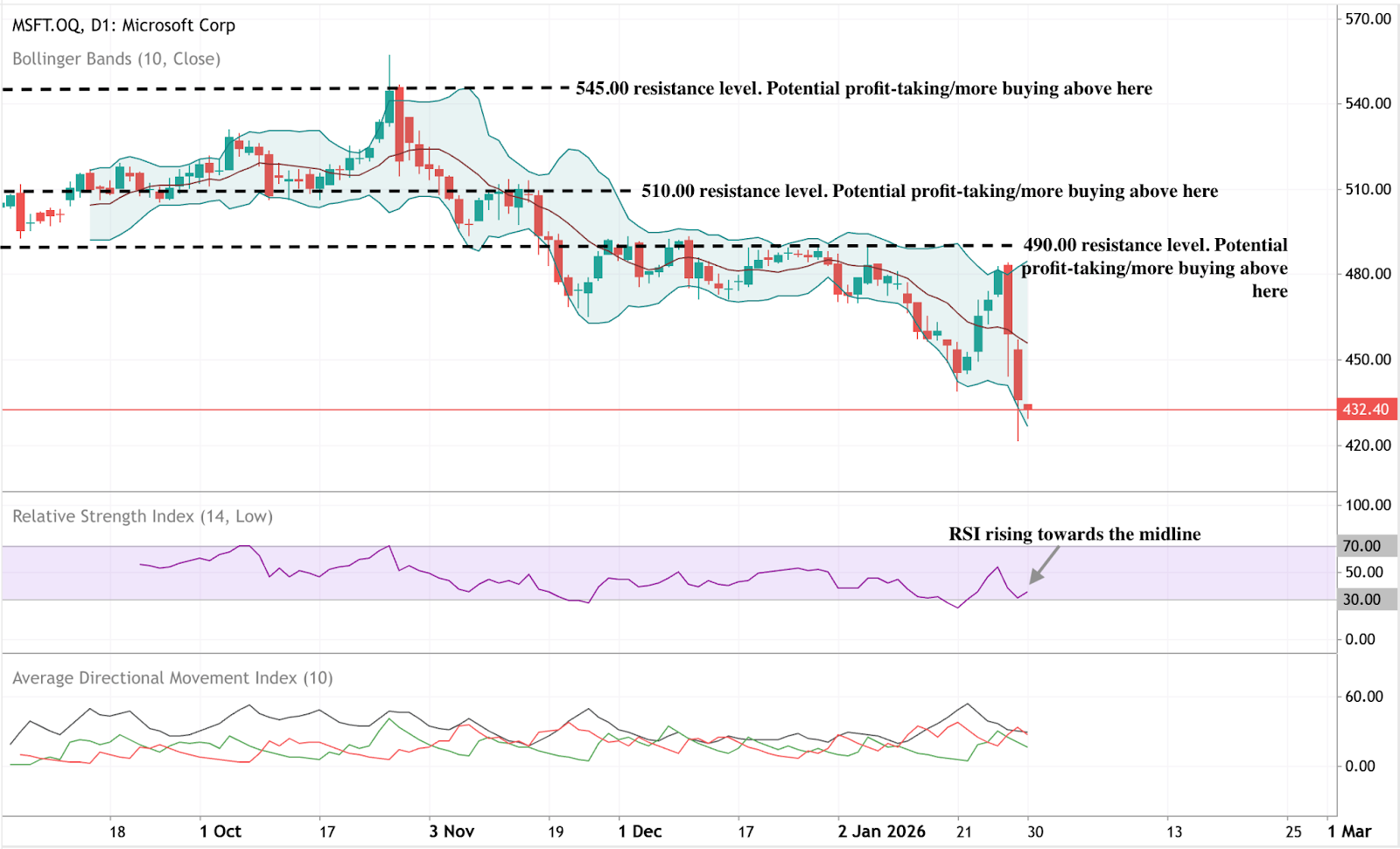
Microsoft has continued to trade lower after failing to hold prior highs, remaining below several former resistance levels and near the lower boundary of its recent trading range. Bollinger Bands remain moderately wide, suggesting volatility associated with the recent decline has not yet fully subsided.
Momentum signals point to tentative stabilisation rather than reversal. The RSI is edging back towards its midpoint after previously weaker readings, indicating slowing downside pressure without clear bullish confirmation. Trend measures remain mixed, with ADX reflecting trend presence but limited directional strength. From a structural perspective, price action below resistance near $490, $510, and $545 suggests consolidation following a corrective move rather than the start of a new directional trend.
إخلاء مسؤولية:
The information contained on the Deriv Market News is for educational purposes only and is not intended as financial or investment advice. The information may become outdated, and some products or platforms mentioned may no longer be offered. We recommend you do your own research before making any trading decisions." is present but requires tailoring. The performance figures quoted refer to the past, and past performance is not a guarantee of future performance or a reliable guide to future performance.
الأسئلة الشائعة
Why did Microsoft shares fall so sharply after earnings?
Is Azure still growing strongly?
What does this mean for the wider AI trade?
Are analysts still bullish on Microsoft?
What should investors watch next?


