المحتويات
مقال
Could Nvidia’s DRIVE breakthrough undermine Tesla’s autonomy story?
January 15, 2026
مقال
Could Nvidia’s DRIVE breakthrough undermine Tesla’s autonomy story?
January 15, 2026
مقال
Could Nvidia’s DRIVE breakthrough undermine Tesla’s autonomy story?
January 15, 2026
.jpg)
The short answer is no, according to investors, but the longer answer is more uncomfortable for Tesla investors. Nvidia’s latest expansion of its DRIVE platform does not erase Tesla’s years of work in autonomous software or its vast driving data advantage. However, it does make advanced self-driving far more accessible to competitors, narrowing a gap that many assumed would remain prohibitively wide.
This shift matters because Tesla’s valuation is increasingly anchored to what it might earn from autonomy rather than what it earns today. Vehicle deliveries dropped 8.5% in 2025, yet the stock pushed higher as markets priced in future robotaxi revenues. Nvidia’s CES 2026 announcements challenge that framing by suggesting autonomy will be competitive, not monopolised. The debate for investors is no longer about whether autonomy arrives, but who captures value once it does.
What’s driving Nvidia’s push into autonomous driving?
Nvidia’s move into autonomous vehicles is a natural extension of its broader AI strategy rather than a detour from its core business. As artificial intelligence matures within data centres, growth increasingly depends on applying that intelligence to the physical world, where machines must interpret complex, uncertain environments in real-time.
That ambition is backed by scale. Nvidia generated $115.2 billion in data center revenue in fiscal 2025, primarily from AI infrastructure, providing it with the financial firepower to invest aggressively in autonomy. At CES 2026, the company introduced a major upgrade to its DRIVE platform built around the Alpamayo family of models, which emphasise reasoning over pure pattern matching. This approach is designed to improve decision-making in situations that fall outside normal driving behaviour.
Why it matters for Tesla’s autonomy narrative
Tesla’s long-term story has shifted decisively from electric vehicles to autonomous software. Even as sales momentum slowed, shares continued to climb through 2025 on expectations that the Cybercab robotaxi could unlock massive new revenue streams. Ark Invest’s projection of $756 billion in annual robotaxi revenue by 2029 captures just how central that vision has become to bullish forecasts.
The challenge lies in execution and timing. The Cybercab is not expected to reach mass production until April 2026, and Tesla’s Full Self-Driving software still lacks approval for unsupervised use in the US. Each regulatory delay increases the risk that market expectations will outpace reality. Nvidia’s announcement does not derail Tesla’s plans, but it does ensure that when autonomy scales, Tesla will not be alone in its efforts.
Impact on the autonomous vehicle market
Nvidia’s expanding DRIVE ecosystem strengthens the competitive field across the automotive industry. Manufacturers such as Toyota, Mercedes-Benz, Volvo, Hyundai, and Jaguar Land Rover are already utilising Nvidia’s hardware and software to accelerate their autonomous vehicle programs. With reasoning-based AI tools now more widely available, development cycles are shortening, and costs are falling, allowing incumbents to challenge perceived leaders more quickly.
At the same time, Alphabet’s Waymo continues to build an operational lead. Completing more than 450,000 paid autonomous rides each week across five US cities, Waymo benefits from live deployment, regulatory experience, and real-world validation. When Tesla’s Cybercab eventually launches, it will be entering an active market rather than defining a new one.
Expert outlook: hype versus execution
Investor reaction to Nvidia’s CES announcements was swift, with some interpreting the developments as a turning point for autonomous driving. Morgan Stanley took a more measured view, cautioning that technological capability does not automatically translate into commercial success. According to the bank, integration, validation, and cost discipline remain decisive factors.
Analyst Andrew Percoco highlighted that autonomy is a long-cycle challenge, not a single breakthrough moment. Nvidia may provide the underlying tools, but manufacturers must still prove safety at scale and secure regulatory approval. The real test begins in 2026, when deployment efforts intensify, and Tesla attempts to convert long-standing promises into revenue-generating services.
Key takeaway
Nvidia’s DRIVE expansion does not spell doom for Tesla, but it does dilute the idea that autonomy is Tesla’s exclusive advantage. By lowering the cost and complexity of developing self-driving systems, Nvidia is reshaping the competitive landscape at a critical point in the autonomy cycle. Over the next year, markets will focus less on ambition and more on delivery, watching closely to see who turns technology into sustainable returns.
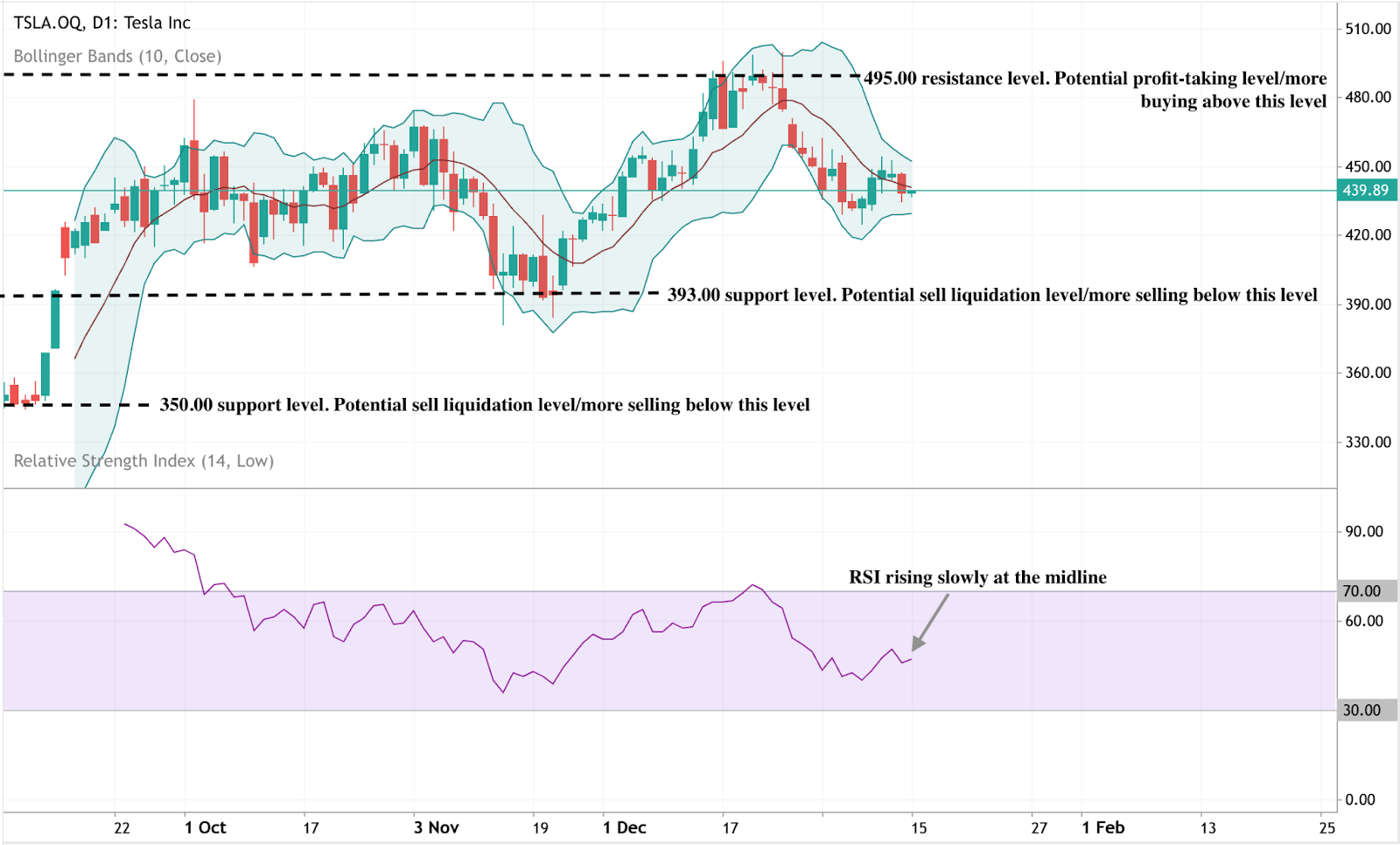
Tesla technical outlook
Tesla shares are consolidating below the $495 level after failing to sustain a recent upside push, with price action drifting back toward the centre of its broader trading range. Bollinger Bands have begun to narrow following a period of expansion, indicating cooling volatility after the earlier surge. Momentum appears to be stabilising rather than building.
The RSI is holding close to the midline, reflecting a neutral momentum backdrop after the prior rally lost steam. Overall, the technical picture suggests consolidation rather than a decisive breakout, as traders reassess direction following the rejection from the highs.
إخلاء مسؤولية:
The performance figures quoted refer to the past, and past performance is not a guarantee of future performance or a reliable guide to future performance.
الأسئلة الشائعة
Does Nvidia’s DRIVE breakthrough make Tesla obsolete?
Why is Nvidia focusing on ‘physical AI’?
Is Tesla’s Cybercab at risk of delays?
Who is currently leading the robotaxi market?


