المحتويات
مقال
Gold outlook: Is XAU/USD gearing up for another leg higher?
January 8, 2026
مقال
Gold outlook: Is XAU/USD gearing up for another leg higher?
January 8, 2026
مقال
Gold outlook: Is XAU/USD gearing up for another leg higher?
January 8, 2026

Gold’s inability to push decisively beyond the $4,500 threshold has put momentum under scrutiny. After a strong climb from November lows, XAU/USD has drifted back towards the $4,430–$4,450 zone as traders locked in gains and the US dollar found firmer footing. The retreat has been orderly, suggesting a pause rather than a reversal.
So far, the broader backdrop continues to argue for patience rather than pessimism. US job openings have slipped to 7.15 million, private payroll growth cooled to 41,000, and markets still anticipate roughly 60 basis points of Federal Reserve rate cuts this year. With Nonfarm Payrolls approaching and geopolitical risks unresolved, gold’s ability to regain traction will depend on whether macro signals tilt back in its favour.
What’s driving gold right now?
Near-term pressure on gold has stemmed largely from positioning adjustments rather than a shift in sentiment. Repeated failures near the $4,500 mark encouraged traders to scale back exposure after an extended rally. That coincided with a modest rebound in the US dollar, supported by signs of resilience in parts of the US economy.
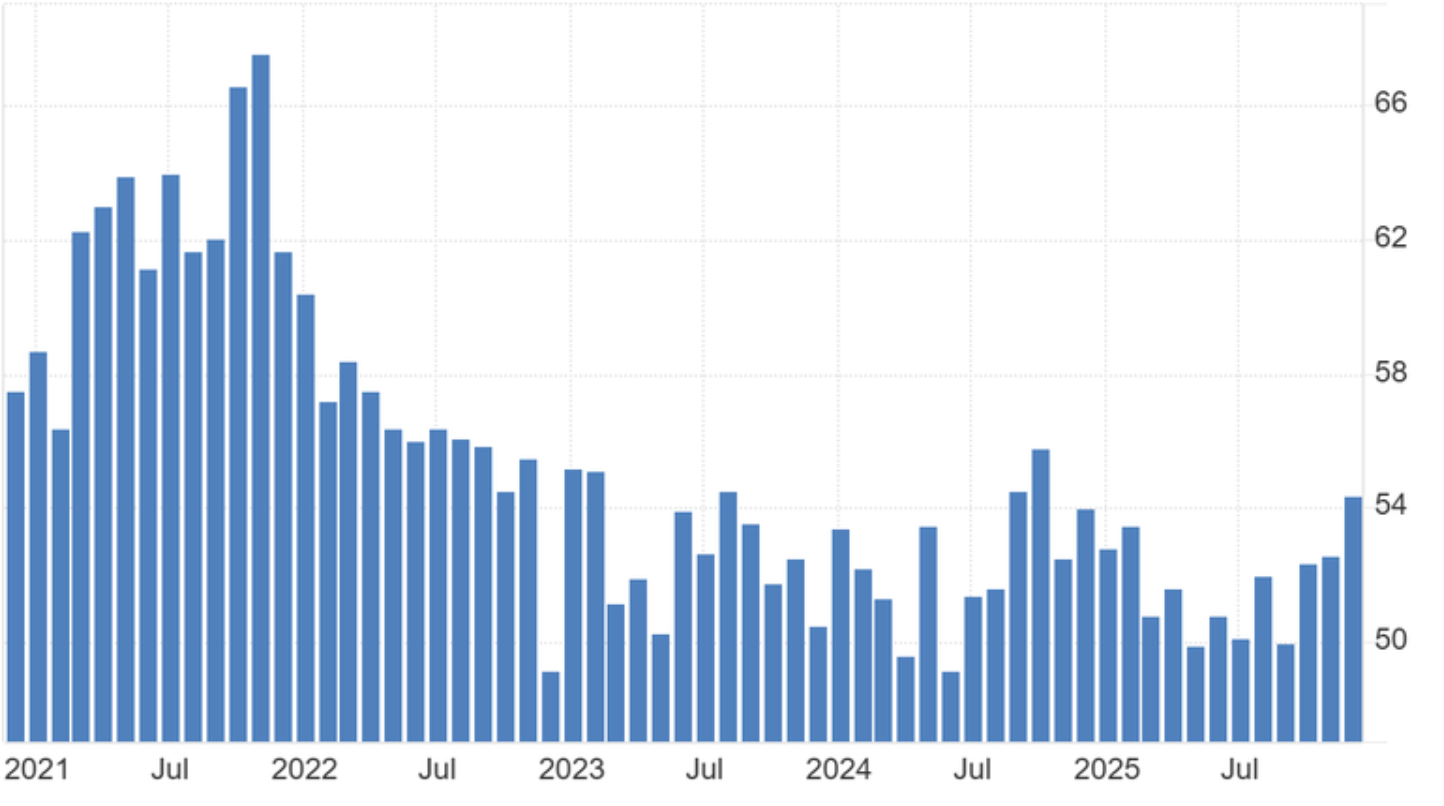
The ISM Services index climbed to 54.4 in December, its strongest reading since October, indicating that activity in the services sector remains robust despite broader signs of slowing growth.
However, labour market data paints a more subdued picture. Job openings declined by more than 300,000 in November, while private-sector hiring again fell short of expectations. Together, these signals suggest that economic momentum is cooling gradually rather than reaccelerating, keeping expectations of Fed easing firmly in place. For gold, this has created a tug-of-war between short-term dollar strength and longer-term macro support.
Why it matters
Understanding whether this move is tactical or structural is crucial. The pullback has not been accompanied by a sharp rise in real yields or a material shift in rate expectations. Instead, it reflects investors crystallising profits after a rapid advance. David Meger, director of metals trading at High Ridge Futures, characterised the move as “general profit-taking after that recent surge,” rather than the beginning of a broader unwind.
From a longer-term perspective, demand dynamics remain supportive. Central banks continue to accumulate gold, with China extending its buying streak to 14 consecutive months in December. Meanwhile, futures pricing still points to more than two quarter-point rate cuts this year, reinforcing gold’s appeal as financial conditions gradually ease.
Impact on the gold market and traders
In the near term, flows and technical factors are likely to play a bigger role in shaping price action. Gold is facing additional pressure from the Bloomberg Commodity Index’s annual January rebalancing, which will lower gold’s weighting from 20.4% to 14.9% under diversification rules.
Deutsche Bank estimates that the adjustment could result in the sale of roughly 2.4 million troy ounces over a five-day period, potentially translating into a 2.5–3% drag on prices.
That said, history shows that index-related selling does not always dictate direction. While several past rebalancing events coincided with price weakness, last year bucked the trend, with gold rising despite a reduced weighting. For traders, this environment suggests heightened short-term volatility, as well as the potential for dip-buying if macroeconomic and geopolitical tailwinds persist.
Expert outlook
Attention now turns to Friday’s US Nonfarm Payrolls report, which could provide the next decisive signal. Market expectations centre on around 60,000 new jobs in December, with the unemployment rate edging lower to 4.5%. A softer outcome would likely reinforce expectations for Fed easing, pressure the dollar, and reopen the door for gold to recover lost ground.
Geopolitical developments remain a key source of underlying support. Ongoing tensions tied to Greenland, evolving US–Latin America dynamics following the capture of Venezuelan President Nicolas Maduro, and renewed trade friction between China and Japan continue to bolster gold’s safe-haven appeal. As long as uncertainty remains elevated and the Fed leans towards easing, pullbacks are more likely to be treated as consolidation phases rather than trend reversals.
Key takeaway
Gold’s retreat from $4,500 appears to reflect consolidation after a strong rally rather than a breakdown in conviction. Mixed US data, a firmer dollar, and index-related flows are shaping near-term price action, while easing expectations and geopolitical risks continue to provide a supportive foundation. The upcoming Nonfarm Payrolls report is the next major test. Beyond that, the focus will be on whether buyers continue to defend dips or whether the market needs a deeper reset before momentum rebuilds.
Gold technical outlook
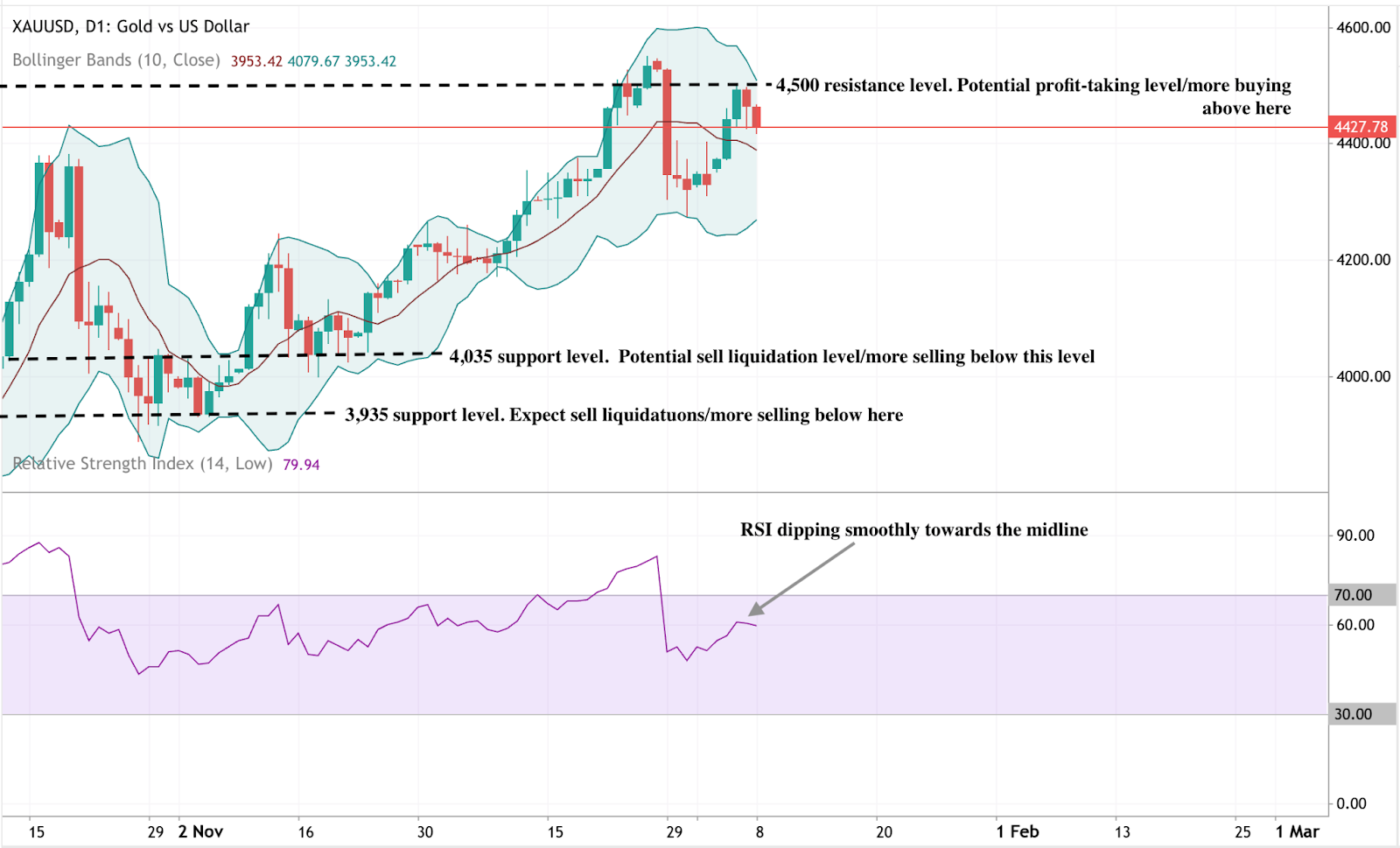
Gold remains within a broader bullish structure but is currently digesting gains after failing to hold above the $4,500 resistance area, which has once again attracted profit-taking. The pullback towards the $4,430 region looks corrective in nature, with no clear signs yet of a trend reversal.
Volatility remains elevated, as reflected by stretched Bollinger Bands, though momentum indicators suggest a cooling phase is underway. The RSI has eased back toward its midline from overbought territory, indicating that bullish pressure is moderating rather than flipping decisively bearish.
As long as price holds above the $4,035 support zone, the broader uptrend remains intact. A break below $3,935 would increase downside risk, while a sustained move back above $4,500 would be needed to reignite upside momentum. Consolidation above support, for now, keeps the bullish bias in play.
إخلاء مسؤولية:
The performance figures quoted refer to the past, and past performance is not a guarantee of future performance or a reliable guide to future performance.
الأسئلة الشائعة
Why did gold pull back after approaching $4,500?
How does US jobs data influence XAU/USD?
What role do central banks play in gold prices?
Will index rebalancing push gold sharply lower?
Is gold still bullish after this pullback?


