المحتويات
مقال
Big tech’s 2025 AI capex race: Amazon extends its lead
November 26, 2025
مقال
Big tech’s 2025 AI capex race: Amazon extends its lead
November 26, 2025
مقال
Big tech’s 2025 AI capex race: Amazon extends its lead
November 26, 2025
The scale of investment heading into 2025 is unlike anything the industry has seen. Amazon, Microsoft, Alphabet and Meta together are guiding toward $360–$400 billion in capital expenditure - an increase of roughly 60% year-on-year. Almost all of this spending is earmarked for AI infrastructure: hyperscale data centres, custom silicon, networking, and massive GPU and accelerator clusters designed for training frontier models.
On 24 November 2025, BNP Paribas Exane initiated coverage of Amazon with an Outperform rating and a $320 price target - the highest among major brokers. Based on Amazon’s 26 November close of around $230, this implies nearly 39% upside, reflecting heightened confidence in Amazon’s aggressive AI build-out.
2025 capex guidance - The big four
Why BNP Paribas Exane sees Amazon differently
Analysts at BNP Paribas Exane argue that concerns about Amazon’s pace of AI investment are misplaced. Based on management commentary, Amazon’s 2025 capital expenditures (capex) are expected to reach nearly $125 billion, with the possibility of increasing even higher in 2026. Almost all of this is channelled into AI infrastructure - from new AWS availability zones to networking improvements and the next generation of Amazon-designed accelerators.
The brokerage highlights three factors that distinguish Amazon from its peers in this capital expenditure cycle. First is vertical integration: Amazon’s Trainium and Inferentia chips allow AWS to manage costs more effectively and alleviate dependency on third-party GPU supply. Second, Amazon has multiple monetisation pathways.
The same infrastructure that powers enterprise AI workloads on AWS also enhances Amazon’s advertising relevance, retail logistics, and consumer services. Third is the margin narrative: with AWS anticipated to reaccelerate into the mid-20% range and advertising growing above 20% annually, Amazon could see multi-year improvements in operating leverage - provided execution remains strong.
Key investor debates & risks
Upcoming catalysts/data points
AWS re:Invent - early December 2025
Investors will watch closely for new AI services, model announcements, TPU/Trainium updates and customer case studies demonstrating deployment at production scale.
Amazon Q4 2025 results - late Jan/early Feb 2026
AWS revenue growth, segment operating income, cloud utilisation and commentary on 2026 AI capex plans will be key market-moving metrics.
Peer earnings - early 2026
Microsoft, Alphabet and Meta will provide fresh updates on capex levels, AI model adoption and how each business is balancing deep investment with free-cash-flow discipline. These read-across signals will shape expectations for whether 2026 spending remains elevated or begins to moderate.
These milestones will help clarify how quickly AI infrastructure investment is converting into revenue - and whether the current capex boom has overshot or remains justified.
Amazon technical insights
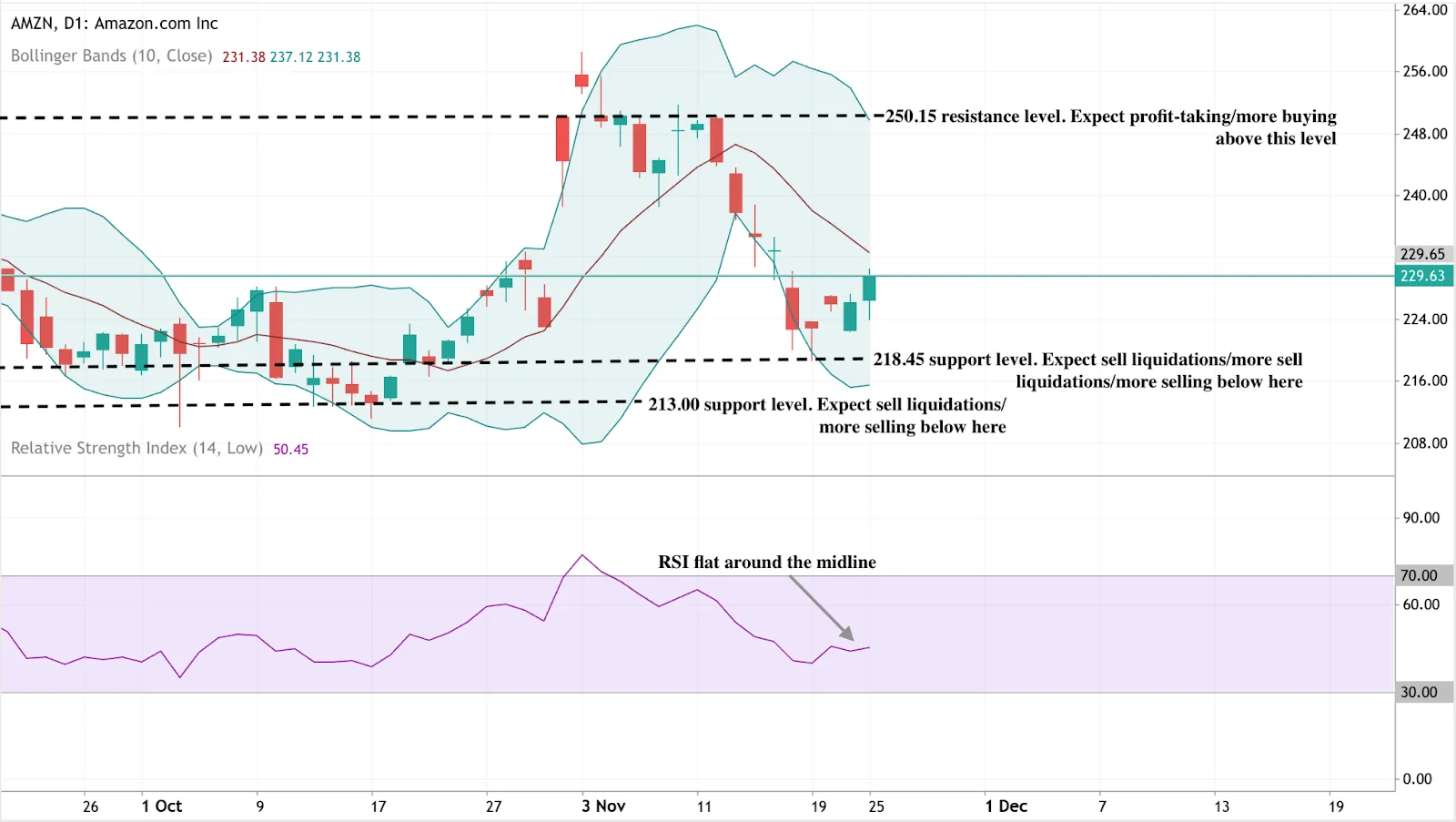
At the time of writing, Amazon (AMZN) is trading around $229, forming a modest recovery from recent lows while staying above notable support zones at $218.45 and $213. A break below these levels risks triggering sell-side pressure and accelerating downside momentum. A strong move higher, however, puts $250.15 back into focus - an area traders may treat as a profit-taking or breakout opportunity.
The RSI sits near 50, signalling neutral momentum and suggesting the market is still digesting the recent pullback. Directional conviction may not emerge until broader sentiment around AI spending turns clearer.
إخلاء مسؤولية:
The performance figures quoted are not a guarantee of future performance.
الأسئلة الشائعة
How much of Amazon’s capex is explicitly AI-related?
When do companies expect AI investment to become profit-accretive?
Which public companies benefit most from the AI infrastructure boom?


