المحتويات
مقال
Why the Gemini–Apple tie-up reshapes the AI race
January 13, 2026
مقال
Why the Gemini–Apple tie-up reshapes the AI race
January 13, 2026
مقال
Why the Gemini–Apple tie-up reshapes the AI race
January 13, 2026

Google’s agreement to integrate its Gemini models into Apple’s Siri represents a pivotal shift in how the competition for artificial intelligence is unfolding. Rather than fighting for visibility through standalone apps or demos, Alphabet has secured placement inside Apple’s ecosystem of more than two billion active devices, embedding its AI directly into daily user behaviour. Distribution, not spectacle, is now the strategic high ground.
Markets took the news in stride, with Alphabet shares gaining about 1% and Apple rising roughly 0.3% in after-hours trading. But the muted reaction masks the scale of what is happening beneath the surface. This deal signals a transition from AI experimentation to operational deployment, where reach, reliability, and user trust take precedence over who launches first.
What’s driving Google’s Gemini push?
At the heart of the partnership is Google’s long-standing playbook: build the backbone, then scale quietly. While competitors focus on public-facing AI products, Alphabet has spent years integrating Gemini across cloud platforms, productivity tools, and enterprise services. Siri’s overhaul gives Google a consumer-facing gateway that extends far beyond its own hardware footprint.
Cost dynamics also explain why this deal makes sense now. Training and running advanced AI models requires massive compute capacity and custom silicon, areas where Google already operates with industrial efficiency. As global chip supply increasingly tilts toward data centers, companies with mature AI infrastructure gain an edge that is difficult to replicate.
Apple’s involvement adds an important layer of validation. The company confirmed that Gemini will underpin the next generation of Apple Foundation Models, while Apple Intelligence continues to operate through on-device processing and Private Cloud Compute. That structure enables Apple to maintain its privacy stance while leveraging Google’s model depth, a compromise that reflects the evolving nature of AI partnerships.
Why it matters
For Alphabet, the deal repositions it in the AI hierarchy. The focus is no longer on headline comparisons with rival models, but on becoming an indispensable layer beneath multiple platforms. Parth Talsania, CEO of Equisights Research, noted that the move “pushes OpenAI into more of a background role,” highlighting how control of distribution can outweigh brand recognition in AI.
From an investor perspective, embedded AI is easier to monetise than standalone tools. When AI becomes part of everyday workflows, it drives consistent demand for cloud services, compute capacity, and long-term enterprise contracts. Access to Apple’s premium user base also expands Alphabet’s reach into segments where it has historically had less direct engagement.
The partnership also challenges the idea that one company is “ahead” while the other is “behind.” Instead, it shows both firms doubling down on their strengths: Google on infrastructure and models, Apple on hardware, privacy, and user experience. Together, they reduce execution risk at a time when AI missteps are costly.
Impact on the AI and smartphone markets
The most immediate impact will be felt in smartphones, where AI is increasingly driving upgrade decisions. Global handset shipments increased by 2% in 2025, with Apple maintaining a market share of around 20%. A more capable, Gemini-enabled Siri gives Apple a clearer narrative for upgrades as hardware innovation alone struggles to excite consumers.
For Alphabet, the benefits extend beyond mobile devices. Every AI interaction powered by Gemini feeds back into demand for Google’s cloud infrastructure, reinforcing a cycle where consumer usage supports enterprise growth. That linkage becomes more valuable as competition intensifies for chips, energy, and data-centre capacity.
Not everyone is comfortable with that concentration. Tesla CEO Elon Musk publicly warned of “an unreasonable concentration of power for Google” after the announcement. Whether regulators respond or not, the comment reflects growing awareness of how deeply Alphabet is embedding itself across the AI value chain.
Expert outlook
Most analysts see the partnership as a long-term strategic win rather than a short-lived catalyst. Wedbush analyst Daniel Ives reiterated his constructive view on Apple while pointing out that Google stands to benefit from sustained AI-driven cloud demand well into 2026.
That optimism is supported by forecasts. Alphabet’s earnings expectations have trended higher over the past year, led by cloud growth and improving AI monetisation. The main risks now centre on execution: maintaining model performance, navigating regulatory scrutiny, and Apple delivering the revamped Siri without further delays.
Attention will turn to Apple’s next earnings call for details on rollout timelines, while Alphabet investors will watch closely for signs that Gemini-related workloads are accelerating cloud revenues.
Key takeaway
The Gemini–Apple partnership marks a shift from AI hype to AI positioning. By embedding its models into Siri, Alphabet secures scale, data flow, and long-term monetization potential. The initial market response was restrained, but the strategic consequences are substantial. The real test will be whether execution, regulation, and user adoption keep pace with ambition.
Alphabet technical outlook
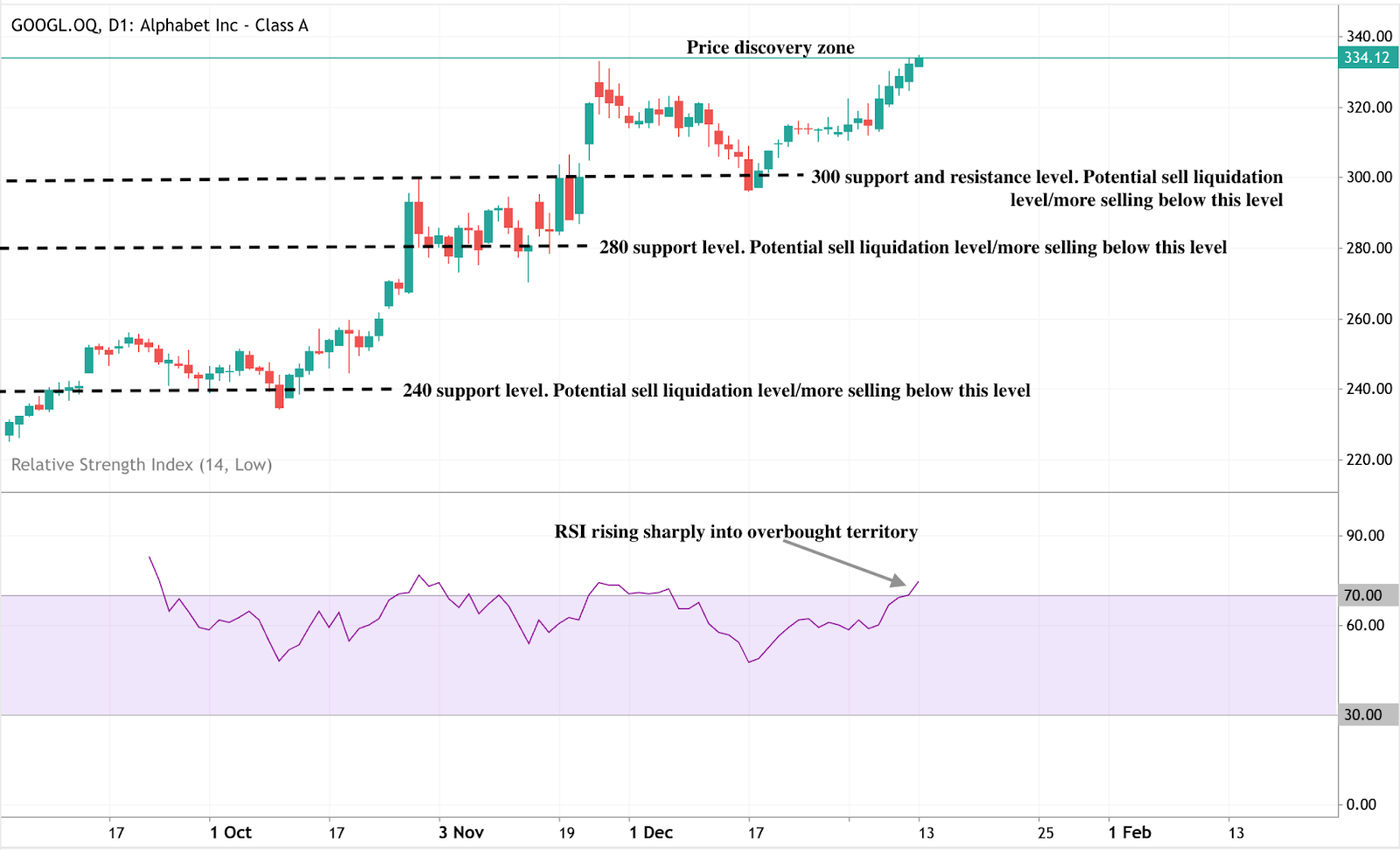
Alphabet has entered price discovery after breaking above previous resistance, extending its bullish structure with strong upside momentum. The advance reflects persistent demand, though momentum indicators suggest the rally is becoming stretched, with the RSI pushing deeper into overbought territory.
From a structural perspective, the trend remains constructive as long as prices hold above the $300 region, which has shifted from resistance to support. A corrective pullback could gain traction below $280, but sustained acceptance above recent highs would maintain the broader upside bias, even if short-term consolidation develops.
Traders tracking these moves can analyze Alphabet and Apple price action in real-time on Deriv MT5, using advanced indicators, multi-timeframe charts, and access to US tech stocks on a single platform.
إخلاء مسؤولية:
The performance figures quoted refer to the past, and past performance is not a guarantee of future performance or a reliable guide to future performance.
الأسئلة الشائعة
Why is the Gemini–Apple deal considered a defining AI moment?
Does this partnership benefit Google more than Apple?
What does this mean for OpenAI and other rivals?
Will this trigger regulatory scrutiny?
How soon will users see Gemini-powered Siri features?


