المحتويات
مقال
Meta stock eases after blockbuster run as AI spending nerves return
December 30, 2025
مقال
Meta stock eases after blockbuster run as AI spending nerves return
December 30, 2025
مقال
Meta stock eases after blockbuster run as AI spending nerves return
December 30, 2025
%20(1)%20(1)%20(1)%20(1)%20(1)%20(1).png)
Meta Platforms headed into the final trading days of the year on a softer note, despite an exceptional rally that has pushed the stock up more than 75% year-to-date. Shares edged lower on Monday, finishing just below $660, as thin holiday liquidity magnified routine year-end profit-taking and a small wave of insider selling that briefly unsettled sentiment.
While the decline was modest, it underlines a familiar tension surrounding Big Tech. Investors continue to balance optimism around Meta’s artificial intelligence strategy with lingering concerns over how much the company is prepared to spend to stay ahead. With only a handful of sessions left before 2026, that debate is beginning to influence short-term price behaviour.
What’s driving Meta’s latest pullback?
The immediate pressure on Meta shares appears to have been driven more by calendar effects than any deterioration in fundamentals. After a strong run through most of 2025, the stock entered the final stretch of the year at levels that naturally encourage profit-taking. Analysts note that low holiday trading volumes often exaggerate moves in large-cap names that carry heavy index weightings.
That seasonal backdrop coincided with Meta’s December dividend period and a small number of pre-arranged insider transactions. Two executives sold slightly over 1,000 shares in mid-December at prices around $646, with the total value coming in at less than $1 million. While insignificant relative to Meta’s market capitalisation, the timing was enough to feed a short-term narrative of trimming exposure during a quiet session.
Why it matters
On its own, a brief bout of selling would rarely attract much attention. What makes this move more notable is how sensitive investors remain to Meta’s cost trajectory. Earlier guidance indicated that expenses would rise “significantly faster” in 2026 than in 2025, primarily due to substantial investments in AI infrastructure and cloud capacity, with spending expected to exceed $40 billion.
That messaging inevitably revived comparisons to the 2021–2022 period, when aggressive investment into the metaverse weighed heavily on sentiment and erased hundreds of billions in market value. Analysts, such as Oppenheimer’s Jason Helfstein, have warned that markets are still quick to react if capital intensity appears to outpace visible returns. Even small pullbacks now reflect that underlying caution.
Impact on the tech market
Meta’s weakness was mirrored across the broader technology sector. Major indices such as the Nasdaq and S&P 500 slipped back from record highs as investors locked in gains across large growth stocks. Other mega-cap names, including Nvidia and Tesla, also ended the session lower, reinforcing the sense of coordinated year-end de-risking.
Given Meta’s size, its share price increasingly acts as a gauge of risk appetite in mega-cap technology. When the stock softens without clear company-specific catalysts, it often signals broader concerns around valuations, interest rates, or the durability of AI-driven earnings expectations. From that perspective, Monday’s move looked less like a verdict on Meta itself and more like a pause across the sector.
Meta’s AI ambitions add a new layer of scrutiny
Investor caution has intensified as Meta accelerates its push into advanced AI capabilities. The company recently confirmed the acquisition of Manus, a Singapore-based autonomous AI agent startup that reportedly achieved $100 million in annual recurring revenue within just eight months of its launch. Manus’s technology is set to be integrated across Meta’s consumer and enterprise offerings, including Meta AI.
Strategically, the deal strengthens Meta’s exposure to general-purpose AI agents, widely seen as the next monetisation phase beyond conversational tools. Financially, however, it reinforces the perception that Meta is entering another capital-heavy investment cycle. Alongside the launch of Meta Superintelligence Labs and continued infrastructure expansion, investors are watching closely to see whether returns emerge more quickly than they did during the metaverse build-out.
Expert outlook
In the near term, market participants are paying closer attention to price levels than headlines. A sustained move below the mid-$650 area could open the door to a test of the late-December support level, while a recovery above $660 would suggest that recent selling was largely seasonal in nature. Trading volume remains a critical signal, as thin liquidity can distort short-term price moves.
Looking ahead to early February, when Meta is expected to report earnings based on historical timing, the focus is likely to shift back to forward guidance rather than headline revenue figures. Investors will be looking for clearer signals on how quickly AI investment can translate into advertising growth and margin resilience. Until then, Meta shares may continue to trade as a proxy for confidence in Big Tech’s AI spending cycle.
Key takeaway
Meta’s late-year dip reflects positioning and sentiment more than any fundamental change. Following a powerful rally, investors are becoming increasingly selective as AI investment accelerates and liquidity dries up. The stock remains caught between confidence in long-term AI monetisation and sensitivity to capital-spending risks. The next earnings update is likely to determine which narrative gains the upper hand.
Meta technical insights
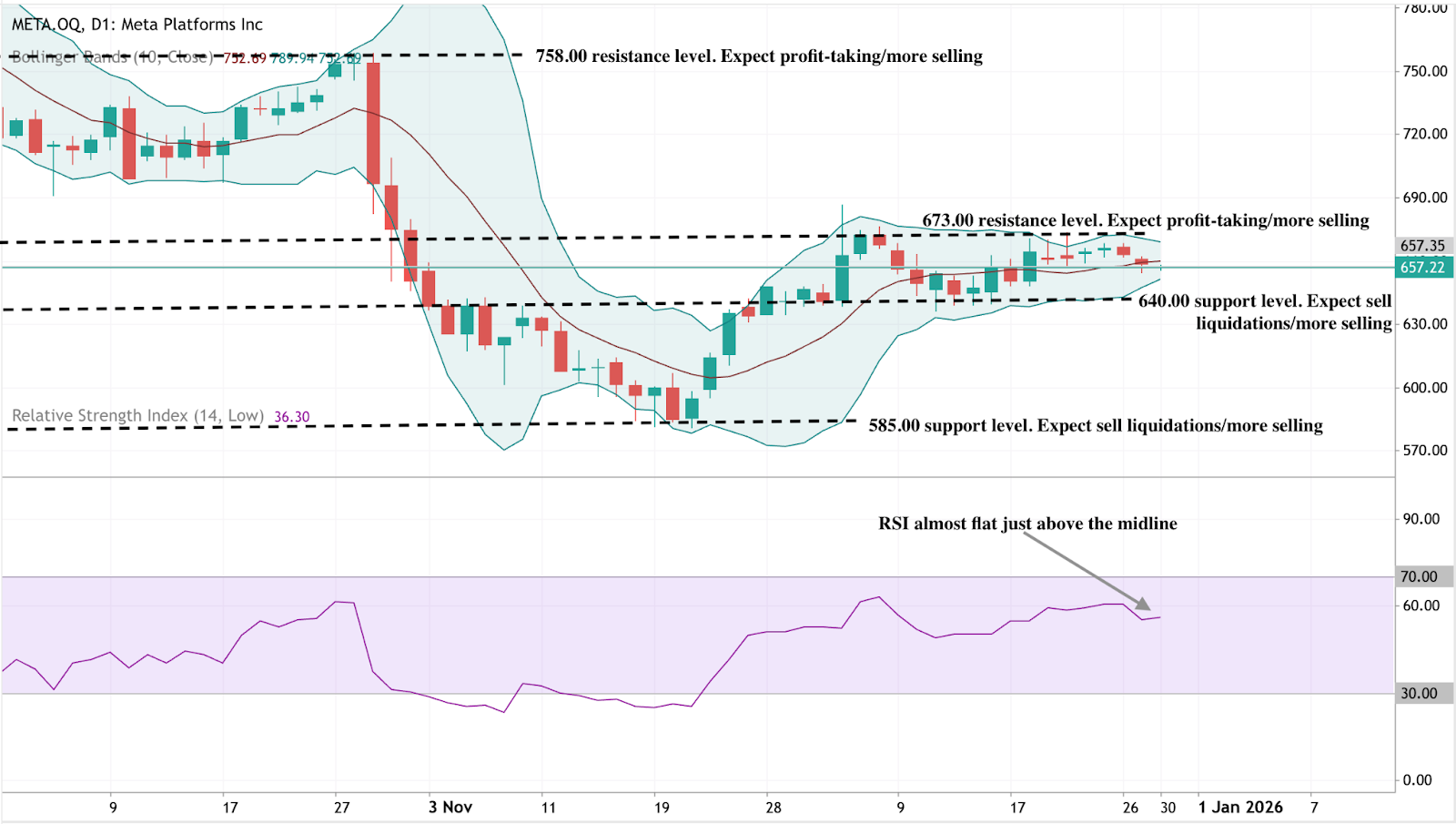
Meta is consolidating after a sharp pullback, with prices hovering around the Bollinger mid-band, suggesting a pause in momentum rather than the start of a fresh trend. The upside remains capped below the $673 resistance zone, where rallies have repeatedly drawn profit-taking.
On the downside, $640 stands out as the first key support level, followed by $585 if selling pressure builds further. A sustained break below the mid-band would tilt the bias lower. Momentum indicators remain neutral, with the RSI holding just above its midpoint, highlighting a lack of strong conviction from both buyers and sellers.
إخلاء مسؤولية:
The performance figures quoted refer to the past, and past performance is not a guarantee of future performance or a reliable guide to future performance.
الأسئلة الشائعة
Why did Meta stock fall despite strong gains this year?
Do insider sales signal trouble at Meta?
How does AI spending affect Meta’s valuation?
What is Manus and why did Meta acquire it?
When is Meta’s next earnings report?


