المحتويات
مقال
Why Nvidia has become the market’s AI litmus test
December 15, 2025
مقال
Why Nvidia has become the market’s AI litmus test
December 15, 2025
مقال
Why Nvidia has become the market’s AI litmus test
December 15, 2025

Many consider Nvidia has emerged as one of the clearest indicators of whether the artificial intelligence boom is built on solid foundations or edging into excess. As the leading supplier of chips used to train and run large language models, its revenues track real capital deployment rather than speculative forecasts. When Nvidia’s momentum falters, it often reflects growing unease about how durable the broader AI investment cycle really is.
That tension is becoming more visible. Nearly three years after ChatGPT triggered an explosion in AI spending, investors are grappling with slower growth trajectories, rising infrastructure costs, and unanswered questions around profitability. With the Nasdaq 100 still trading well above historical norms, Nvidia now sits at the heart of a market-wide reassessment that could shape sentiment through 2026, based on recent reports.
What’s driving Nvidia’s role in the AI cycle?
Nvidia’s significance lies in its control of AI’s physical backbone. Advanced models still rely heavily on their GPUs, tying the company’s fortunes directly to the pace of data-centre construction worldwide. While software firms can promise future applications, Nvidia’s sales reveal whether those ambitions are being backed by concrete investment.
This exposure also makes the stock highly reactive to any hint of slowdown. According to analysts, when major cloud providers temper their capital expenditure plans, or when data centre projects face delays due to energy, labour, or funding constraints, Nvidia often responds first. Its share price increasingly functions as a live gauge of whether the AI buildout is accelerating or losing momentum.
They also added that attention has also turned to the way AI demand is being sustained. Nvidia has channelled significant resources into supporting customers and partners, helping expand the ecosystem around its technology. While that approach underpins long-term adoption, it has fuelled debate over how much demand is naturally driven versus structurally supported, complicating the investment narrative at a time when transparency is prized.
Why it matters
Nvidia’s reach extends far beyond its own earnings reports. Market watchers noted the stock has become a proxy for the wider AI economy, linking cloud platforms, semiconductor suppliers, power providers, and data-centre developers into a single trade. Strength in Nvidia reinforces confidence that AI spending is productive. Weakness, by contrast, suggests capital may be flowing faster than returns can keep up.
That sensitivity is amplified by the increasing concentration of AI exposure. A significant portion of recent equity gains has been driven by a narrow group of technology leaders and their suppliers. As one investor recently observed, companies like Nvidia tend not to struggle when growth slows marginally, but when it stops exceeding expectations. In such conditions, even modest disappointments can trigger swift shifts in positioning.
Impact on the AI infrastructure market
Recent volatility across AI-linked stocks highlights just how finely balanced sentiment has become. Oracle’s sharp decline after reporting higher capital spending alongside softer cloud growth underscored the friction between aggressive data-centre investment and near-term financial performance.
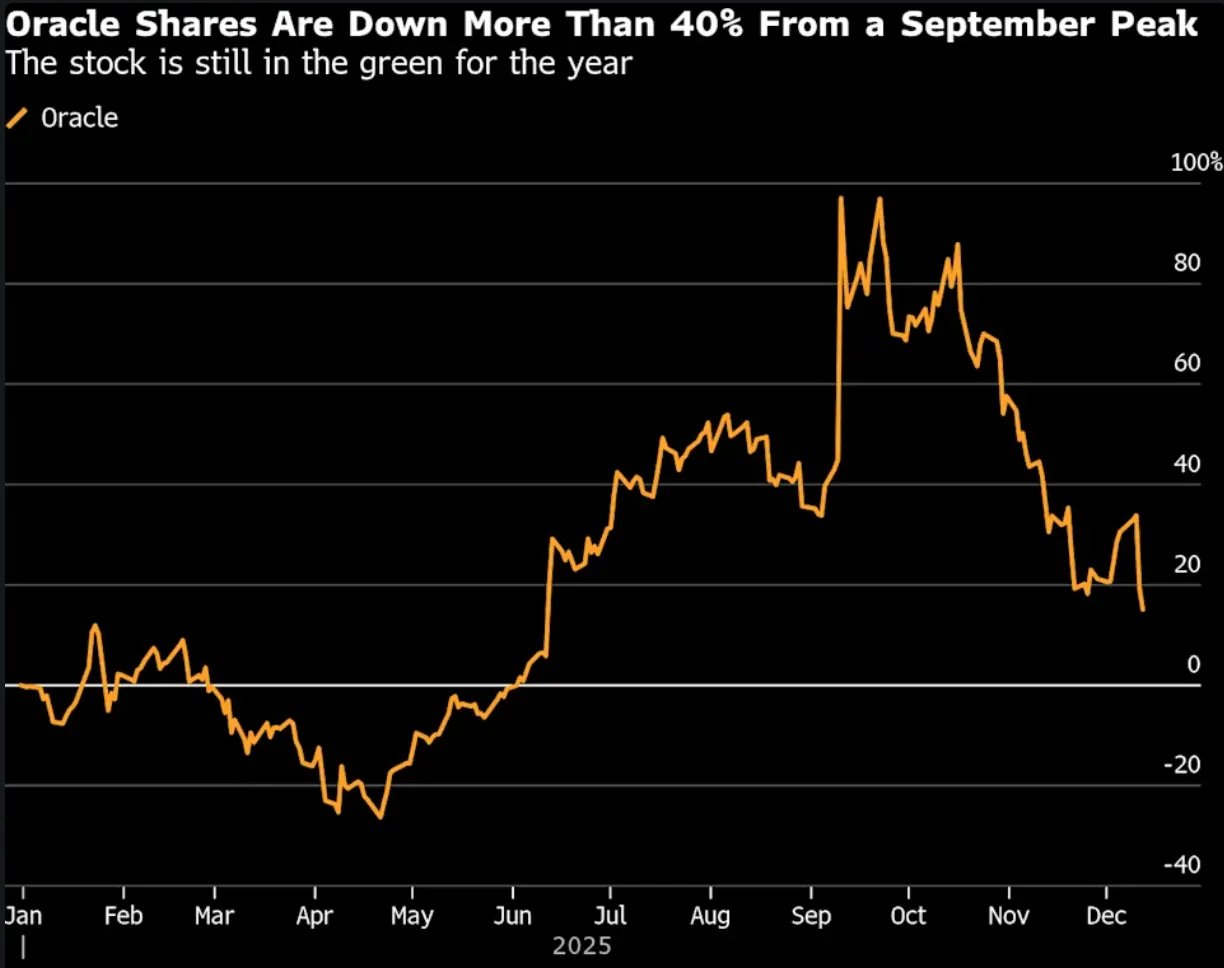
Although Oracle maintained confidence in its expansion plans, the sell-off quickly spread across the AI supply chain, including Nvidia. The reaction illustrated how closely investors are linking infrastructure costs to future profitability reports revealed.
More broadly, the episode exposed a structural challenge facing AI. Building data centres demands enormous capital, reliable power supplies, skilled labour, and long lead times. These constraints do not undermine AI’s long-term potential, but they do squeeze margins and push returns further out - outcomes markets are increasingly sensitive to.
Geopolitical uncertainty compounds the picture, experts added. Nvidia remains exposed to export restrictions and evolving China policy, which can cloud revenue visibility even as global AI demand continues to grow. While this does not diminish AI’s strategic importance, it limits the extent to which markets are willing to price in optimism.
Expert outlook
Most analysts are not forecasting a sudden collapse reminiscent of the dot-com era. Today’s AI leaders are larger, more established, and far better capitalised than their late-1990s counterparts. A more likely scenario is a recalibration within the AI trade, where investors favour companies demonstrating scale and cash generation while reassessing those dependent on flawless execution.
For Nvidia, the focus now shifts firmly to delivery. Markets will monitor whether major customers sustain capital spending as depreciation rises, whether demand broadens beyond a small circle of dominant buyers, and whether AI revenues can absorb the scale of ongoing investment. Continued execution could ease bubble concerns. Failure to meet those expectations would likely prompt a reset in valuations rather than a rejection of the AI theme itself.
Key takeaway
Market watchers expressed Nvidia has become the market’s most effective gauge of whether the AI boom is durable or overstretched. Its central role in AI infrastructure means it reflects tangible investment decisions rather than sentiment alone. While fears of an imminent bubble burst may be overstated, the era of unquestioned enthusiasm is clearly waning. The next signals will come from capital discipline, execution, and AI’s ability to convert scale into lasting profitability.
Nvidia technical insights
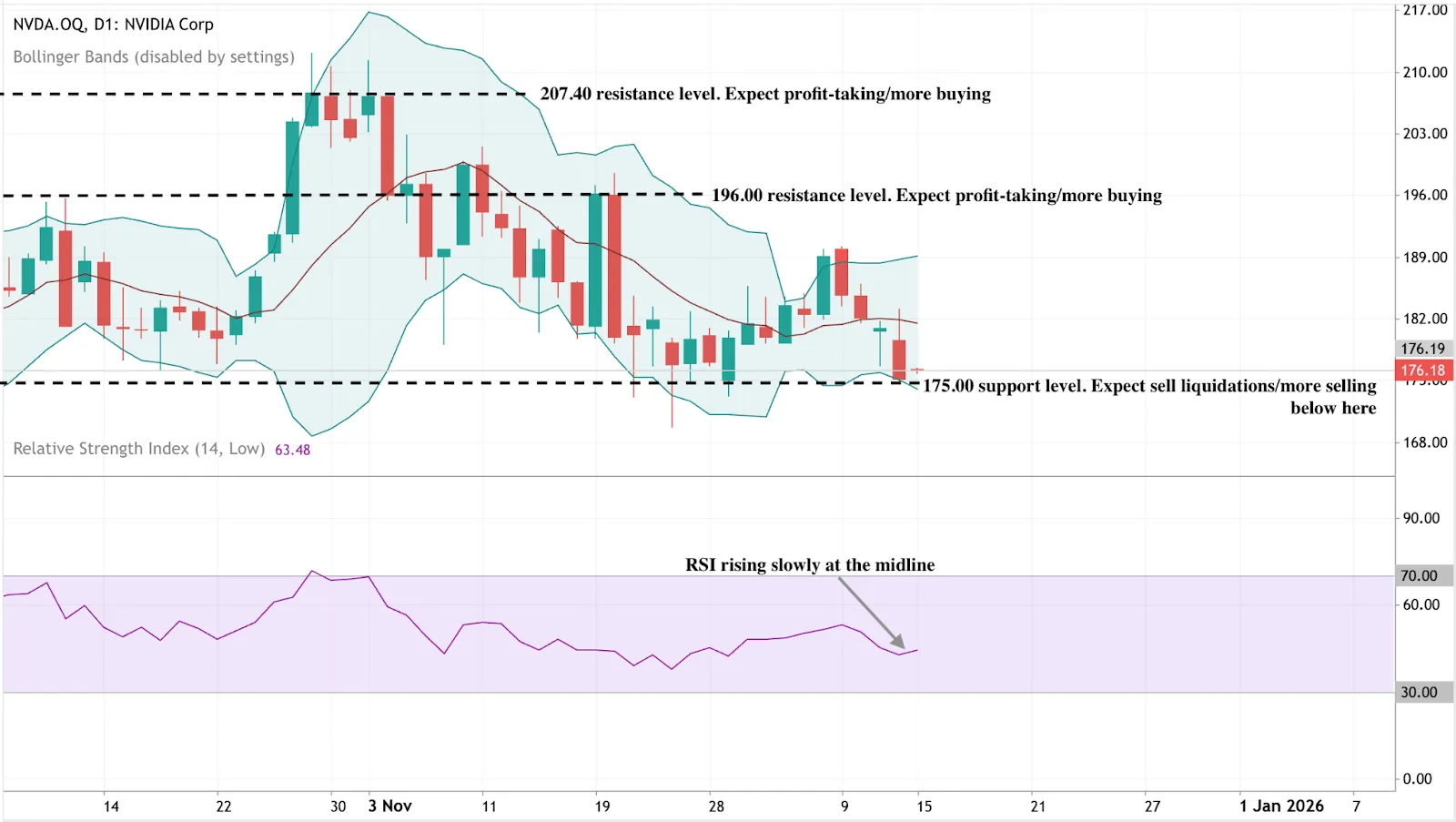
At the time of writing, NVIDIA (NVDA) is trading around $176, holding just above the key $175.00 support level. This area remains crucial for determining the near-term direction. A sustained move below it could accelerate downside pressure, while holding above it leaves room for stabilisation.
On the upside, resistance is layered around $196.00 and $207.40, zones where profit-taking or renewed buying interest often emerges if momentum improves. Recent price action suggests consolidation following a sharp pullback, with tight candle ranges indicating market indecision over whether the correction has fully run its course.
Momentum indicators echo that caution. The RSI, hovering near 63, suggests improving but restrained upside momentum rather than a decisive bullish shift. For now, NVDA appears range-bound, with a clearer trend likely only if buyers can convincingly reclaim the $196 resistance area.
إخلاء مسؤولية:
The performance figures quoted are not a guarantee of future performance.
الأسئلة الشائعة
Why are investors watching Nvidia so closely for AI risk?
Does an AI bubble mean a crash is inevitable?
How do data-centre costs affect Nvidia?
Is Nvidia overvalued compared with other AI stocks?
What should investors watch next?


