المحتويات
مقال
Nvidia’s next test: Can AI spending keep the stock moving higher?
February 9, 2026
مقال
Nvidia’s next test: Can AI spending keep the stock moving higher?
February 9, 2026
مقال
Nvidia’s next test: Can AI spending keep the stock moving higher?
February 9, 2026

Yes - continued investment in AI infrastructure can still support further upside in Nvidia shares, but the pace of gains is likely to slow, according to analysts. The story has shifted from rapid repricing to one of durability, where sustained capital spending and margin discipline matter more than enthusiasm alone.
That shift came into focus this week as Nvidia shares staged a sharp rebound, climbing more than 8% in a single session. The move was sparked not by Nvidia’s own results, but by Amazon’s projection of around $200 billion in capital expenditure for 2025, with a large portion earmarked for AI-related infrastructure. For markets, it was a timely signal that the AI investment cycle remains intact, even as valuations come under closer examination.
What’s driving Nvidia now?
Amazon’s guidance arrived at a sensitive point for Nvidia. Earlier selling pressure had reflected broader unease around elevated technology valuations, rather than a collapse in AI demand itself. Amazon’s outlook reframed the narrative, shifting attention back to the scale and visibility of future spending.
A capex figure of that magnitude suggests momentum rather than moderation. Nvidia continues to sit at the heart of hyperscale AI build-outs, supplying the advanced chips required to train and deploy large models. As long as cloud providers prioritise capacity expansion, Nvidia remains directly exposed to that investment flow.
The market’s response highlighted this distinction. Amazon shares declined following its earnings miss, while Nvidia moved sharply higher. That contrast reinforces Nvidia’s role as a proxy for AI infrastructure demand. Compute requirements are no longer speculative or optional; they are embedded in long-term budgets and strategic plans that are costly to reverse once underway.
Why it matters for Nvidia’s valuation
Valuation has become the defining issue for Nvidia. Since late 2022, the company has consistently exceeded expectations, fuelled by surging AI-related revenue. Those results propelled the stock into a wide range of portfolios, leaving less incremental capital available to drive further rapid rerating.
Jensen Huang addressed this tension by describing the recent technology pullback as “illogical”. While executive optimism is expected, Huang’s comments tend to resonate because they align closely with observed spending behaviour among Nvidia’s largest customers. Investors appear to be weighing his remarks as confirmation that current valuations remain anchored to earnings potential rather than detached speculation.
Impact on the AI and semiconductor landscape
Nvidia’s recovery has broader implications for the sector. It underscores that AI investment is becoming increasingly concentrated among a small number of global technology firms, rather than dispersing or slowing. Amazon, Microsoft, and Google continue to expand their AI footprints, reinforcing demand at the infrastructure level.
This concentration works in Nvidia’s favour. Its strength extends beyond chip performance to include software tools, interconnects, and developer ecosystems that are deeply embedded across customer operations. While competitors are advancing, replicating Nvidia’s full-stack offering remains challenging. That structural advantage helps preserve pricing leverage, at least while AI deployment continues to scale rapidly.
Expert Outlook: Where the real test lies
Focus now shifts to Nvidia’s earnings release on 25 February. Goldman Sachs expects the company to exceed expectations, forecasting a revenue beat of roughly $2 billion for the fiscal fourth quarter, with revenue estimated at $67.3 billion and earnings ahead of consensus. The bank also anticipates stronger-than-average performance in the following quarter.
Even so, caution remains. Goldman noted that expectations are already elevated, increasing the risk that guidance rather than results will drive the next move. The market’s attention is drifting toward Nvidia’s outlook for 2026 and 2027, where competitive pressures and margin sustainability will be more visible. The question is no longer about near-term demand, but about how long Nvidia can extend its lead.
Key takeaway
AI investment can still support Nvidia’s share price, but the margin for error is narrowing. Amazon’s substantial capex plans reinforced Nvidia’s strategic importance within the AI ecosystem, offering reassurance on near-term demand. However, future performance will hinge on guidance, competitive dynamics, and the company’s ability to protect profitability. Nvidia’s next phase will be shaped less by momentum and more by execution.
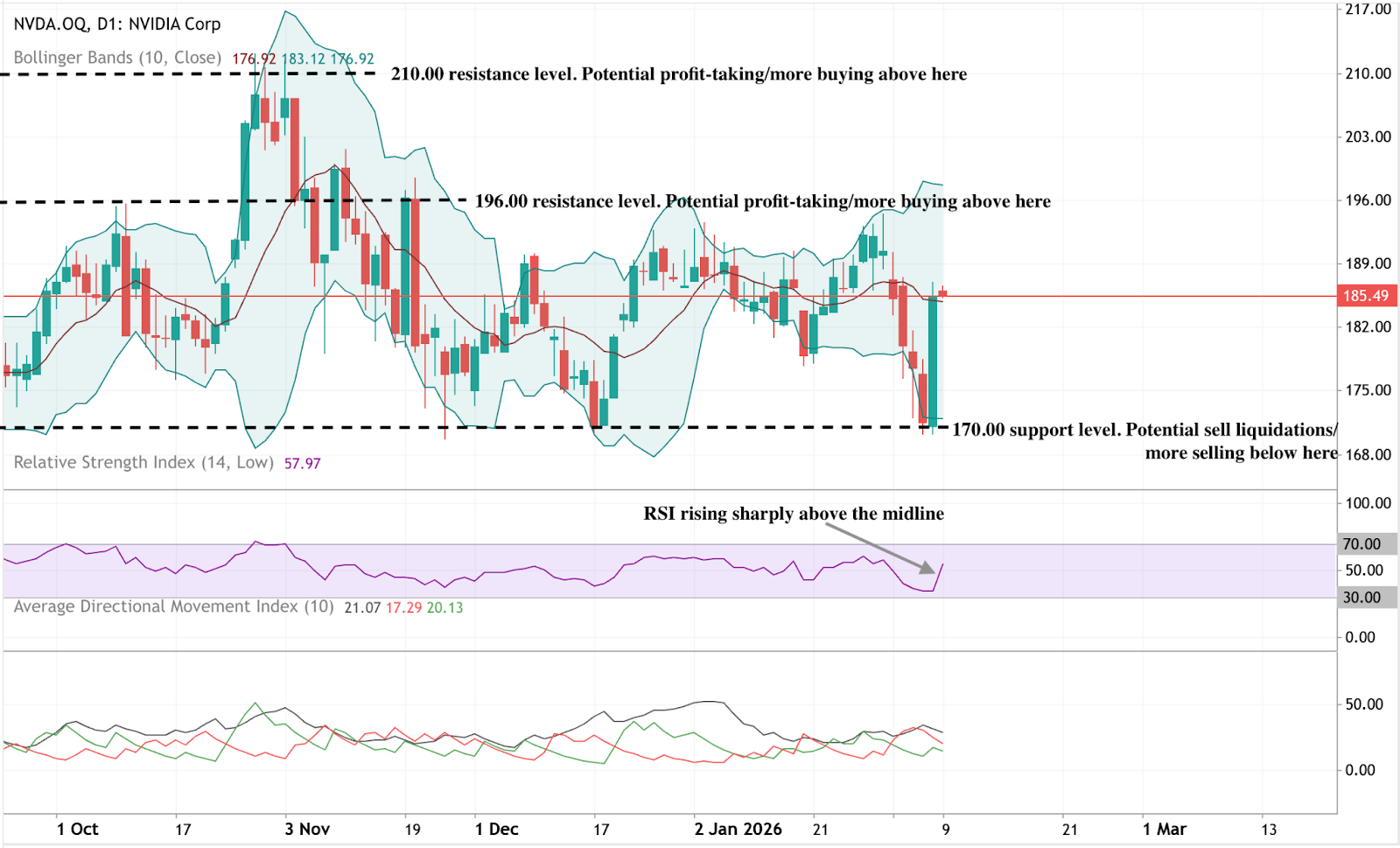
Nvidia technical outlook
Nvidia remains within a wide consolidation range following earlier volatility, with prices holding above the lower support zone near $170 and facing resistance around $196 and $210.
Bollinger Bands have widened modestly after a period of compression, signalling increased volatility without a decisive trend. Momentum indicators suggest a short-term recovery, with RSI rebounding above the midline after a recent dip. However, trend strength remains limited, as ADX levels continue to indicate a lack of strong directional conviction.
إخلاء مسؤولية:
The information contained on the Deriv Market News is for educational purposes only and is not intended as financial or investment advice. The information may become outdated, and some products or platforms mentioned may no longer be offered. We recommend you do your own research before making any trading decisions. The performance figures quoted refer to the past, and past performance is not a guarantee of future performance or a reliable guide to future performance.
الأسئلة الشائعة
Can AI spending still drive Nvidia shares higher?
Why did Nvidia rise when Amazon shares fell?
Is Nvidia still overvalued?
What risk does competition pose to Nvidia?
What should investors watch next?


