المحتويات
مقال
Is Nvidia’s latest slide setting up a buying window?
December 9, 2025
مقال
Is Nvidia’s latest slide setting up a buying window?
December 9, 2025
مقال
Is Nvidia’s latest slide setting up a buying window?
December 9, 2025
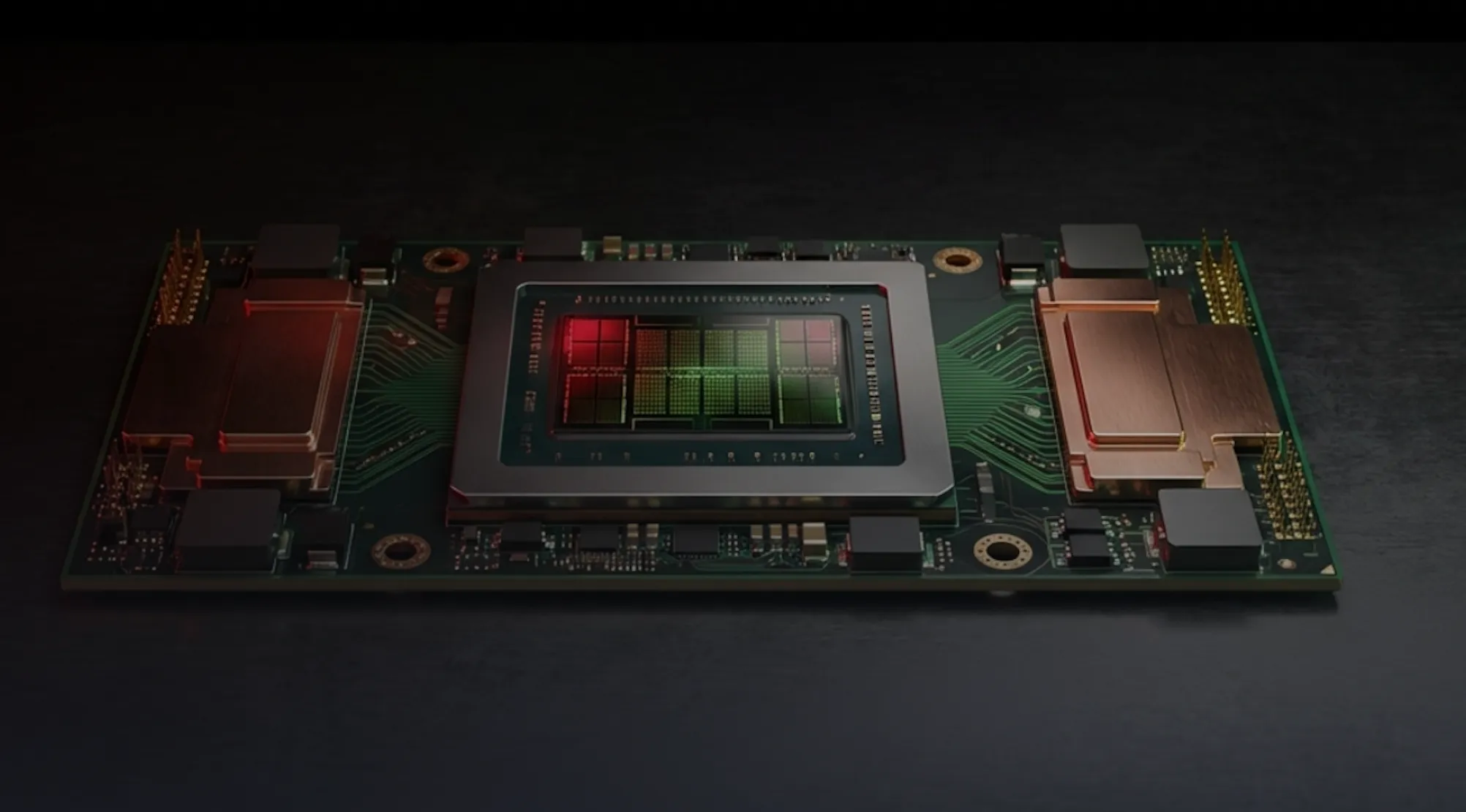
Is Nvidia’s latest slide a sign of fatigue or the kind of reset seasoned investors wait for? The stock has dipped after an extraordinary multi-year rally, despite the company still commanding a valuation of nearly $4.6 trillion and continuing to post quarterly revenue above $55 billion. According to analysts, that mismatch between market scepticism and operational strength is now shaping the conversation.
Despite the turbulence, Nvidia’s profit margins remain above 50%, guidance still points higher, and recent adjustments to US export rules for H200 chips could reopen a major revenue stream in China. The central question is whether investors are overstating short-term risks while overlooking the staying power of Nvidia’s dominance in AI - and that’s where the story gathers pace.
What’s driving Nvidia’s moment?
Nvidia’s pullback reflects a recalibration of expectations around competitive pressures and shifting political winds. Investors are watching closely to see whether Google will commercialise its in-house AI chips and sell them at scale to external clients such as Meta. OpenAI’s growing partnership with Broadcom - a firm now valued at $1.7 trillion - adds further weight to the evolving competitive field. Meanwhile, China’s semiconductor ambitions have accelerated, with companies like Alibaba, SMOC and Moore Threads expanding their capabilities. Moore Threads’ more than 500% surge on debut highlights the speed at which domestic contenders can gain traction.
Even so, Nvidia has a long track record of thriving in crowded markets. Revenue growth continues to accelerate, and executives expect fourth-quarter figures to approach $65 billion as data-centre demand intensifies. Fears of “circular” AI investment patterns - where Nvidia-backed firms become Nvidia’s customers - often overlook how the company’s software stack, CUDA ecosystem, and networking technology lock developers and enterprises into its platform. Many expressed that Nvidia’s moat extends far beyond hardware; it is an interlinked ecosystem that competitors struggle to replicate.
Why it matters
Nvidia’s valuation debate ultimately comes down to how investors think the AI cycle evolves from here. On raw figures, the stock is not excessively priced relative to its own history. A forward price-to-earnings ratio around 29.94 sits comfortably below its five-year average of 45, while the forward PEG ratio, hovering around 1.0, is significantly below the broader sector median. That signals that the market is valuing Nvidia’s rapid growth less than it did during previous expansion phases.
However, geopolitics is now adding a premium to sentiment. President Donald Trump’s decision to permit the export of H200 chips to “approved customers” in China has sharply divided U.S. lawmakers. Nvidia praised the decision as a pragmatic balance of security and competitiveness, while senior Democrats condemned the move as a national security mistake that could strengthen China’s military-tech capabilities. This kind of policy whiplash underscores how deeply Nvidia’s earnings outlook is tied to the shifting US–China relationship, not just organic AI demand.
Impact on markets, industry and consumers
Analysts suggest that allowing limited exports to China could materially influence Nvidia’s revenue trajectory. The H200 chip is vastly more capable than the H20 model previously authorised under Biden-era restrictions, with some think tanks estimating multiple-fold improvements in key AI workloads.
If Chinese firms are permitted to purchase in scale - and if Beijing allows them to do so - Nvidia could tap into billions of dollars of deferred demand from cloud giants and emerging AI companies. Still, China’s commitment to reducing its reliance on US technology means adoption may remain uneven.
Globally, the policy shift signals a shift away from blanket technology denial towards a more calibrated approach to competition. Former US officials warn that easier access to advanced chips could help Chinese AI developers narrow the performance gap and expand their influence across emerging markets. That may compress margins for some US tech firms over time, yet paradoxically, it also increases near-term demand for Nvidia’s cutting-edge hardware as more regions accelerate their AI infrastructure buildout.
For enterprise users, Nvidia’s dominance remains pivotal. Its approximate 53% net margin stands in stark contrast to AMD’s 10% and Micron’s 23%, while its Rule of 40 score above 100% underscores a rare combination of scale and efficiency. Strategic investments, including a $2 billion stake in Synopsys and broader exposure to cloud and AI-infrastructure companies, reinforce Nvidia’s influence over next-generation chip design and deployment. Despite selective selling by institutions such as Rothschild Investment LLC, investor appetite remains broadly supportive of Nvidia’s leadership position.
Expert outlook
Investors weighing whether Nvidia’s pullback marks a buying opportunity or a structural turning point face a mixed but intriguing landscape. Many analysts still view Nvidia as the backbone of global AI development well into the next decade, citing unmatched performance, ecosystem lock-in and an aggressive roadmap that rivals have yet to match.
Jensen Huang’s pledge to invest heavily in US-based AI infrastructure further solidifies Nvidia's position in the foundations of the next computing era. If China ultimately accepts H200 imports, earnings estimates may again lag reality.
However, experts added that political uncertainty remains the biggest variable. Bipartisan concerns in Washington could spark renewed restrictions if policymakers conclude that the current export framework benefits China more than the US. Beijing, for its part, may continue prioritising domestic semiconductor champions regardless of US concessions. Meanwhile, competition from Google, AMD, Broadcom and China’s rising chipmakers is intensifying. Even so, Nvidia’s operational scale, margins and software ecosystem make the recent sell-off look more like a recalibration than a structural downturn.
Key takeaway
Nvidia’s pullback appears more aligned with shifting sentiment and geopolitical noise than deteriorating fundamentals. The company continues to post exceptional growth, maintain industry-leading profitability and strengthen an ecosystem that competitors still struggle to penetrate. New export rules add volatility, but they could also unlock renewed demand and accelerate global AI adoption. For now, the evidence suggests the slide is mispriced - with the next key signals likely to come from Washington, Beijing and Nvidia’s ability to break above nearby resistance levels.
Nvidia technical insights
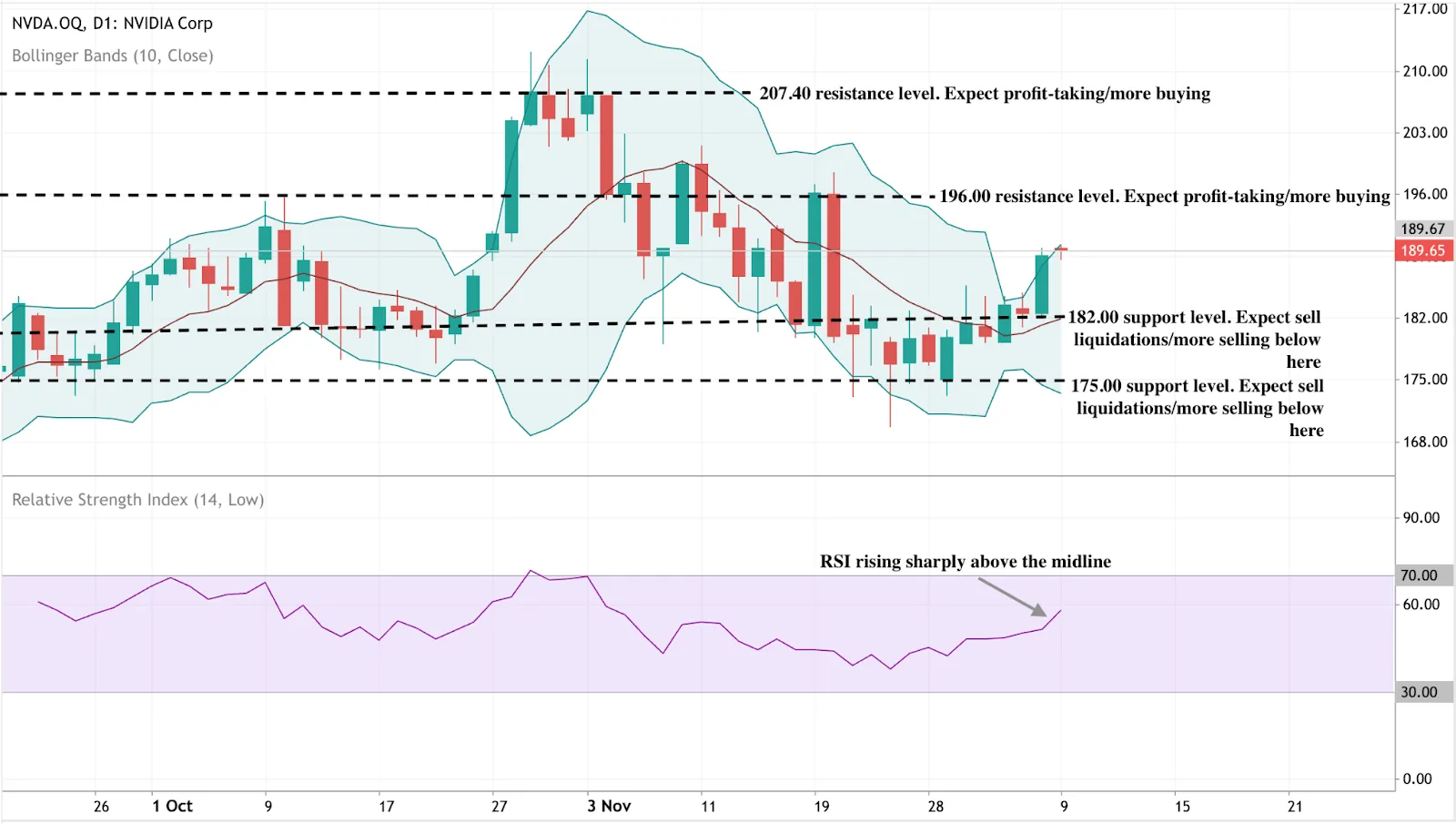
Nvidia is trading around $189.65, extending its rebound after breaking out of a short-term consolidation zone. Price action is now pressing towards the $196.00 resistance level, followed by a more substantial ceiling at $207.40, where traders often anticipate a battle between profit-takers and momentum buyers. Support levels at $182.00 and $175.00 remain critical; a drop through either could trigger liquidation-driven selling and deepen the correction.
Recent movement shows Nvidia climbing back into the upper region of its Bollinger Band range, signalling a revival in bullish appetite. Strong bullish candles highlight renewed buying interest, while the RSI moving above the midline towards 60 supports the case for continued upside. The indicator is not yet in overbought territory, meaning momentum could continue building if Nvidia manages to clear the $196 resistance barrier.
إخلاء مسؤولية:
The performance figures quoted are not a guarantee of future performance.
الأسئلة الشائعة
Why has Nvidia’s share price fallen despite strong results?
Does the H200 export decision change Nvidia’s outlook?
How strong is Nvidia’s lead over rivals like AMD?
What role do Chinese chipmakers play in Nvidia’s risk profile?
Is Nvidia overvalued at current levels?


