المحتويات
مقال
Sam Altman’s code red: OpenAI enters crisis mode
December 3, 2025
مقال
Sam Altman’s code red: OpenAI enters crisis mode
December 3, 2025
مقال
Sam Altman’s code red: OpenAI enters crisis mode
December 3, 2025
%20(1)%20(1).webp)
OpenAI has slammed its biggest internal alarm. On Monday, Sam Altman fired off a company-wide “Code Red” memo - the first full red alert in OpenAI’s history - telling staff to drop anything that doesn’t make ChatGPT noticeably better, immediately. It’s the clearest admission yet that the company feels its lead in AI is under real threat.
Furthermore, the numbers are sobering. OpenAI is projecting around $13 billion in revenue for 2025, but expects to lose $9 billion in the same period. For a company building the most expensive software ever created, the financial tightrope is becoming increasingly precarious.
The memo that broke the internet
Altman didn’t bother with corporate euphemisms. In his Monday message, he declared that OpenAI is now in “red” mode, escalating from a softer “orange” status just a few weeks earlier. The mission: overhaul what it feels like to use ChatGPT, not just its headline capabilities.
Internally, that translates into three urgent priorities:
- Faster, smarter responses - cutting response times, reducing hallucinations, and making ChatGPT feel less sluggish or flaky.
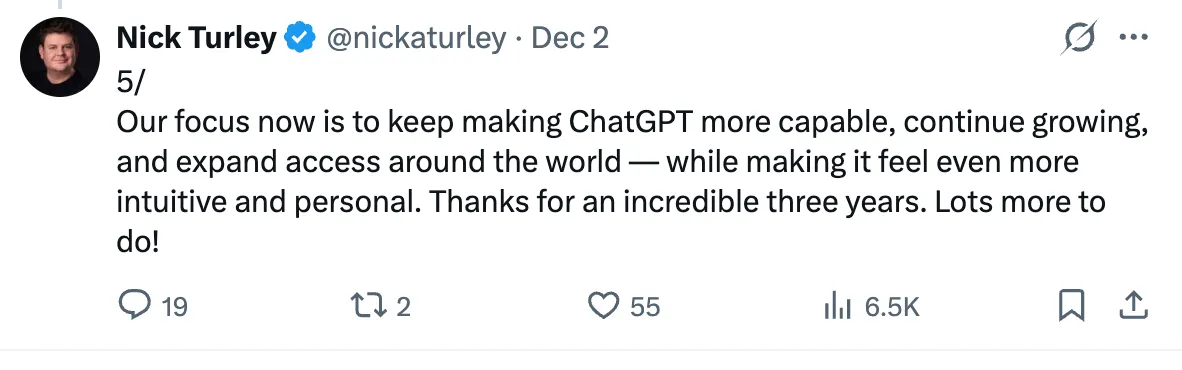
- Deeper personalisation - as ChatGPT app boss Nick Turley put it, the product should “feel intuitive and personal”, more like a tool that remembers you than a generic chatbot.
- Stronger reasoning abilities - handling strangers, more complex requests without retreating into stock refusals, while strengthening core reasoning.
To get there, OpenAI has shifted into war footing, with daily coordination calls among product, research, and engineering teams, shuffling personnel, and revising previous roadmaps. The earlier “orange” alert flagged concern. “Red” signals something else: a full reallocation of resources to stop users slipping away.
What ‘Code Red’ actually changes?
Altman’s leaked memo makes one thing clear: OpenAI is scrambling to fix the pain points Gemini 3 so ruthlessly exposed - speed, reliability, and consistency.
Sources: Forbes, HSBC, Techcrunch
At the same time, competition has turned brutal. Anthropic’s Claude 4 has become the go-to model for many businesses, while Meta’s Llama family continues to improve and spread through open-source ecosystems. OpenAI’s oft-quoted 70% market share now feels more like a relic than reality.
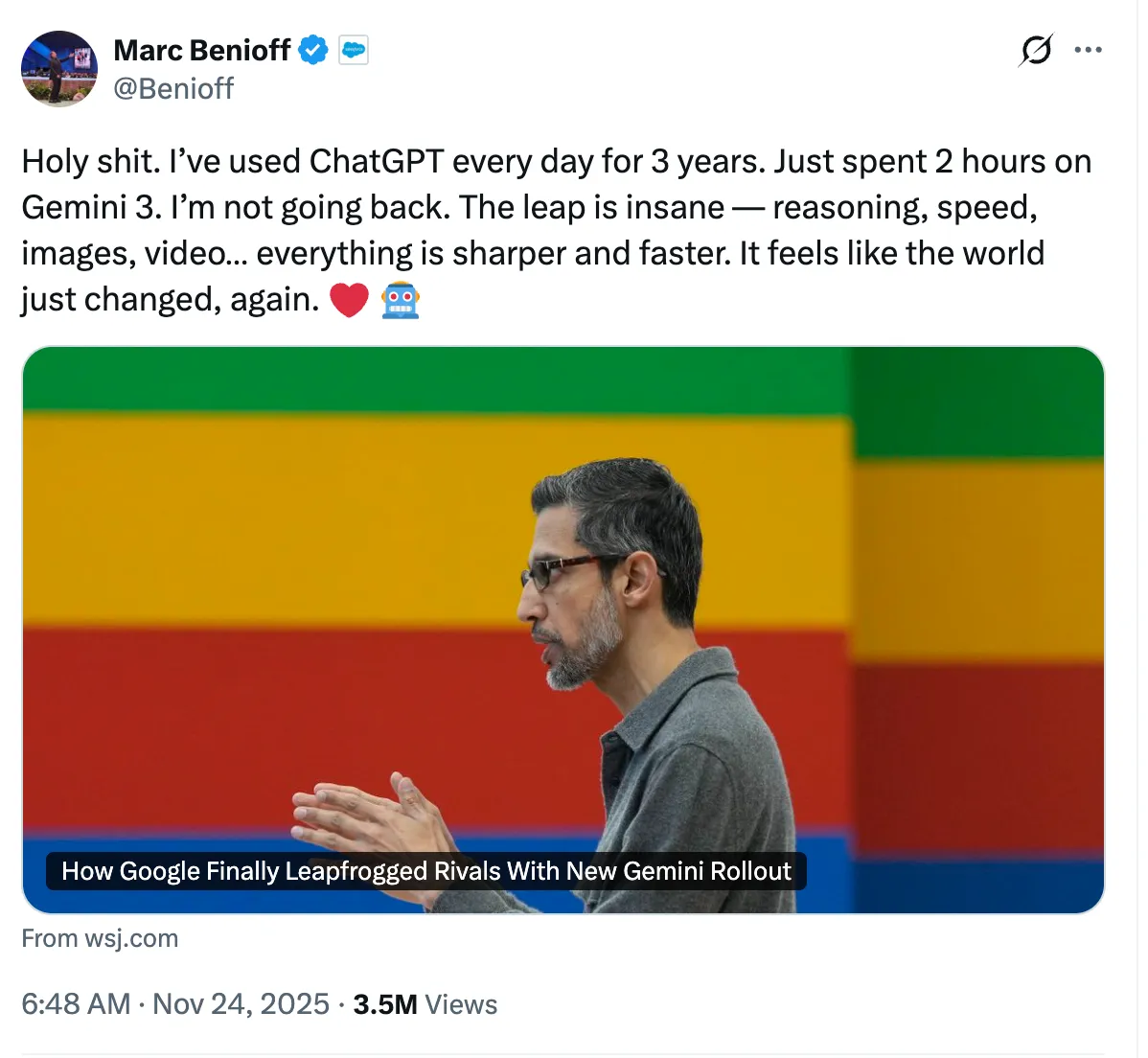
Even long-time AI champions are shifting. Salesforce CEO Marc Benioff tested Google’s Gemini 3 and publicly switched, saying: “The leap is insane.”
Silver lining? A new model drops soon
OpenAI does have a potential counterpunch. The company is preparing to ship a “brand-new reasoning model” - internally whispered as “o3-pro” or “Orion” - as soon as next week. If it performs as promised, it could slow user churn, win back power users, and recover top rankings in reasoning, coding, and maths.
Nick Turley, VP and head of the ChatGPT app, captured the shift on X:
OpenAI has stayed quiet on the leaked memo, but its actions suggest a company acutely aware of the stakes. With a projected 220 million paying users by 2030, it cannot afford to let rivals define what “state-of-the-art” looks like.
This sprint could reignite a distracted giant - or reveal weaknesses that glossy demos can no longer hide. In the AI race, yesterday’s winner can become tomorrow’s case study in complacency.
Why this matters
OpenAI’s Code Red is more than an internal drama; it’s a snapshot of an industry at a turning point. A year ago, OpenAI looked uncatchable. Now Gemini 3’s surge, Claude’s enterprise grip, and Llama’s rapid evolution have compressed that lead in record time. When the most visible AI company in the world scrambles so publicly, it signals that the competitive and financial pressure is real, not theoretical.
It also indicates that the game has shifted from headline model launches to everyday product performance. Users care less about benchmark scores and more about whether their assistant is fast, accurate, affordable, and tailored to their specific needs. On those metrics, ChatGPT has shown a drift. If OpenAI can’t close that gap quickly, corporate budgets, investor conviction, and user loyalty could rotate away far faster than they arrived.
Key takeaway
OpenAI’s Code Red is its biggest course correction since ChatGPT first went viral - a forced reset on fundamentals as rivals accelerate. The coming weeks will reveal whether a new reasoning model can stabilize user growth and regain its technical lead, or whether Gemini, Claude, and Llama will turn this moment into a lasting power shift. In this phase of the AI race, advantage no longer belongs to the first mover, but to the fastest learner.
إخلاء مسؤولية:
The performance figures quoted are not a guarantee of future performance.
الأسئلة الشائعة
Why did OpenAI declare a Code Red?
Is OpenAI in financial trouble?
Does ChatGPT risk losing its market lead?
What new model is OpenAI releasing?
What happens if ChatGPT doesn’t improve quickly?


