المحتويات
مقال
Are precious metals entering a new safe-haven cycle?
January 23, 2026
مقال
Are precious metals entering a new safe-haven cycle?
January 23, 2026
مقال
Are precious metals entering a new safe-haven cycle?
January 23, 2026

The question is no longer whether precious metals are rallying, but whether something more durable is unfolding, analysts say. Gold has surged beyond $4,900 per ounce, silver has climbed to record highs above $96, and platinum prices have doubled in just seven months. Moves of this scale, across multiple metals at once, tend to reflect deeper shifts rather than speculative excess alone.
What distinguishes the current phase is the alignment of forces behind it. A weakening US dollar, persistent geopolitical tension, growing confidence that the Federal Reserve will cut rates, and continued central bank demand are reinforcing one another. When gold, silver, and platinum rise together amid macro strain, it often signals a renewed defensive mindset across markets.
What’s driving precious metals?
Gold’s advance is rooted in a familiar macro mix that has recently intensified. The US dollar index has slipped roughly 0.4%, improving purchasing power for overseas buyers, while bond markets are pricing in at least two Federal Reserve rate cuts in the second half of the year. As yields fall, the opportunity cost of holding non-yielding assets declines, supporting gold at a time when confidence in policy stability remains fragile.
Geopolitics has added momentum. Ongoing tensions involving Iran and Venezuela, alongside lingering uncertainty around Greenland and NATO security commitments, have kept risk appetite in check. Although President Trump’s decision to delay some European tariffs for a brief period soothed markets, the absence of long-term clarity on trade and defence arrangements continues to favour defensive positioning. As Peter Grant of Zaner Metals has noted, gold demand increasingly reflects a broader shift away from reliance on the dollar rather than reactions to individual headlines.
Why it matters
This rally carries more weight because it extends beyond speculative flows. Central banks have continued to add gold to reserves, reinforcing its role as a strategic asset during periods of fiscal pressure and political uncertainty. That steady demand has helped underpin prices even during intermittent pullbacks.
Silver adds complexity to the picture. While it does not hold the same reserve status as gold, it sits at the intersection of monetary demand and industrial use. Nikos Tzabouras of Tradu highlights that silver often benefits from safe-haven flows during periods of dollar weakness, while its industrial exposure magnifies price swings. When both metals attract capital simultaneously, it suggests investors are hedging against broader systemic risks, not just market volatility.
Impact on precious metals markets
Below the surface, physical market conditions are tightening. Stefan Gleason, CEO of Money Metals Exchange, describes current silver trading as unusually intense, with new participants entering the market even as long-term holders take partial profits. Over the past month, demand has exceeded levels seen during the COVID-era panic, despite prices having roughly doubled over the past year.
The strain lies less in raw supply and more in processing capacity. In the United States, large silver bars remain available, but limited refining and minting capacity has created bottlenecks, pushing up premiums and delaying deliveries. Elsewhere, particularly in London and Asian markets, conditions are tighter still. ETF inflows have removed physical metal from circulation, contributing to regional price gaps. Asian silver prices are now trading as much as $3 above New York levels, a divergence that may persist due to logistical and transportation constraints.
Copper’s role: a parallel signal, not a safe haven
Copper is neither a precious metal nor a traditional safe haven, yet its recent performance reinforces the broader commodities narrative. Demand continues to accelerate as electrification, renewable energy investment, and the expansion of AI-driven data centres gather pace. AI infrastructure alone is expected to require around 500,000 tonnes of copper annually by 2030, adding to already robust demand from construction, transport, and power networks, particularly in China and India.
Supply, however, has struggled to respond. Disruptions in Chile and Indonesia, falling ore grades, and long development timelines have constrained output growth. Policy uncertainty has added volatility, with US tariffs on semi-finished copper products and the potential for duties on refined copper from 2027 distorting trade flows. While copper’s medium-term outlook remains mixed, its structural tightness mirrors the same theme evident in precious metals: demand is evolving faster than supply can adapt.
Expert outlook
From a technical standpoint, gold’s trend remains intact, even as rapid gains raise the likelihood of near-term pullbacks. Grant argues that any retracements are likely to attract buyers, with $5,000 per ounce now firmly within reach. The key issue is not volatility itself, but whether underlying demand continues to absorb it.
Platinum’s outlook may prove even more sensitive. UBS expects platinum to trade near $2,500 per ounce in the coming months, citing strong investment demand and constrained physical supply. Given the metal’s relatively small market size, even modest shifts in investor appetite can produce outsized price moves. Elevated lease rates in London suggest ongoing tightness, though UBS cautions that volatility is likely to remain a defining feature.
Key takeaway
Precious metals appear to be transitioning from a simple rally into a broader safe-haven phase. Gold’s approach toward $5,000, tightening physical conditions in silver, and platinum’s supply constraints all point to a reassessment of defensive assets. Volatility is likely to persist, but the underlying macro drivers remain aligned. The next signals to watch will be Federal Reserve guidance, ETF flows, and physical premiums across major global hubs.
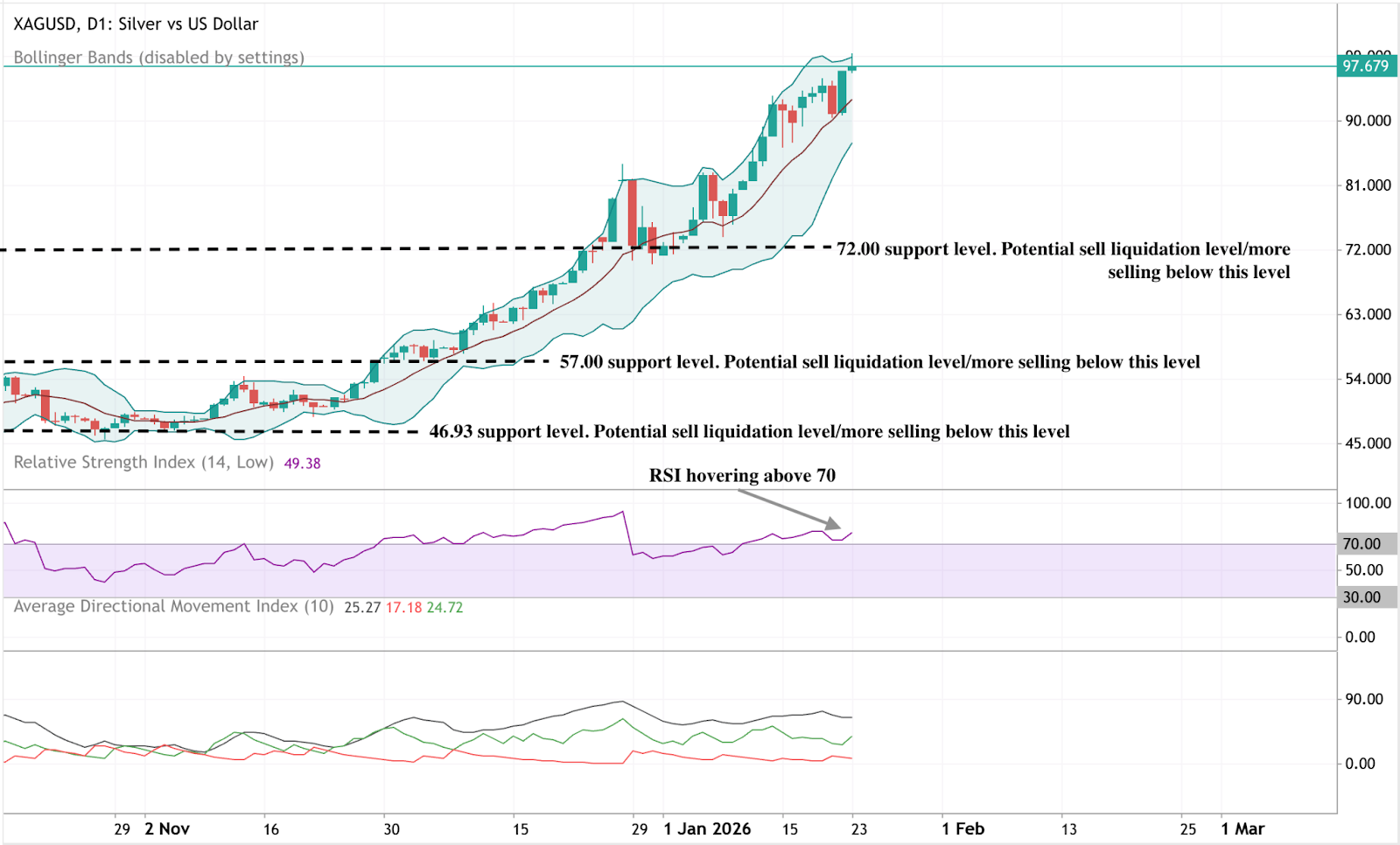
Silver technical outlook
Silver continues to trade near recent highs following a powerful, sustained advance, with prices holding close to the upper Bollinger Band. The bands remain widely expanded, indicating elevated volatility and persistent directional pressure rather than consolidation.
Momentum indicators reflect stretched conditions. The RSI remains above 70, signalling strong momentum rather than imminent mean reversion. Trend strength also remains elevated, with the ADX confirming the prevailing move's dominance. Structurally, silver is holding well above former breakout zones around $72, $57, and $46.93, underscoring both the scale and durability of the rally.
إخلاء مسؤولية:
The information contained on the Deriv Market News is for educational purposes only and is not intended as financial or investment advice. The information may become outdated, and some products or platforms mentioned may no longer be offered. We recommend you do your own research before making any trading decisions. The performance figures quoted refer to the past, and past performance is not a guarantee of future performance or a reliable guide to future performance.
الأسئلة الشائعة
Why are precious metals rising together now?
Is gold close to $5,000 per ounce?
Is there a silver shortage?
Why is platinum outperforming expectations?
Could precious metals fall from here?


