Contents
Article
Bitcoin slides as analysts warn the downturn may not be over
February 10, 2026
Article
Bitcoin slides as analysts warn the downturn may not be over
February 10, 2026
Article
Bitcoin slides as analysts warn the downturn may not be over
February 10, 2026

Bitcoin’s recent pullback has rattled a market already grappling with uncertainty. After dipping to roughly $64,000 last week, the largest cryptocurrency is now more than 40% below its October highs, unwinding much of the confidence that carried prices through the latter part of 2025. What began as a healthy correction is increasingly being viewed as something more entrenched.
Market participants are now reassessing the outlook. Veteran traders, technical analysts, and even policymakers are questioning whether Bitcoin has truly reached a cycle low. With downside targets clustering between $50,000 and $42,000, attention is shifting away from short-term volatility towards broader concerns around liquidity, positioning, and structural support.
What’s driving Bitcoin’s slide?
The latest sell-off has not been triggered by a single catalyst, but by a gradual erosion of bullish assumptions. Bitcoin’s surge toward six-figure territory last year was underpinned by steady ETF inflows, improving regulatory narratives, and expectations that institutional participation would anchor prices. That confidence faltered once Bitcoin failed to defend key psychological levels, prompting systematic selling and liquidation-driven moves.
Long-time chart analyst Peter Brandt sharpened the focus with his characterisation of the decline as a “banana peel” event - a sudden, destabilising slip that wrong-footed traders. In a post on X, Brandt suggested the market may need to revisit the $42,000 region before sentiment is fully reset. The suggestion that the cycle’s low may still lie ahead added to the prevailing unease rather than easing it.
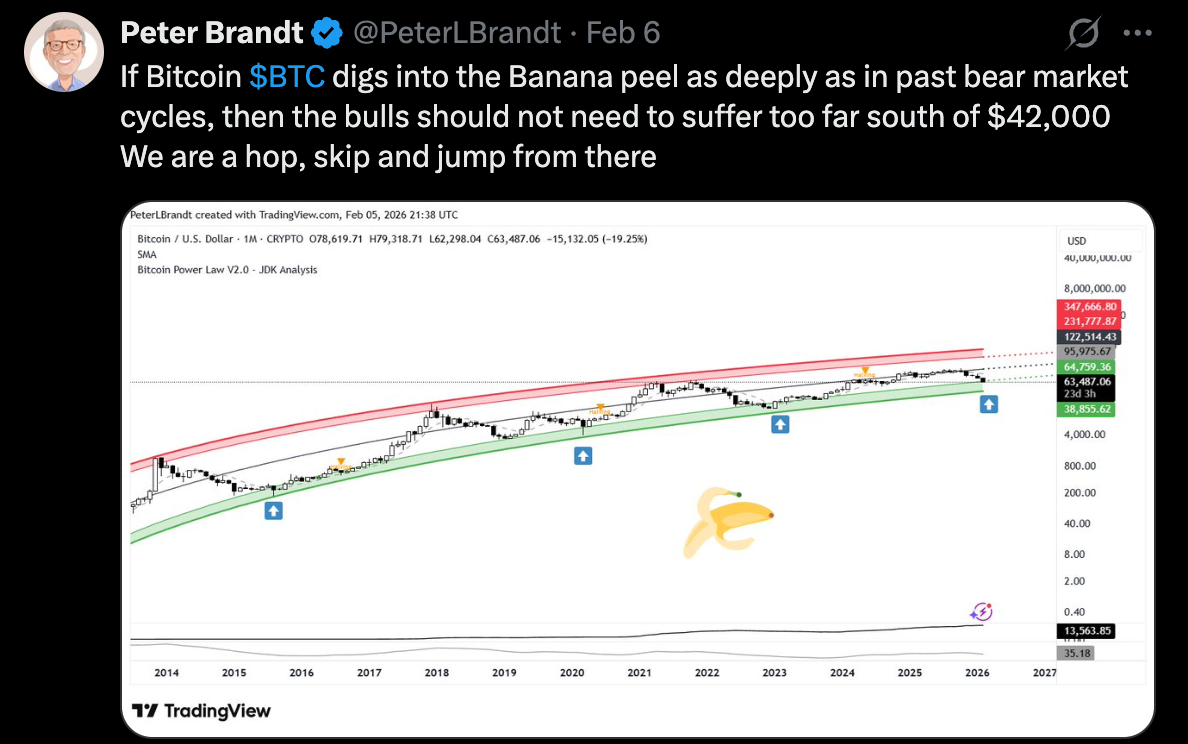
Market conditions have also grown tighter beneath the surface. Bitcoin briefly slid to $60,033 last week, its weakest level since October 2024, triggering the most pronounced volatility spike since the FTX collapse in 2022. Funding rates turned negative as traders moved to hedge exposure or position defensively, reinforcing the bearish tone.
Why it matters
Bitcoin’s decline carries greater weight today because the market’s composition has changed. Crypto is no longer dominated by retail flows alone. Institutional players, trading firms, and exchange-traded products now play a central role, amplifying both rallies and downturns. When price structures break, the impact tends to be faster and more forceful.
Another analyst drawing attention is KillaXBT, whose mid-2025 roadmap accurately identified the market peak above $100,000. His analysis, which has resurfaced amid the sell-off, suggests Bitcoin is currently locked in a distribution phase. In this environment, rallies are met with supply rather than accumulation. According to the model, a final capitulation toward the $50,000 region may be required before a sustainable base can form.
Sentiment data appears to support that view. Indicators such as Crypto Fear and Greed have dropped to levels historically associated with market stress. While such conditions often precede long-term bottoms, they have typically followed a more complete exhaustion of sellers.
Impact on crypto markets and investors
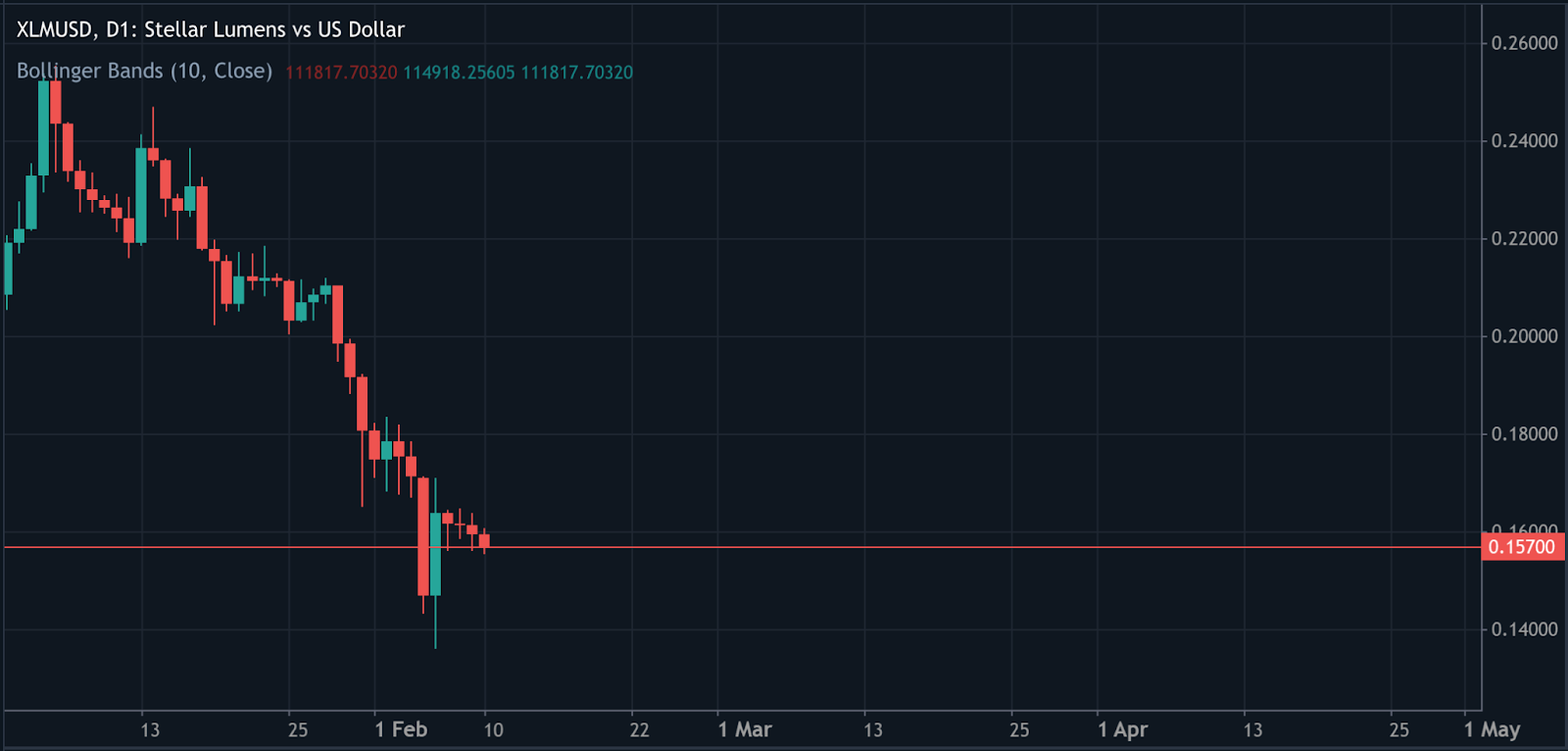
The pressure has spilled across the wider crypto market. Altcoins have broadly underperformed Bitcoin, with sharper drawdowns reflecting fading risk appetite. Stellar (XLM), for example, declined by more than 16% over the past week before finding short-term stability around $0.16, hinting at selective resilience rather than a broad recovery.
Investor behaviour is also evolving. Instead of chasing rebounds in major tokens, speculative flows are increasingly targeting smaller, narrative-driven themes, particularly those linked to artificial intelligence. This dynamic has appeared in previous late-cycle phases, where traders seek asymmetric opportunities while limiting exposure to Bitcoin’s headline volatility.
For longer-term participants, the implications are more strategic. Without the development of a macro base - a period of sustained price stability - continued weakness could influence portfolio construction, ETF positioning, and institutional risk frameworks for months to come.
Expert outlook
Policy commentary is adding another layer of caution. Federal Reserve Governor Christopher Waller recently remarked that the post-election enthusiasm that lifted crypto markets may be losing momentum, as mainstream financial institutions reassess exposure and tighten risk controls.
From a technical standpoint, analysts broadly agree that market structure has taken precedence over sentiment. A sustained break below $60,000 would increase the likelihood of a move towards $50,000 or even $42,000. On the other hand, a decisive recovery above the $70,000 area would weaken the bearish case and point to renewed institutional interest.
Until a clearer signal emerges, volatility remains the defining feature. Bitcoin’s next directional move is likely to be driven less by narrative and more by whether the price can stabilise without external support.
Bitcoin technical outlook
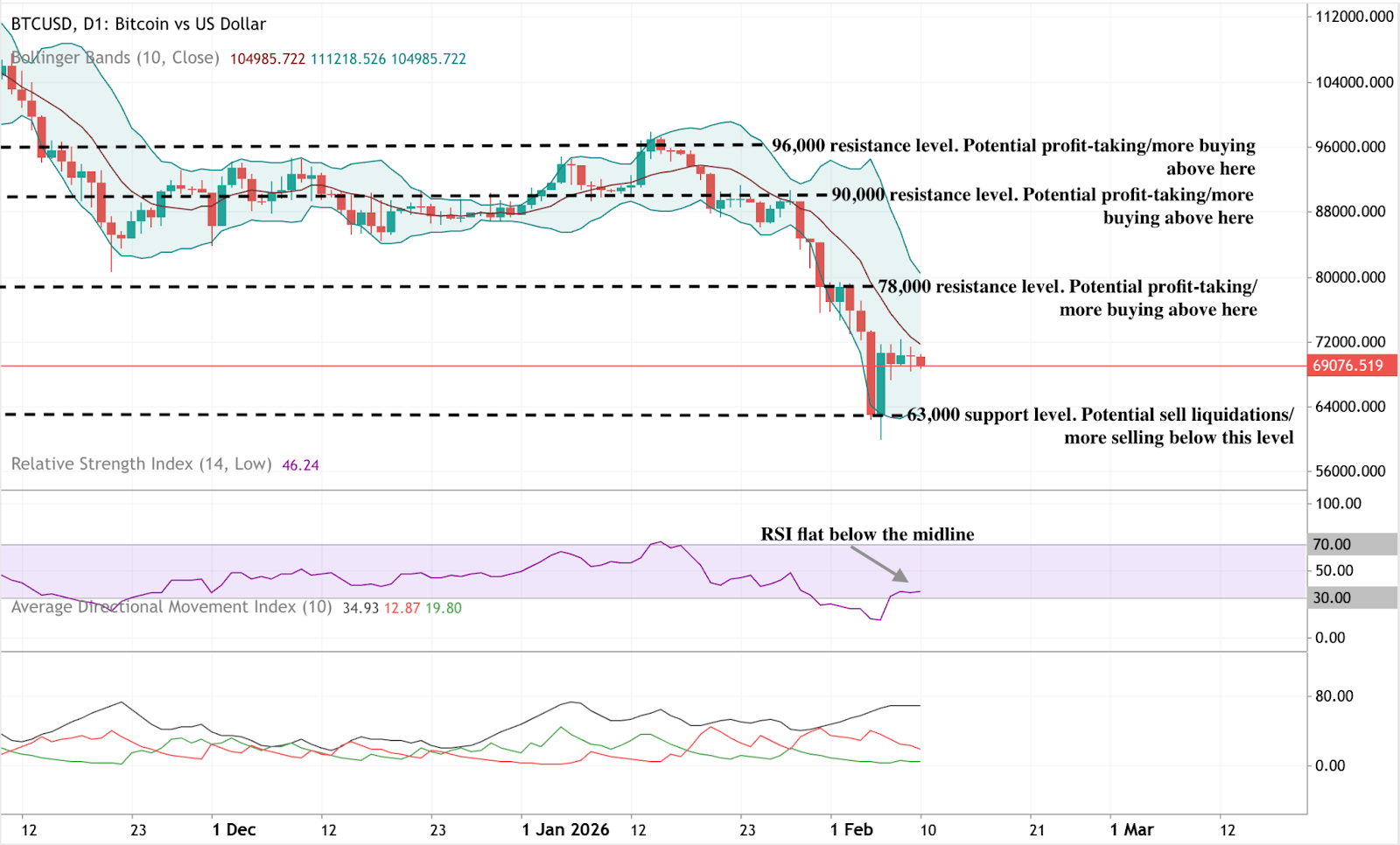
Bitcoin continues to trade lower within its recent range, having declined from the upper boundary before finding tentative support near the lower portion of the structure around $69,000. Bollinger Bands remain wide, reflecting elevated volatility following the sharp sell-off, even as price action has moved back inside the bands.
Momentum indicators point to subdued conditions. The RSI remains below its midpoint, suggesting lingering weakness rather than a renewed directional push. Trend strength remains moderate, with ADX readings indicating an established trend but without strong directional conviction.
From a structural perspective, Bitcoin remains below previously important zones near $78,000, $90,000, and $96,000. This reinforces the view that the market is consolidating after a sharp repricing, rather than entering a fresh phase of price discovery.
Key takeaway
Bitcoin’s latest slide has highlighted just how fragile last year’s bullish narrative has become. With analysts warning that the cycle low may still be ahead, the market now faces a decisive test of structure and confidence. Whether this period proves to be a final flush or the early stages of a deeper reset will depend on liquidity conditions, institutional behaviour, and Bitcoin’s ability to establish a stable base. The coming weeks are likely to be pivotal.
Disclaimer:
The information contained on the Deriv Market News is for educational purposes only and is not intended as financial or investment advice. The information may become outdated, and some products or platforms mentioned may no longer be offered. We recommend you do your own research before making any trading decisions.
FAQs
Why is Bitcoin falling again?
Is $42,000 a realistic Bitcoin bottom?
What does a “capitulation” mean for Bitcoin?
How are institutions influencing Bitcoin’s price?
What should investors watch next?


