Contents
Article
Bitcoin’s next move: Could a rate cut this week set off a rally?
December 8, 2025
Article
Bitcoin’s next move: Could a rate cut this week set off a rally?
December 8, 2025
Article
Bitcoin’s next move: Could a rate cut this week set off a rally?
December 8, 2025
.webp)
Bitcoin’s rebound towards $92,000 comes at a moment of heightened anticipation, with traders assessing whether an expected Federal Reserve rate cut could spark the market’s next significant move. According to reports, the climb back from December’s $82,000 lows has helped stabilise sentiment after October’s $19 billion leverage flush-out, although liquidity remains fragile and order books still feel noticeably thin.
A cut would ease funding conditions and potentially revive appetite for risk, yet Bitcoin’s recent behaviour shows a market still digesting the consequences of tighter monetary policy and patchy inflation data. With jobless-claim projections rising and the Fed having wrapped up its quantitative tightening programme, analysts noted this week’s decision may determine whether Bitcoin finally breaks out of its holding pattern-or extends the drift that has characterised recent weeks.
What’s driving Bitcoin’s move?
Data showed that Bitcoin edged up to roughly $91,550 after reclaiming the $90,000 level, buoyed by a subtle shift in macro sentiment. The fallout from October’s $19 billion long liquidation event continues to weigh on confidence, having stripped away substantial liquidity and exposed weaknesses in market depth across exchanges.
Market makers, still cautious, have been slow to deploy capital at scale, which has constrained both upside momentum and intraday volatility. At the same time, the Fed’s conclusion of quantitative tightening on 1 December has encouraged expectations of looser policy, particularly as economists predict a sharp rise in this week’s initial jobless claims - an indicator that historically strengthens the case for rate cuts.
Meanwhile, Bitcoin’s broader backdrop continues to evolve. Glassnode’s Q4 Digital Assets Report highlights that the 2022–2025 cycle has attracted a record-breaking $732 billion in net inflows - surpassing the sum of all previous cycles combined.
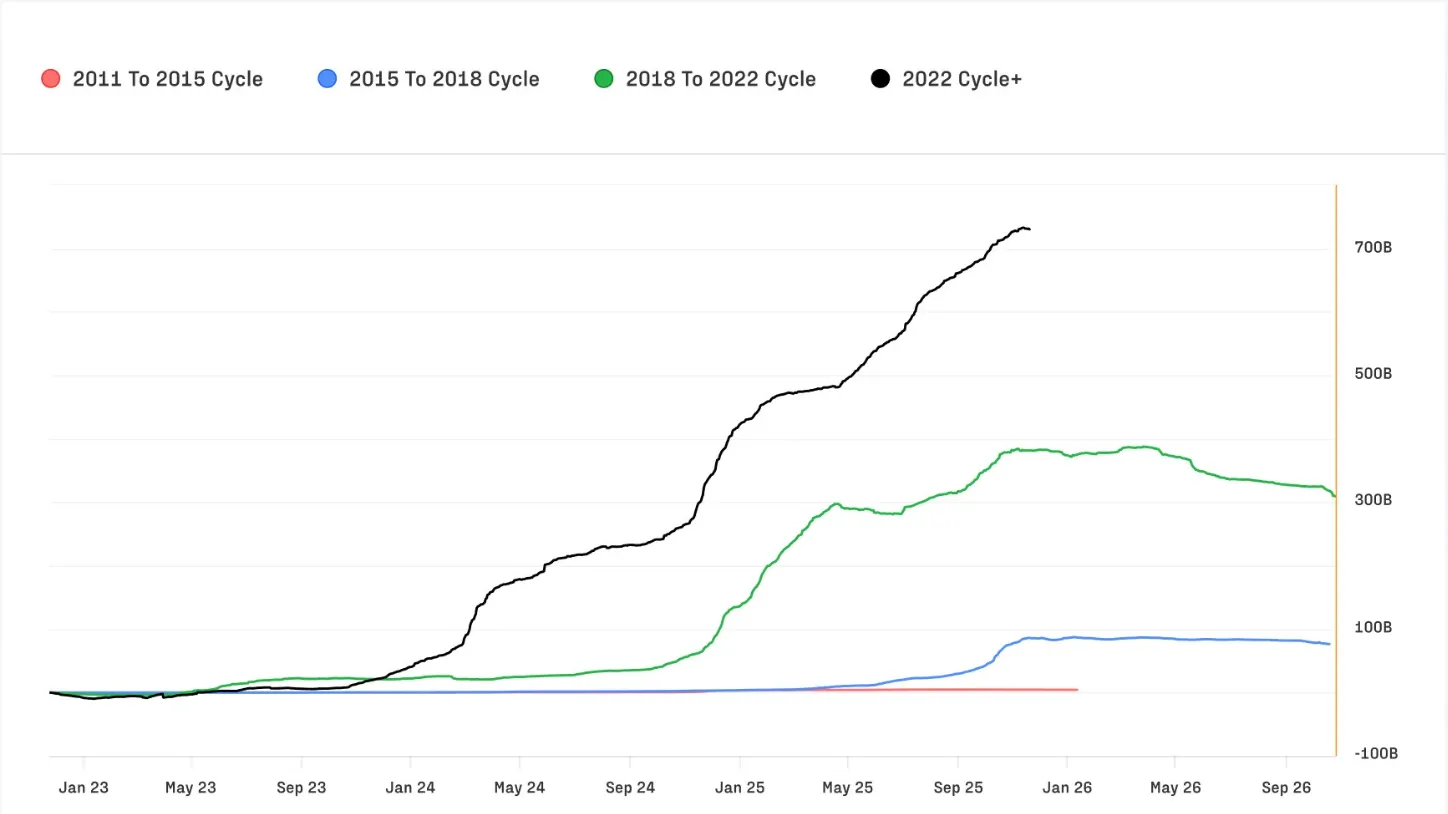
Monthly inflows, which neared $40 billion in October, have since settled closer to $15 billion, yet this remains substantial by historic standards. Realised Cap has also climbed to a new peak of $1.1 trillion, signalling entrenched long-term conviction despite Bitcoin’s muted short-term price action.
Why it matters
Bitcoin’s growing institutional stature has increased its sensitivity to shifting interest-rate expectations. Amber Group CEO Michael Wu observes that rate signals “ripple through crypto funding markets in Asia far more quickly than traditional asset classes,” with borrowing costs and funding spreads adjusting almost immediately. This heightened responsiveness has pushed trading desks to spread liquidity across CeFi and DeFi venues, helping guard against sudden volatility spikes.
Market watchers noted that the inflation picture further complicates this environment. While services inflation has eased from last year’s extremes, it remains stickier than goods inflation, and shelter costs continue to overshoot the Fed’s target range. This uneven progress has blurred the timeline for rate cuts, prompting investors to seek defensive hedges such as gold and silver. Bitcoin, with its still-fragile liquidity conditions, has struggled to assert direction under these circumstances.
Bloomberg strategist Mike McGlone notes that Bitcoin often lags behind the S&P 500 when equity volatility increases, reflecting broader shifts in risk allocation. His view underscores a central point: the crypto market is increasingly governed by macroeconomic tides rather than internal industry narratives.
Impact on markets and investors
The October liquidation shock continues to shape price dynamics. Ryan McMillin of Merkle Tree Capital highlights how “order books were wiped out,” and the recovery has been slower than many expected. With liquidity still thin, macro announcements carry outsized influence, often compressing Bitcoin into a tighter trading range and prompting sharper intraday swings.
Institutional flows amplify this pattern. Bitcoin’s dominance has risen from 38.7% to 58.3% since late 2022, signalling a retreat from speculative altcoins towards higher-liquidity assets. Ethereum’s share has slipped to 12.1%, extending its multi-year underperformance relative to Bitcoin following the 2022 Merge. Stablecoins, which now represent 8.3% of the market, remain crucial to liquidity provisioning across global venues, especially in emerging markets where they facilitate dollar-based activity.
Against this analytical backdrop, more ideological narratives continue to circulate. MicroStrategy’s Michael Saylor recently advanced a geopolitical argument for large-scale U.S. Bitcoin accumulation, warning rivals could end up “buying it back at $50 million a coin.” While such statements energise segments of the crypto community, they sit apart from the liquidity-driven forces influencing near-term price action.
Expert outlook
Whether a rate cut triggers a meaningful breakout remains the central question, according to experts. Lower borrowing costs typically favour risk positions and could entice market makers to scale liquidity back into the order book. McMillin believes the groundwork for a rebound is already forming following the Fed’s halt to quantitative tightening, suggesting that “the market is set to rally,” with a cut acting as a potential spark. Even so, many institutional desks remain wary, anticipating that liquidity may rebuild gradually rather than all at once.
Long-term indicators remain constructive. Record inflows, elevated Realised Cap, and a structural decline in volatility suggest a more mature and resilient Bitcoin market than in previous cycles. Yet the asset’s next major move hinges on how macro conditions unfold. Traders will scrutinise the Fed’s communication, labour-market data, and equity-market volatility for clarity. A sustained push above recent highs is possible but will likely require deeper liquidity and more consistent funding conditions. For now, Bitcoin’s recovery above $90,000 marks the beginning of a transition phase rather than a decisive shift in trend.
Key takeaway
Bitcoin’s return above $90,000 comes at a critical juncture, with the Federal Reserve positioned to shape the asset’s next meaningful move. A rate cut could reinforce bullish momentum, yet thin liquidity and cautious market makers may limit the immediate upside reaction. The broader market structure remains strong, but its near-term direction will depend on macroeconomic signals rather than crypto-specific developments. Traders will watch the Fed’s tone, jobless-claim data, and liquidity trends closely in the days ahead.
Bitcoin technical insights
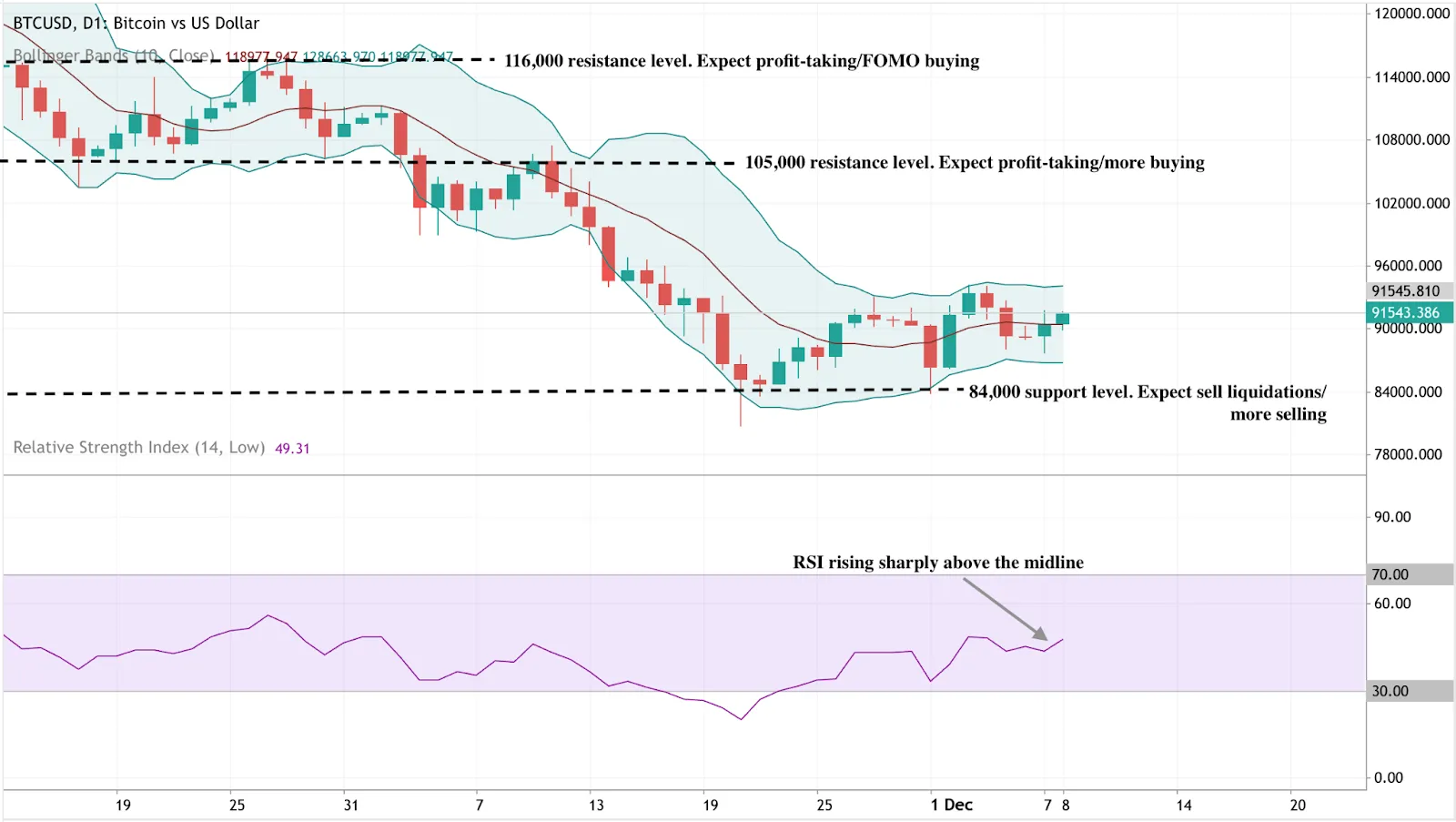
At the time of writing, Bitcoin (BTC/USD) is trading near $91,545, continuing to stabilise above the important $84,000 support region. A clear break below this level would risk accelerating liquidations and deepen the broader corrective structure. On the upside, resistance remains concentrated at $105,000 and $116,000 - zones where traders often anticipate either profit-taking or renewed momentum if sentiment shifts decisively.
For now, price action reflects a measured recovery. BTC sits within the middle of its Bollinger Band range following several weeks of downside pressure, hinting at improving confidence even if buyers are not yet willing to chase higher levels. The RSI, hovering around 49, demonstrates a clear rebound from oversold conditions and indicates that selling momentum has weakened. Still, the indicator has yet to enter bullish territory. For the structure to turn convincingly positive, Bitcoin will need to establish higher lows and build pressure against the $105,000 resistance.
Disclaimer:
The performance figures quoted are not a guarantee of future performance.
FAQs
Will a rate cut trigger a Bitcoin rally?
Why is Bitcoin reacting so strongly to jobless-claim forecasts?
Why has liquidity been so weak since October?
What explains the record $732B in inflows this cycle?
Why is Bitcoin underperforming equities at times?


