Contents
Article
Why are analysts scaling back Bitcoin targets for 2025–2030?
December 10, 2025
Article
Why are analysts scaling back Bitcoin targets for 2025–2030?
December 10, 2025
Article
Why are analysts scaling back Bitcoin targets for 2025–2030?
December 10, 2025
.webp)
Analysts are revising their Bitcoin expectations downwards as the drivers behind earlier optimistic projections lose strength. ETF inflows, once viewed as the structural engine of the next bull market cycle, have slowed to their weakest pace since the products were introduced. Corporate treasury buyers, who once aggressively accumulated Bitcoin, have dialed back their activity, with firms like MicroStrategy no longer adding the same upward pressure they once did.
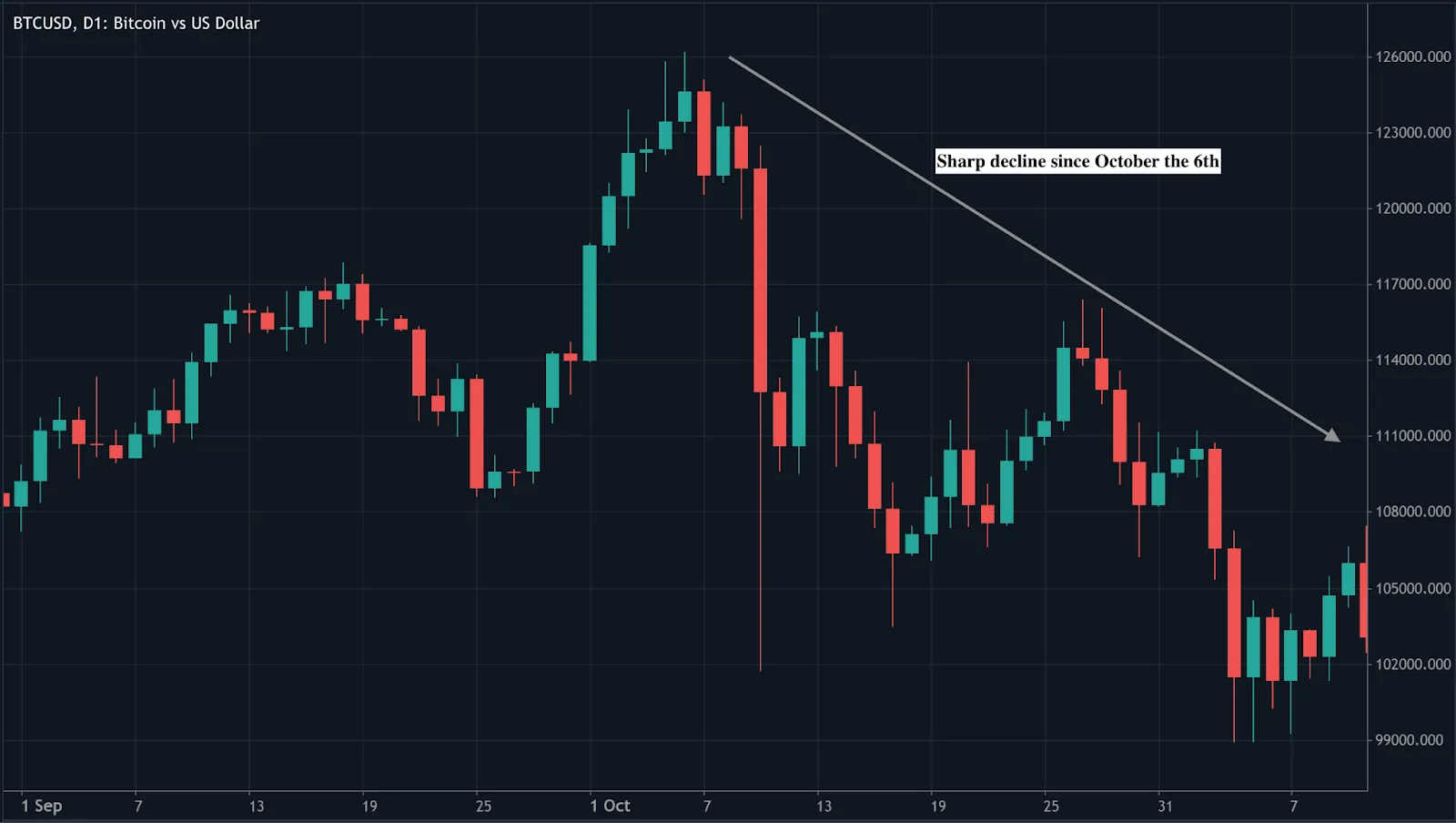
Standard Chartered, which previously forecasted Bitcoin reaching $200,000 by year-end, now predicts just $100,000 and has reduced its estimates across the remainder of the decade. This comes as Bitcoin trades slightly above $91,000, still nursing a 30% pullback from its October high.
With liquidity thinning and uncertainty building ahead of a widely anticipated December rate cut, traders are looking to the Federal Reserve for direction. Whether this proves to be a temporary slowdown or a deeper repricing will influence Bitcoin’s long-term trajectory into the 2030s.
What’s driving Bitcoin’s repricing?
Bitcoin’s tight consolidation between $91,000 and $94,000 reflects a market caught between fading confidence and a cooling demand base. November’s drop to $82,221 - the lowest level in seven months - highlighted how sensitive the cryptocurrency has become to shifts in liquidity and risk appetite. Spot Bitcoin ETFs, which were expected to absorb supply consistently through 2025, have attracted only around 50,000 BTC this quarter, marking their weakest performance since launch.
This slowdown has forced analysts to question assumptions about steady institutional accumulation. Standard Chartered’s Geoffrey Kendrick framed the bank’s downgrade as a “recalibration of demand expectations”, noting that the digital-asset treasury buyers who propelled earlier surges no longer have the balance-sheet flexibility or strategic need to continue accumulating at the same pace. With that source of demand fading, ETFs must now shoulder almost the entire burden of maintaining upward pressure.
Bernstein’s revised outlook follows a similar logic: the long-term adoption story remains positive, but growth is flattening, extending the timeline for higher price targets rather than eliminating them.
Why it matters
These downward revisions extend beyond price targets; they challenge the notion that Bitcoin’s trajectory can be predicted through familiar cycles. The 30% slide from the October peak above $126,000 has already cast doubt on the idea that halving events alone can underpin major rallies. If institutional participation becomes choppy instead of structural, Bitcoin’s performance becomes increasingly tied to interest-rate policy, global liquidity conditions, and market psychology rather than predictable supply mechanics.
The political backdrop adds further complexity. While a 25-basis-point rate cut is widely expected, the market is more interested in Powell’s comments on what comes next. Speculation that Kevin Hassett could eventually take the helm at the Fed has intensified debate over whether policy may lean towards more accommodative settings. Because Bitcoin often behaves like a high-beta asset during liquidity swings, changes in policy tone can outweigh traditional narratives focused on the crypto sector.
Impact on markets and investors
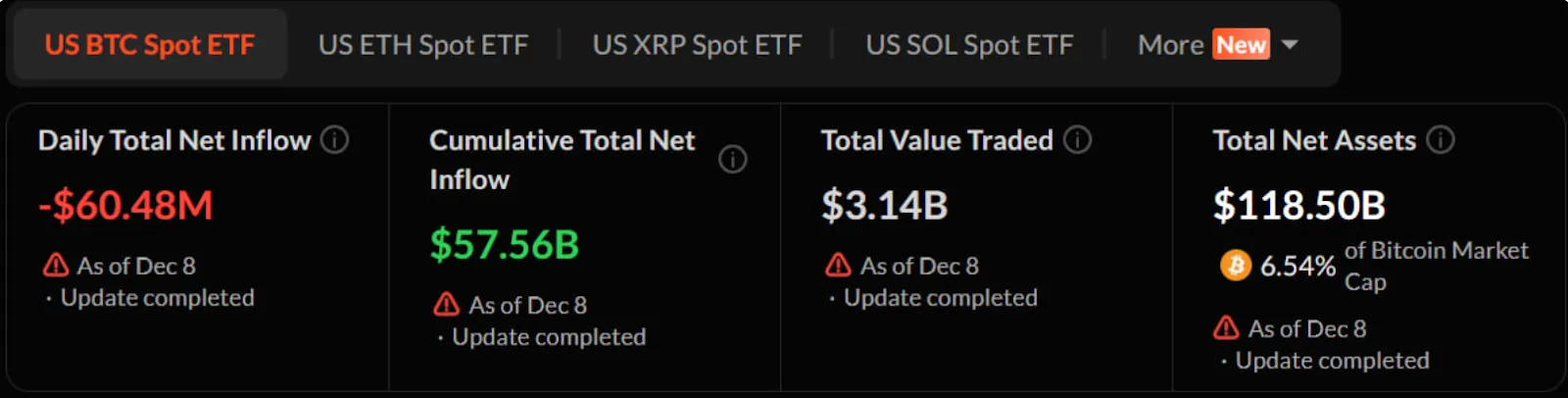
The downturn in Bitcoin sentiment has filtered through to the broader digital-asset market. Spot ETFs recorded $60 million in net outflows on Monday, reversing the trend of steady inflows earlier in the year. Institutional traders who once bought dips with confidence are now cautious, preferring to wait for the Fed’s next signal before committing more capital.
Although volatility has remained contained, it has masked the thinning of market depth in recent weeks.
This shift has also influenced how traders view important levels. Delta Exchange analysts highlight $94,000 as the key point at which sentiment could shift decisively to the upside. Yet the lack of strong order-book support suggests that investors are unwilling to chase breakouts without clearer macro guidance. Ethereum’s relative resilience before the FOMC meeting implies selective optimism, but not enough to claim a broader recovery in risk appetite.
Expert outlook
Despite the cut in forecasts, Bitcoin’s long-term narrative remains constructive, albeit far more gradual than initially anticipated. Standard Chartered now expects Bitcoin to reach $150,000 in 2026, down from its earlier projection of $300,000, and has pushed its $500,000 call from 2028 to 2030. Bernstein forecasts that Bitcoin will climb to around $150,000 next year and approach $200,000 by 2027.
These more measured projections support the idea of a maturing market, led by professional capital flows and policy-driven cycles, rather than dramatic retail-fueled booms.
The biggest variable remains U.S. monetary policy. A dovish shift could revive ETF inflows and ease financial conditions, while a more guarded stance may extend Bitcoin’s consolidation into the early months of 2026. Traders will dissect Powell’s language for clues about January and beyond, knowing that even subtle hints can move crypto markets meaningfully.
Key takeaway
Analysts are reducing their Bitcoin forecasts because the strongest sources of demand - ETF inflows, corporate treasury interest, and supportive liquidity conditions - have all weakened at once. Yet the broader view remains cautiously optimistic, with long-term targets simply pushed further out rather than abandoned.
The next decisive catalyst is likely to come from the Federal Reserve’s updated guidance, which will set the tone for whether Bitcoin regains momentum or remains stuck in consolidation.
Bitcoin technical insights
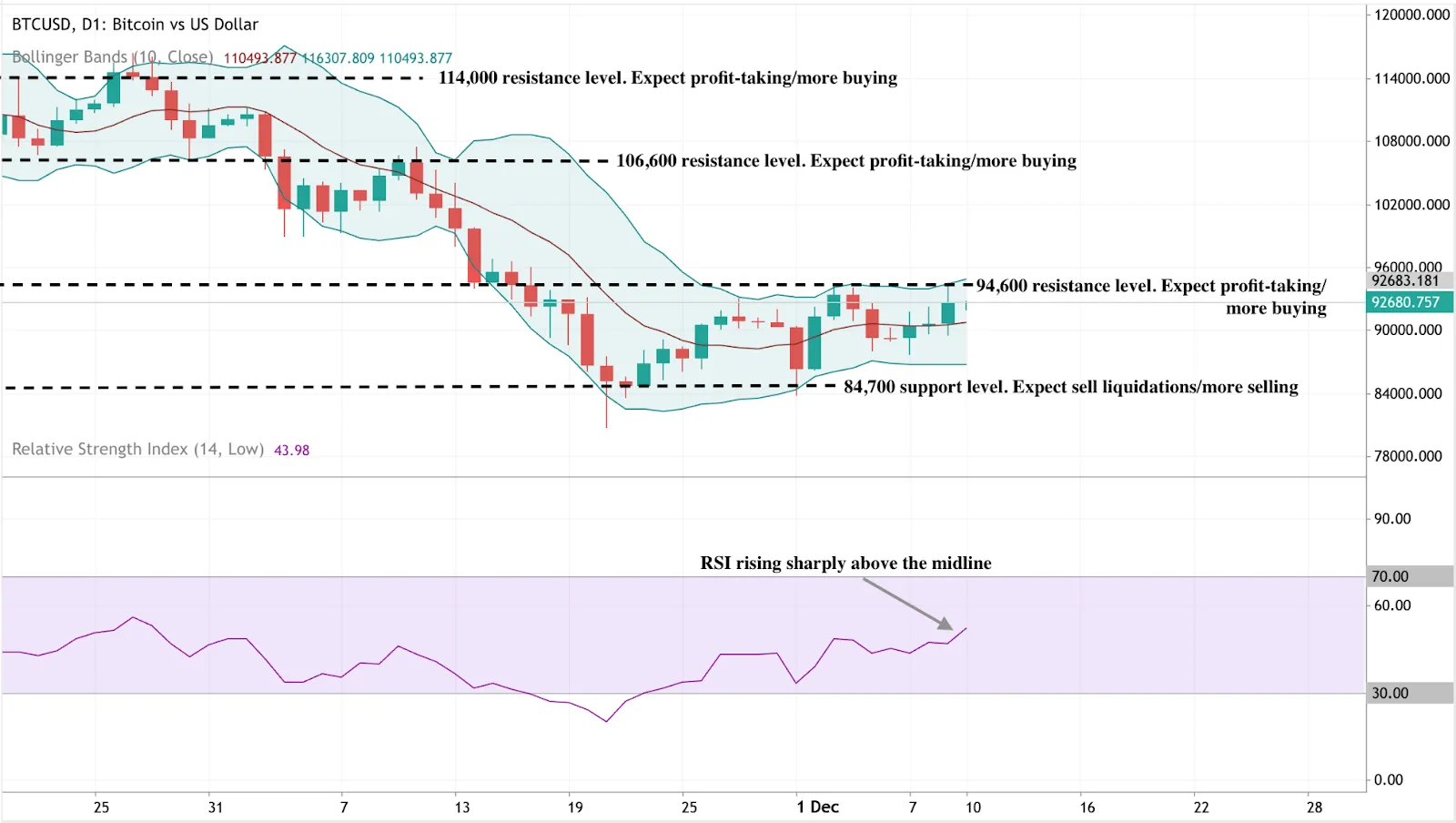
At the time of writing, Bitcoin (BTC/USD) is trading near $92,680, steadying after rebounding from the $84,700 support area - a region where deeper losses might have triggered a wave of forced selling. Price is now pushing towards the $94,600 resistance, with further barriers at $106,600 and $114,000 where traders typically reassess risk or consider fresh entries if momentum strengthens.
BTC remains positioned in the upper half of its Bollinger Band range, signalling improved sentiment while highlighting hesitation as candles approach resistance. Buyers are regaining traction, yet the wider price structure still suggests consolidation unless the market can secure a firm close above $94,600.
This is where tools such as the Deriv Trading Calculator become valuable, allowing traders to estimate margin requirements, position sizes, or risk before engaging with potential breakout levels.
The RSI’s move towards the 55–60 zone signals strengthening bullish momentum. Still below overbought territory, the indicator shows a constructive backdrop for continued recovery if Bitcoin can clear $94,600. A confirmed breakout would shift focus towards the higher resistance zones and could offer a more supportive narrative heading into the next macro event.
Disclaimer:
The performance figures quoted are not a guarantee of future performance.
FAQs
Why are analysts cutting Bitcoin targets now?
Has Bitcoin stopped following the halving cycle?
What price level would confirm a bullish breakout?
How important are ETF flows to Bitcoin now?
Will a Fed rate cut boost Bitcoin?


