Contents
Article
Microsoft Copilot ARPU vs Nvidia GPU economics: Who captures the AI edge in 2025?
December 4, 2025
Article
Microsoft Copilot ARPU vs Nvidia GPU economics: Who captures the AI edge in 2025?
December 4, 2025
Article
Microsoft Copilot ARPU vs Nvidia GPU economics: Who captures the AI edge in 2025?
December 4, 2025

The race for AI profitability in 2025 is being shaped by two very different business models. Microsoft is lifting average revenue per user by weaving Copilot into the core of its subscription offering, while Nvidia continues to command exceptional margins from the hardware that powers today’s AI surge. Both companies sit at the heart of the AI revolution, yet they monetise the same technological moment in strikingly different ways.
The spotlight now turns to which of these models proves more durable as global AI spending enters a more mature phase. Microsoft’s most recent quarter showed an 18% rise in revenue, partly fuelled by Copilot’s integration into Microsoft 365, while Nvidia’s meteoric 960% share-price rise over three years underscores relentless demand for its Blackwell GPUs and CUDA software. What emerges next will reveal whether software-based recurring income or capital-intensive compute infrastructure delivers the stronger long-term upside.
ARPU vs GPU economics - The simple breakdown
A helpful frame for understanding this divide is the classic gold-rush analogy: do the fortunes favour those selling the final product, or those selling the picks and shovels that make the hunt possible?
Microsoft’s revenue model sits squarely in the first camp. Copilot offers a polished, end-user experience-the kind of AI-driven productivity boost that workers engage with daily. Each subscription adds a steady stream of income, meaning Microsoft’s economics is supported by millions of people paying a little more each month for integrated AI capability.
Nvidia’s role is entirely different. Analysts often refer to it as the ultimate picks-and-shovels provider, because every modern AI model-whether it’s Copilot, Gemini, or a bespoke enterprise agent-relies on GPU compute.
This creates a high-value, upfront monetisation cycle: hyperscalers buy enormous volumes of Nvidia hardware, often years in advance. When AI deployments accelerate, demand spikes dramatically; when budgets tighten, orders can stutter. Both companies thrive on the same trend, but one generates steady subscription revenue while the other profits from the world’s rising appetite for processing power.
What’s driving Microsoft Copilot ARPU vs Nvidia GPU economics
Microsoft’s strategy has been to make AI unavoidable across its productivity stack. By merging the £20 standalone Copilot Pro subscription into the £19.99 Microsoft 365 Premium tier, the company increases adoption without forcing customers to make a separate AI decision. This shift plays out in a SaaS landscape already normalising higher prices, with subscription costs climbing more than 11% in 2025-far beyond inflation across major economies.
For Nvidia, the drivers are hardware scarcity, technological leadership and sheer scale. Generative AI workloads have pushed compute requirements to unprecedented levels, and Nvidia remains at the centre of that demand. Its Blackwell architecture and CUDA ecosystem continue to underpin model training and inference across the world’s largest cloud providers.
The company’s collaboration with Palantir pushes this further, embedding Nvidia’s GPUs into real-time enterprise workflows across defence, healthcare and industrial automation. Nvidia is no longer just fuelling AI research-it is becoming the core infrastructure layer for applied AI.
Why it matters
Microsoft’s method of monetising Copilot creates both strength and vulnerability, according to reports. Recurring revenue rises steadily as AI becomes tied to essential productivity tools, but this also exposes the company to customer fatigue. Users are increasingly asking whether bundled AI tools genuinely improve their output, especially after seeing firms like Adobe and Google raise prices between 16% and 33% on the grounds of AI enhancement.
Nvidia, meanwhile, faces a different kind of sensitivity. Because its revenue hinges on the scale of enterprise and hyperscaler investment, even brief signals of slowing demand can shake confidence. The recent market wobble triggered by rumours around Microsoft’s AI agent sales targets showed how quickly sentiment can reverse. Investors view Nvidia as a proxy for global AI spending, making the stock particularly vulnerable to budget cycles and macroeconomic uncertainty.
Impact on the industry, markets and consumers
Across the broader tech sector, AI-fuelled pricing is redefining expectations. By placing Copilot inside core productivity bundles, Microsoft has legitimised a new era of premium subscription models. This has encouraged rivals such as Slack, Salesforce and Adobe to follow suit, often rebranding products with an AI veneer while raising monthly fees. The result is a growing backlash among creative communities and small businesses, who question whether the benefits match the cost.
This tension is increasingly reflected in market behaviour. Value stocks found support after concerns emerged around Microsoft’s AI sales trajectory, highlighting how investors are now distinguishing between AI narratives backed by measurable revenue and those driven by hype. Nvidia, in contrast, strengthened its strategic footing through deeper integration with Palantir, widening the scope for GPUs in mission-critical operations-from logistics optimisation to defence systems.
For everyday users, pricing structures remain a pain point. Subscription fatigue is mounting as AI tools become embedded by default rather than chosen. Hybrid pricing, mixing fixed fees with AI credits, is intended to soften the impact but often introduces complexity. The core problem is the growing gap between perceived value and rising subscription costs.
Expert outlook
Two outlooks dominate the debate over AI profitability. If enterprises accelerate their use of AI agents, Microsoft’s ARPU strategy could provide a stable growth engine. With two-thirds of surveyed CEOs reporting meaningful productivity improvements from Copilot, early indications suggest a real return on investment. Yet, Microsoft must continue to prove that Copilot enhances workflows rather than merely inflating software bills.
Nvidia’s future hinges on whether hyperscalers maintain aggressive investment in compute. Although demand remains intense, major players like Google and Amazon are leaning further into custom silicon. Google’s £10 billion TPU collaboration with Anthropic signals a meaningful shift toward internal chip development. Even so, Nvidia’s move deeper into applied AI-through partnerships like Palantir-may help buffer the company by anchoring its hardware in long-cycle enterprise deployments.
Investors will track three themes closely: enterprise AI budgets, regulatory developments tied to compute intensity, and central-bank decisions shaping liquidity. These factors will reveal whether subscription-driven software or infrastructure-driven hardware holds the advantage.
Key takeaway
Microsoft and Nvidia highlight two distinct pathways to monetising the AI boom. Microsoft relies on recurring software revenue and the growing indispensability of Copilot, while Nvidia benefits from the physical infrastructure required to run increasingly complex AI systems. Both face headwinds-Microsoft from user scepticism, Nvidia from rising competition and hyperscaler caution. The decisive factor in 2025 will be how quickly enterprises move from pilot projects to full-scale deployment across workflows and industries.
Microsoft vs Nvidia technical insights
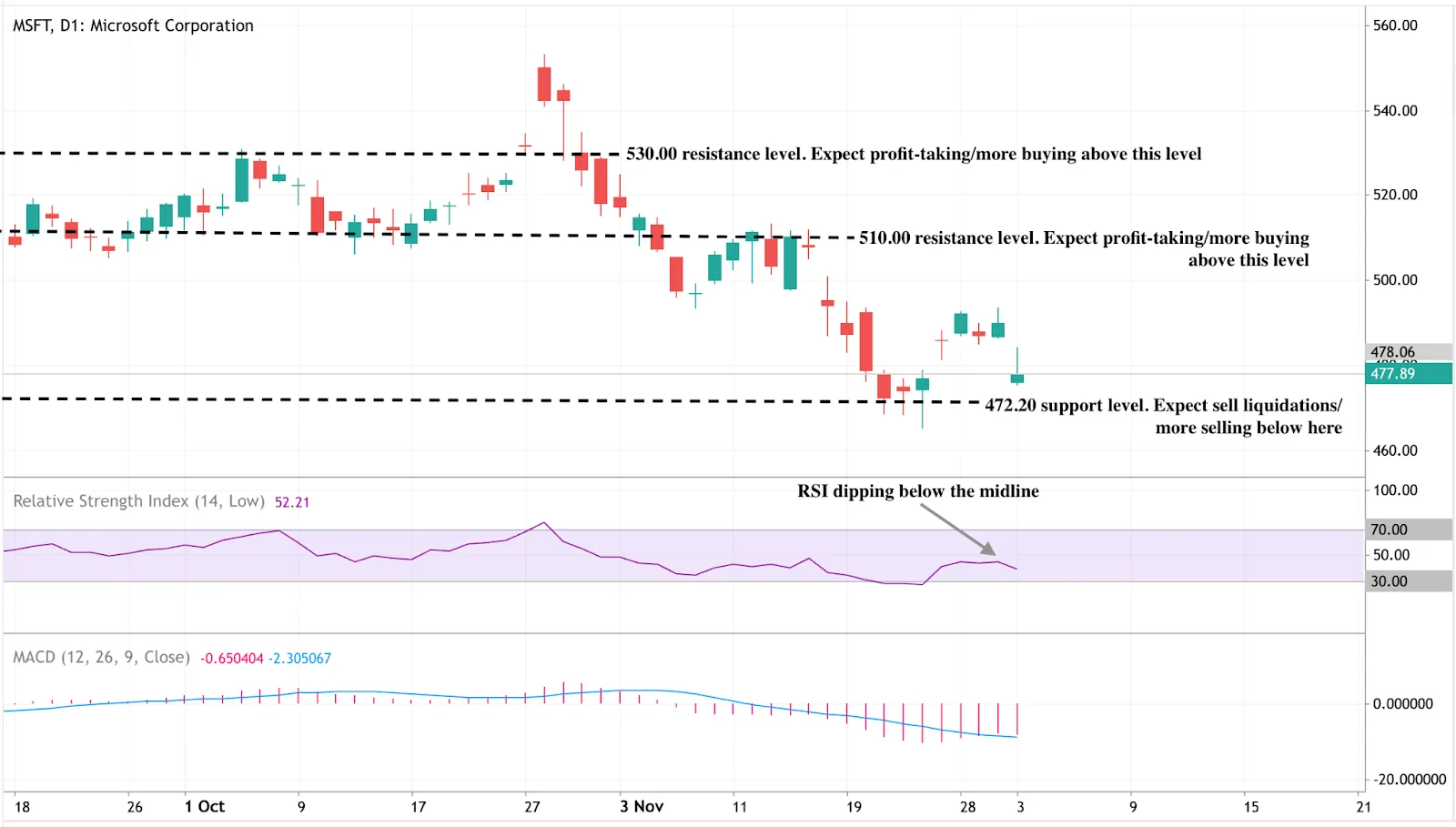
At the time of writing, Microsoft (MSFT) is trading near $478 as it attempts to stabilise after a recent pullback. Support sits close to $472.20; a clear break below this level could accelerate selling and expose deeper downside targets. On the upside, resistance lies at $510.00 and $530.00, areas where traders may consider taking potential profits unless momentum is strong enough to force a breakout.
Recent price action shows consolidation after the sharp early-November reversal. Candlesticks reflect uncertainty as the market weighs macro data and wider tech sentiment. The RSI hovers near 52, suggesting softening momentum, while the MACD histogram remains slightly negative but is showing signs of improvement. Altogether, the setup implies a market awaiting a catalyst.
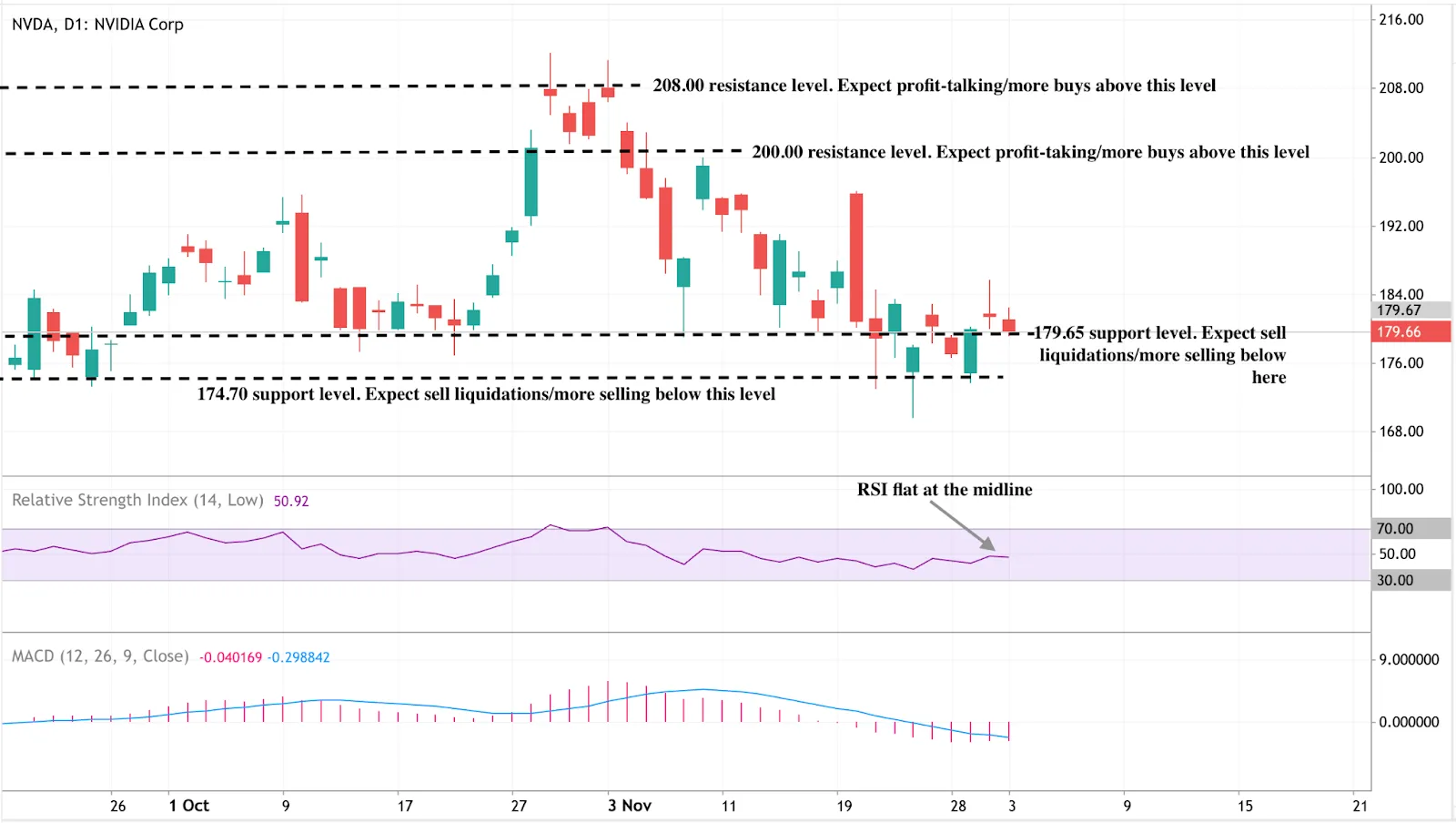
Nvidia (NVDA) begins the session around $179.66, holding just above immediate support at $179.65. A break beneath this zone could trigger selling pressure and open the path to $174.70. Resistance sits at $200.00 and $208.00, both areas where traders may look to trim exposure unless strong buying pushes the stock higher.
The chart reflects a period of tight consolidation, with volatility narrowing as NVDA waits for a clear directional cue-likely from incoming macro data or shifts in tech sentiment. The RSI remains neutral near 51, while the MACD histogram shows gradually shortening negative bars, hinting that bearish momentum may be fading. NVDA appears well-positioned for a breakout once fresh catalysts emerge.
Disclaimer:
The performance figures quoted are not a guarantee of future performance.
FAQs
Why is Microsoft pushing Copilot into every Microsoft 365 tier?
How does Nvidia’s business model differ from Microsoft’s?
What triggered the recent wobble in AI stocks?
Is the Nvidia–Palantir partnership significant?
Should consumers worry about subscription inflation from AI bundling?


