Contents
Article
Why defence stocks have returned to the spotlight after Trump’s budget shock
January 9, 2026
Article
Why defence stocks have returned to the spotlight after Trump’s budget shock
January 9, 2026
Article
Why defence stocks have returned to the spotlight after Trump’s budget shock
January 9, 2026

Defence stocks have pushed back into focus after President Donald Trump hinted at a sharp escalation in US military spending. In a social media post that unsettled markets, Trump outlined a potential $1.5 trillion defence budget for 2027, a sizeable leap from the roughly $901 billion earmarked for 2026. The scale of the proposal sparked an abrupt after-hours rebound in key US defence names, reversing declines seen earlier in the session.
Lockheed Martin rallied 7%, while Northrop Grumman advanced 4%, reinforcing how closely defence share prices track political direction. With investors already wary of elevated valuations across technology stocks, Trump’s comments have pulled attention back toward defence as a trade shaped by policy decisions and global security risks.
What’s driving defence stocks?
The initial trigger was Trump’s renewed push to build what he labelled a “Dream Military”, supported by a materially larger defence budget. The proposed increase is not incremental. A move toward $1.5 trillion would mark one of the most aggressive peacetime expansions in US military spending, significantly altering long-term revenue expectations for contractors tied to government procurement.
Earlier in the day, sentiment had turned sharply negative after Trump criticised defence firms for prioritising dividends and share buybacks over investment in production capacity. Those remarks briefly raised concerns around tighter oversight and reduced flexibility on capital returns. The subsequent rebound highlighted that, for investors, spending commitments still outweigh governance concerns when multi-year contracts and budget visibility come into play.
Beyond US politics, defence demand remains underpinned by broader structural forces. European rearmament continues, NATO members face mounting pressure to lift military budgets, and ongoing conflicts in Ukraine and the Middle East have reinforced the strategic importance of defence readiness. Together, these dynamics have helped insulate defence stocks from wider market volatility.
Why it matters
Defence stocks occupy a distinct position within equity markets. Unlike most cyclical sectors, their revenues depend heavily on government spending decisions rather than consumer demand or borrowing conditions. When defence budgets expand, earnings visibility improves rapidly, even though contract execution may unfold over several years.
This explains why defence shares often behave more like political instruments than industrial companies. As one US defence strategist noted, markets tend to price the sector on policy momentum rather than balance-sheet metrics. Once budget direction becomes clearer, valuations can be adjusted quickly.
For investors, this creates a landscape shaped by both opportunity and risk. Sudden shifts in political tone can drive sharp price swings, making positioning and timing more critical than traditional valuation frameworks.
Impact on markets and sector rotation
The renewed focus on defence coincides with growing signs of fatigue in the semiconductor and AI-led rally that dominated early 2026. Chipmakers powered the market higher at the start of the year, but rising valuation concerns and questions around earnings sustainability have prompted a gradual shift in capital allocation. Defence stocks appear to be among the beneficiaries of that rotation, supported by clearer fiscal tailwinds.
Recent performance reflects the change. Lockheed Martin is up close to 8% year to date, while Halliburton has gained 12%, benefiting from exposure to both defence-related demand and the broader energy cycle.
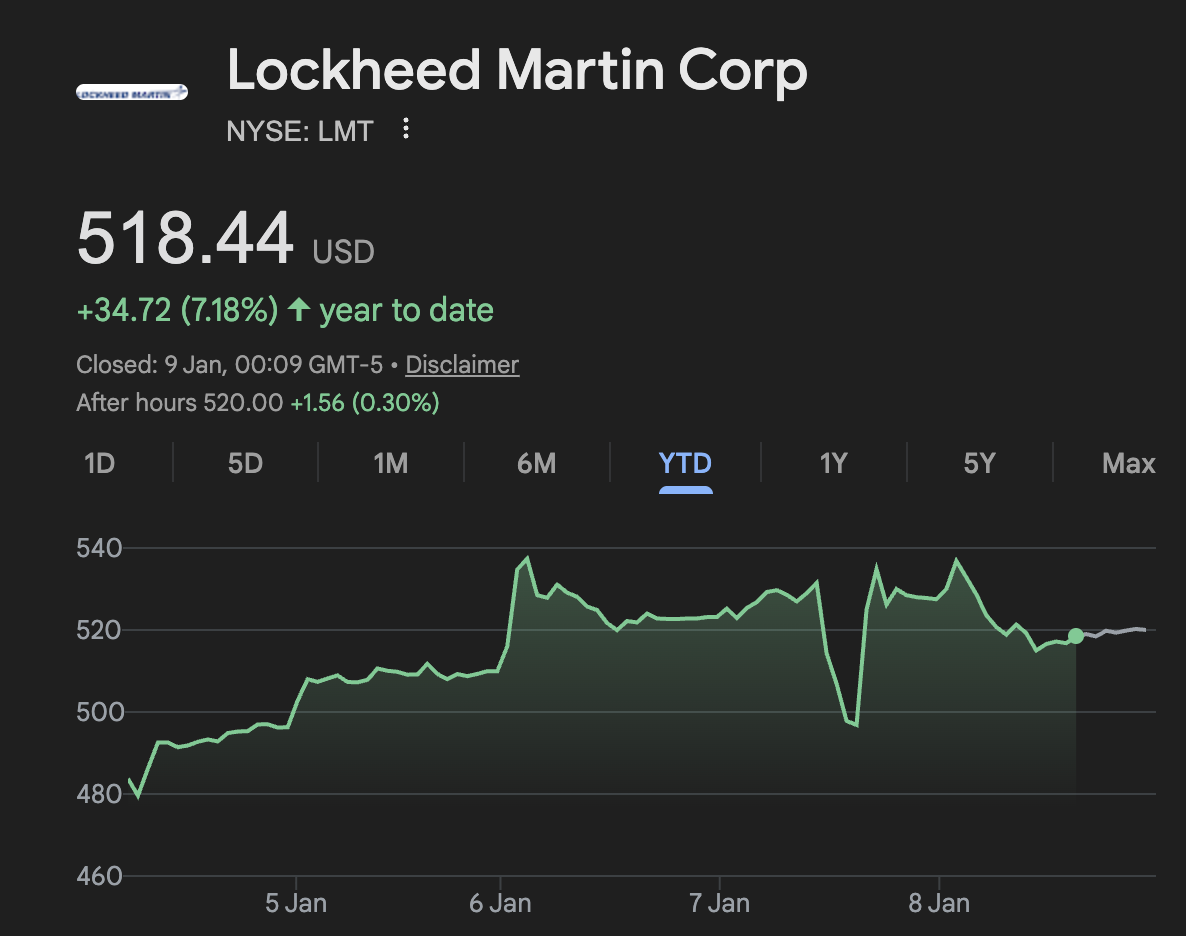
In Europe, defence leaders such as BAE Systems and Rheinmetall have also posted solid gains, driven by persistent geopolitical developments. Options markets suggest investors are bracing for larger price swings ahead. Implied volatility has climbed, echoing early 2022 when escalating tensions triggered sharp rallies in European defence stocks. Rheinmetall’s 30% surge in a single week following the Ukraine invasion remains a clear reminder of how quickly the sector can reprice.
Expert outlook
Looking ahead, defence stocks face a familiar balance between optimism and uncertainty. Trump’s proposal still requires political backing, and negotiations could water down the headline figure. Even so, a partial increase would still represent a meaningful shift in US defence priorities compared with recent years.
Strategists expect defence to remain a headline-driven theme in the near term. Some see volatility as an opportunity, while others caution against chasing rallies without clearer confirmation on funding and policy follow-through. The prevailing tone is constructive, but selective.
Key developments to monitor include responses from Congress, updates on NATO defence commitments, and further detail on how tariff revenues might be used to support higher military spending. Until greater clarity emerges, defence stocks are likely to remain highly sensitive to policy headlines.
Key takeaway
Defence stocks have moved back into focus as Trump’s budget proposal reshapes expectations around future military spending. The speed of the rebound highlights how tightly the sector remains linked to political direction rather than short-term earnings trends. With signs of rotation away from AI-led trades, defence could stay a prominent market theme through 2026. Investors should watch policy signals and geopolitical developments closely.
Lockheed Martin technical outlook
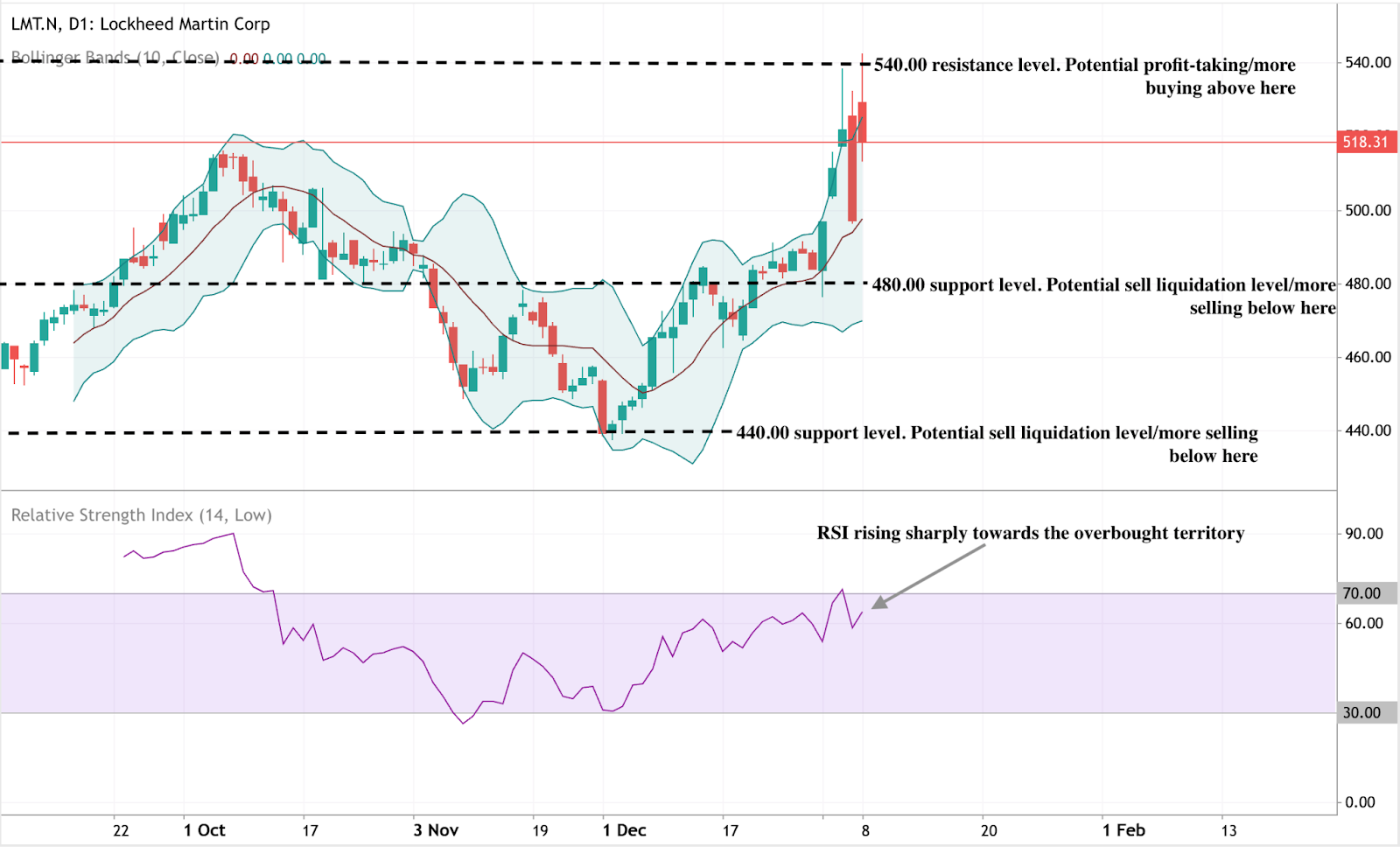
Lockheed Martin has rebounded strongly from the $480 support area, briefly testing resistance near $540 before encountering heavy selling pressure. The rally confirms strong upside momentum, but the swift pullback from resistance suggests the stock may be entering a consolidation phase rather than extending immediately higher. Momentum indicators reflect this tension, with the RSI pushing toward overbought levels, signalling strong demand alongside rising short-term exhaustion risk.
From a structural standpoint, holding above $480 preserves the broader bullish bias. A deeper breakdown would only come into focus below $440. On the upside, a sustained move above $540 would be required to confirm trend continuation, while sideways price action would be consistent with the market digesting recent gains.
Disclaimer:
The performance figures quoted refer to the past, and past performance is not a guarantee of future performance or a reliable guide to future performance.
FAQs
Why are defence stocks rising now?
Why did defence stocks fall earlier in the day?
Are defence stocks replacing AI stocks as a market theme?
Which defence stocks are in focus?
Is the defence rally sustainable?


