Contents
Article
Dollar pressure intensifies: Can USDJPY break higher as EURUSD holds?
December 2, 2025
Article
Dollar pressure intensifies: Can USDJPY break higher as EURUSD holds?
December 2, 2025
Article
Dollar pressure intensifies: Can USDJPY break higher as EURUSD holds?
December 2, 2025
.webp)
The dollar finds itself caught in a tightening squeeze across the FX landscape, forcing traders to reassess their positioning as year-end approaches. USDJPY has pushed higher from a two-week low near 154.65, even as expectations grow that the Bank of Japan could deliver a rate hike in December - a shift that has sent two-year JGB yields to 1% for the first time since 2008.
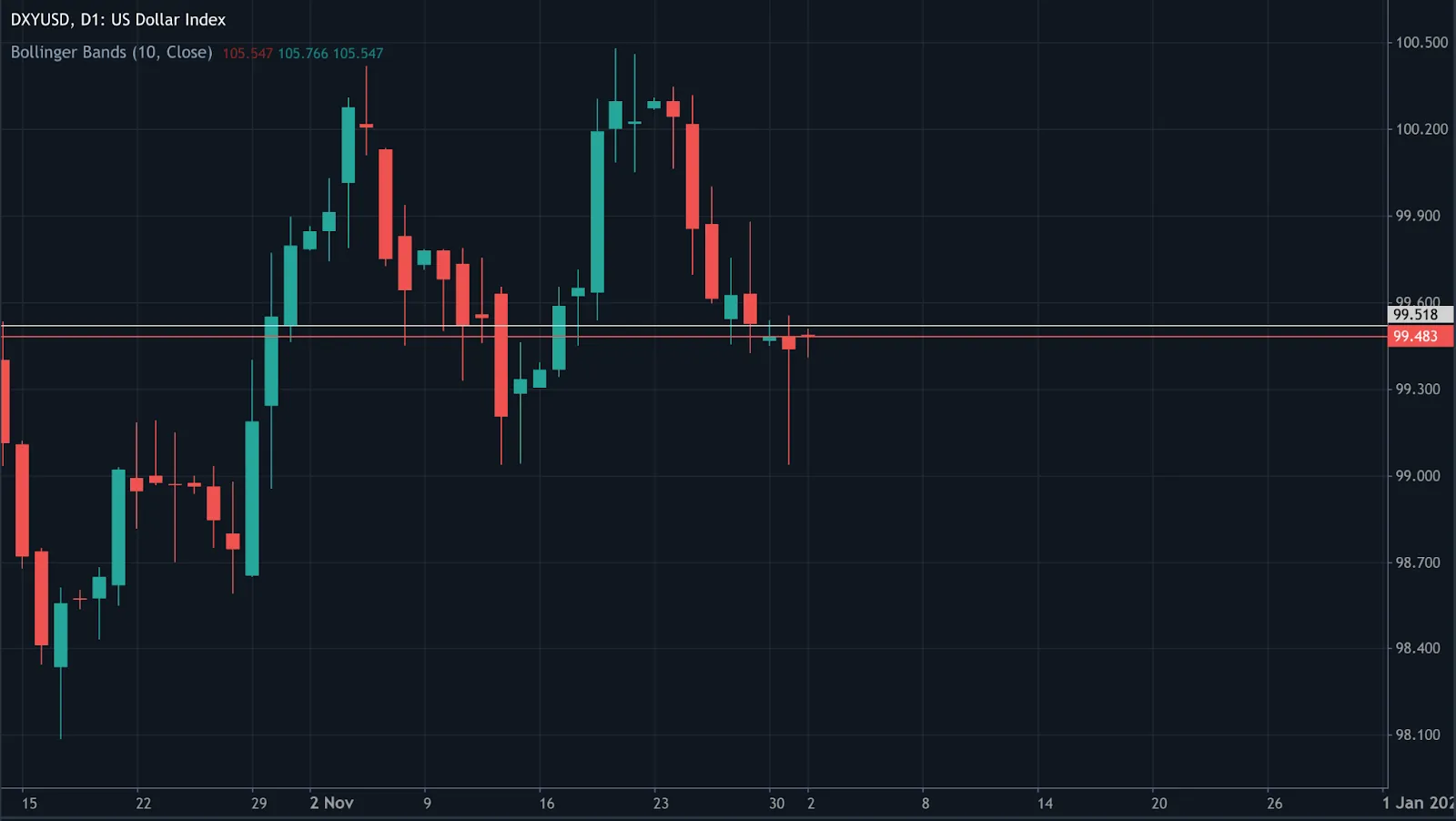
EURUSD, meanwhile, has held its ground for now, with the dollar index lingering near 99.48. A shift in sentiment could still send it toward the 100.50 zone, leaving the euro vulnerable despite its recent stability. This divergence - a yen supported by policy momentum and a euro balancing on broader dollar flows - places the greenback at the centre of a delicate equilibrium.
With the Fed’s December decision drawing near and Japan signalling a slow but meaningful move toward normalisation, the next stretch of trading will determine whether USDJPY can maintain its footing above 155 or whether EURUSD starts shaping the market narrative into year-end.
What’s driving the two pairs’ moves?
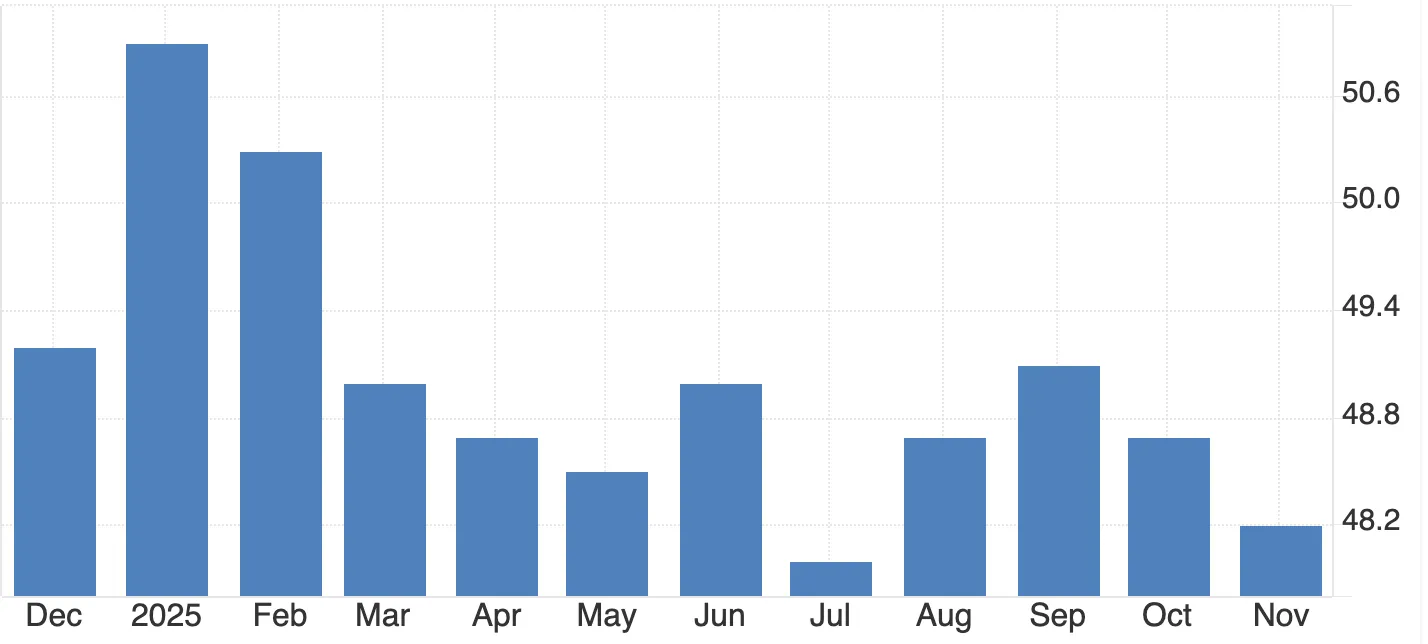
Dollar momentum is being pulled in opposite directions by competing macro signals. On one side, softer US data continues to weigh on yields - with the ISM Manufacturing PMI dropping to 48.2 and December rate-cut expectations sitting around 87.2%.
Under normal circumstances, this combination would place downward pressure on USDJPY. But a stronger tone in Asian equities has dampened demand for the yen as a safe haven, blunting the impact of firmer BoJ tightening expectations. That dynamic has allowed USDJPY to climb back toward 156 even as Japan telegraphs a more hawkish stance than at any point in recent years.
EURUSD has remained resilient above 1.16 despite the broader pressure on the dollar. Traders are keeping a close eye on whether the dollar index can anchor itself above 99.40 - a level that would expose EURUSD to a deeper pullback toward 1.1550 if momentum turns.
Seasonality typically favours the euro in early and late December, though its influence tends to fade when shifting yield differentials and policy divergence dominate the landscape.
Why it matters
The dollar squeeze has consequences well beyond speculative trading desks. Global corporates often adjust their hedges heading into year-end, and abrupt shifts in USDJPY or EURUSD can force rapid recalibration. When USDJPY trades between 155-158 and EURUSD edges toward 1.1550, even small moves can trigger mechanical hedging flows that intensify volatility. As one Tokyo strategist told Bloomberg, “fundamentals and flows are clashing at the worst possible moment,” underscoring how thin liquidity heightens every fluctuation.
For traders, the stakes are even greater. A BoJ rate hike would mark a major departure from its decades-long policy stance and could send USDJPY sharply lower. A softer Fed stance, on the other hand, might weaken the dollar more broadly and fuel a sharper EURUSD rebound. With both paths plausible, markets have become extremely reactive to US and Japanese data releases.
Impact on markets and traders
Yield differentials remain the backbone of price action across both currency pairs. Japan’s 10-year government bond yield - now at a 17-year high - has significantly narrowed its spread against US Treasuries.
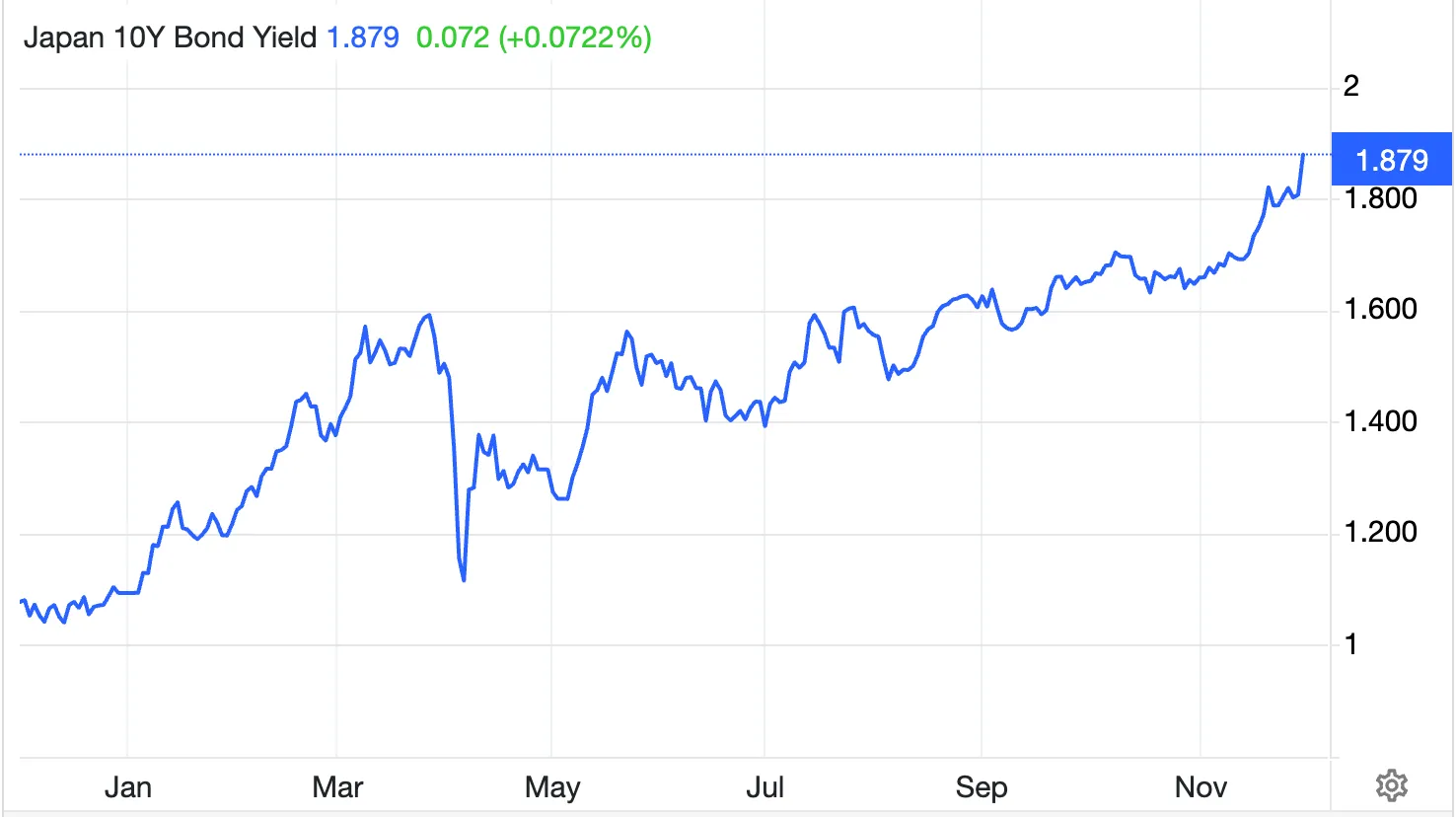
This narrowing erodes one of USDJPY’s long-time supports, explaining why the pair struggled to sustain moves above 158 earlier in the quarter. Many traders now view the 156 level as a critical pivot point that will determine whether bullish momentum can be sustained.
EURUSD faces its own structural constraints. While rising German yields would normally support the euro, the pair continues to respond more directly to shifts in the dollar index. Analysts note that a decisive break below 1.16 raises the likelihood of a slide toward 1.1550 - with brief spikes toward 1.1500 possible in thin liquidity. Although EURUSD typically enjoys seasonal strength between 22-27 December, those patterns weaken substantially when major central bank decisions fall in the same window.
Expert outlook
Analysts remain divided on how the dollar squeeze will play out. Some expect USDJPY to soften into year-end if the BoJ reinforces its message that inflation is on track toward the 2% target. Governor Kazuo Ueda has already suggested that the likelihood of meeting that objective has improved, and markets now assign roughly an 80% probability to a December hike. If the BoJ delivers, USDJPY could slide quickly toward 152, with the prospect of intervention helping drive it even lower in a stressed scenario.
EURUSD’s trajectory is governed largely by the Fed. A December cut appears almost fully priced in, leaving the dollar exposed to a stronger tone from policymakers. Should the Fed push back against expectations of an aggressive easing cycle, the dollar may bounce, lifting EURUSD back toward 1.1650 before sellers return. The unknown lies in upcoming PCE readings - and whether they cause markets to recalibrate expectations once again.
USDJPY technical insights
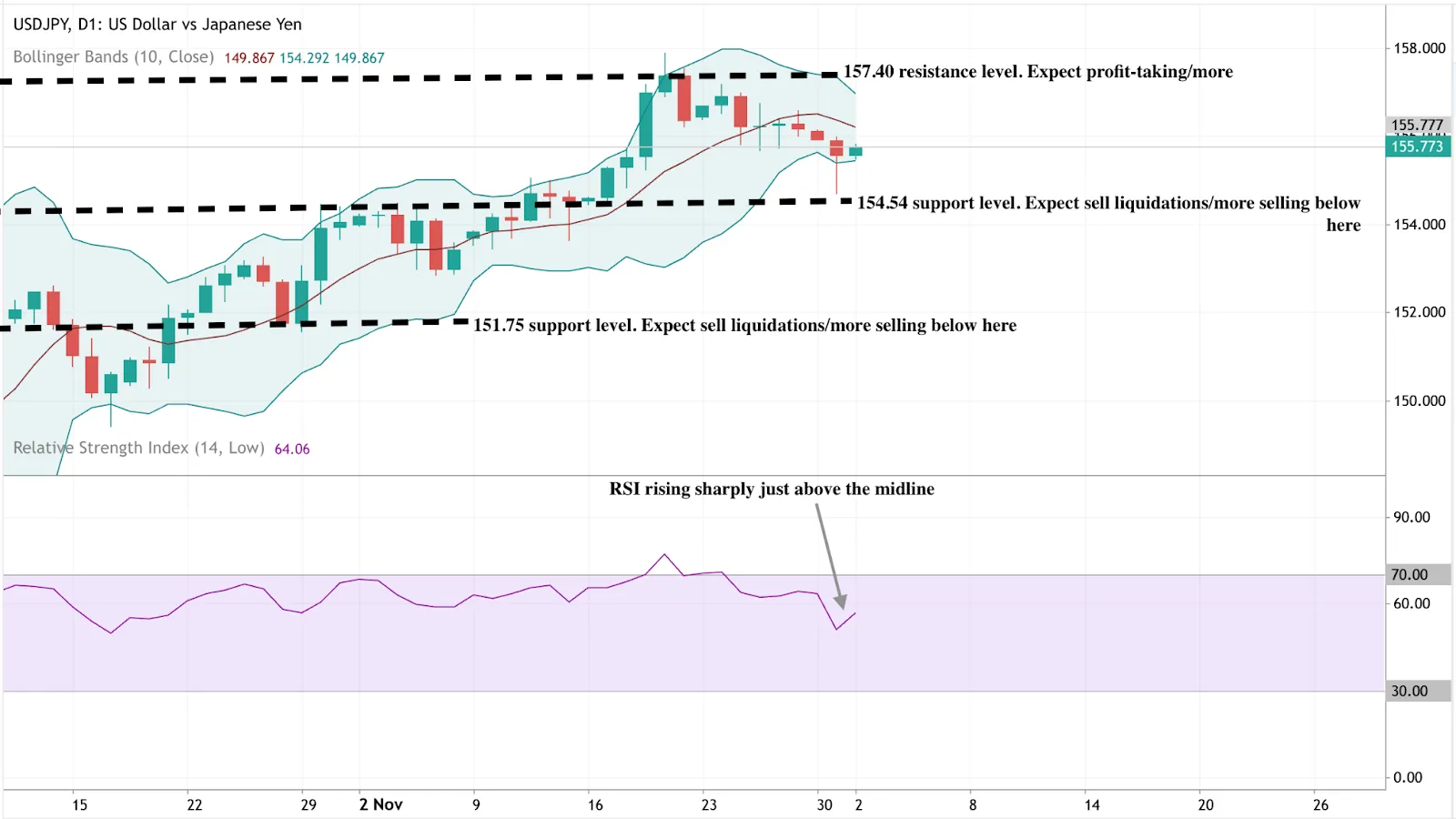
At the time of writing, USD/JPY trades around 155.77 as it attempts to stabilise after a brief retracement. Resistance near 157.40 remains a key battleground where buyers have struggled to gain traction. A clear break above this zone could unlock a fresh bullish extension. Immediate support sits at 154.54 and then 151.75; falling below these levels would suggest weakening momentum and could trigger forced selling through the lower Bollinger band.
Despite the pullback, the pair remains in the upper half of the Bollinger Band structure, indicating that the broader uptrend is still intact. Consolidation is likely until a catalyst - such as a notable shift in US yields or fresh BoJ commentary - pushes the pair decisively in one direction. The RSI has rebounded to 64, showing improving bullish momentum without reaching overbought conditions.
EURUSD technical insights
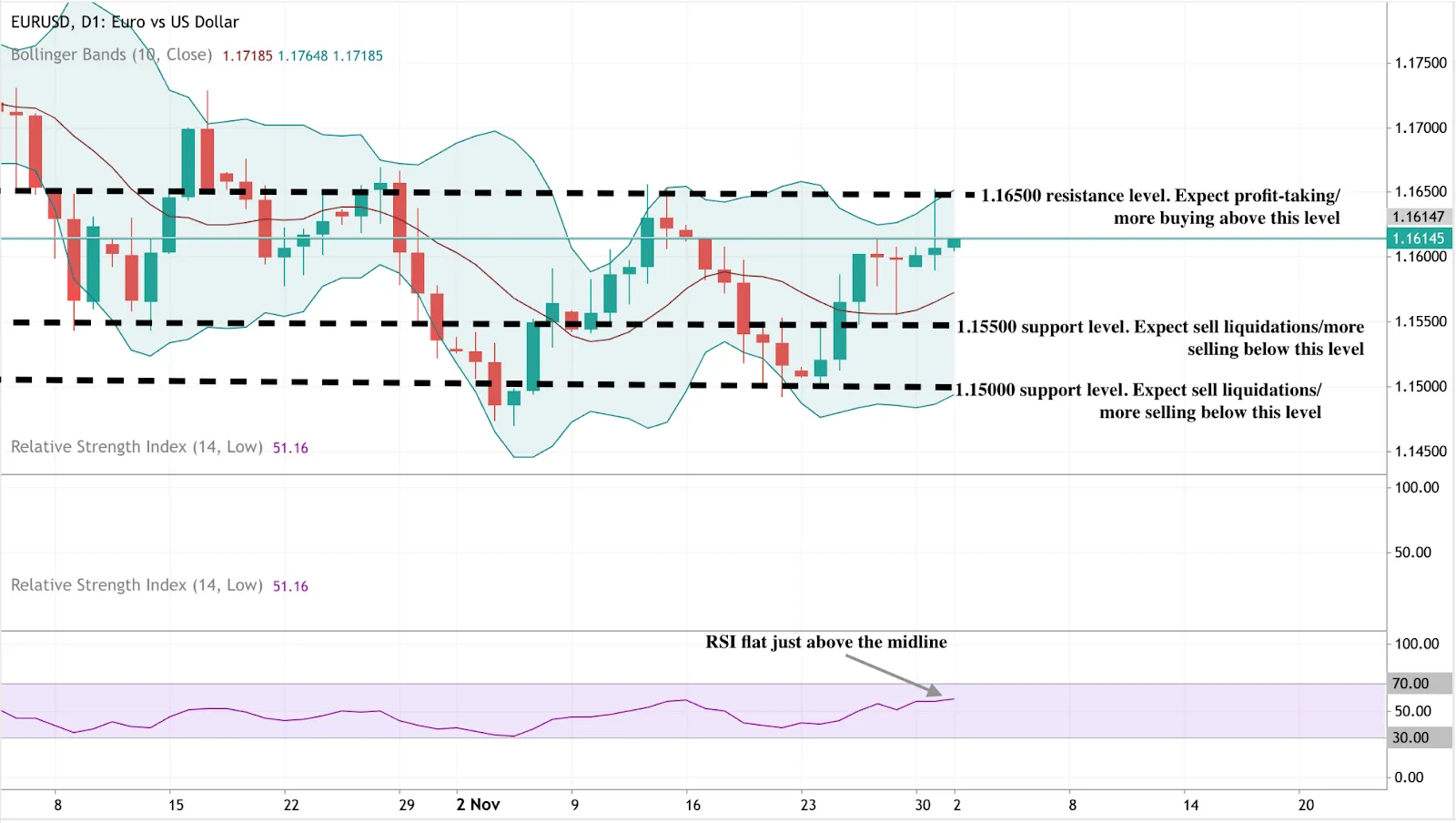
EUR/USD trades near 1.1614, inching toward the key 1.1650 barrier that has repeatedly halted upside attempts. A clean break above this zone would signal a strengthening bullish bias, while failure to clear it could invite renewed selling pressure. Initial support at 1.1550 and deeper support at 1.1500 remain levels where liquidity gaps may trigger further downside.
The pair continues to move within the upper half of its Bollinger Band channel, indicating a mild bullish tendency but not a confirmed trend shift. EURUSD remains in a broad consolidation, suggesting that macro catalysts - such as US labour data or ECB guidance - may be needed for a decisive breakout. The RSI sits just above 51, reflecting neutral-to-slightly-positive momentum and leaving room for further upside if resistance gives way.
Key takeaway
The dollar remains under pressure from both directions as USDJPY responds to speculation about the BoJ's tightening and EURUSD reflects broader shifts in dollar positioning. Yield moves and central-bank decisions over the coming weeks will determine which currency pair takes control of the market narrative. With year-end liquidity thinning, traders should expect sharper swings and faster reactions. The next phase in USDJPY and EURUSD could set the pace for early 2026 trading.
Disclaimer:
The performance figures quoted are not a guarantee of future performance.
FAQs
Why is USDJPY rising despite expectations of a BoJ rate hike?
What’s driving EURUSD above 1.16?
Could Japan intervene again if USDJPY climbs toward 160?
How significant are December seasonal patterns this year?
What data releases could move the dollar next?


