Contents
Article
“No one’s above the law”: Powell hardens his stance as pressure from the White House intensifies
January 12, 2026
Article
“No one’s above the law”: Powell hardens his stance as pressure from the White House intensifies
January 12, 2026
Article
“No one’s above the law”: Powell hardens his stance as pressure from the White House intensifies
January 12, 2026

Jerome Powell has long been associated with restraint. As chair of the world’s most influential central bank, his public remarks are typically calibrated to reassure markets rather than provoke them. That approach shifted noticeably on Sunday, 11 January.
In a rare and direct statement, Powell accused the Trump administration of engaging in what he described as “pretextual” legal action. The comments marked an unusually public escalation in tensions between the Federal Reserve and the White House.
According to Bloomberg, the dispute extends well beyond a $2.5 billion renovation project. At its core lies a broader question of independence - and whether the central bank can continue to operate without political influence. For markets, the long-standing assumption of a dependable “Fed Put” has given way to unease over what some are now calling a “Fed Probe”.
The pretext: A $2.5 billion renovation
At face value, the conflict centres on the modernisation of the Federal Reserve’s Washington D.C. headquarters. On Friday, the Department of Justice issued grand jury subpoenas linked to the decade-long renovation project.
Powell has rejected the framing of the investigation as routine oversight. In his statement, he described the inquiry as a pretext designed to exert pressure on monetary policy decisions. Reuters reported that Powell views the threat of criminal charges as a consequence of the Fed setting interest rates based on its assessment of economic conditions, rather than political preference.
The remarks underscore how sharply the disagreement has moved beyond the scope of the renovation itself.
Trump’s populist push: lighting the fuse
The latest escalation followed a week in which President Trump intensified populist economic messaging, seemingly aimed at supporting markets in an election year. Instead, the announcements added to investor unease.
Among the measures floated or directed:
- Instructing representatives to purchase mortgage-backed securities to reduce borrowing costs
- Restricting institutional investors from buying single-family homes
- Proposing a one-year 10% cap on credit-card interest rates, without enforcement details
For institutional investors, the combination of unconventional policy signals and renewed pressure on the Federal Reserve raised concerns about political involvement in monetary and financial systems.
As one strategist observed privately, efforts to boost markets through pressure on independent institutions can have the opposite effect, particularly for long-term capital.
Market mayhem: Gold soars, dollar dips
Financial markets reacted quickly. Political and institutional risk moved to the forefront of pricing decisions.
- Gold’s historic run: Spot gold climbed to a record $4,563.61 per ounce, according to The Straits Times, reflecting a shift toward traditional safe-haven assets.
- Greenback under fire: The US dollar index slipped 0.3% to 98.899, Reuters reported, as confidence in policy independence appeared to weaken.
- Futures in the red: US stock futures declined, with the Nasdaq-100 down 0.6% in early trading as markets adjusted to heightened uncertainty.
The moves highlighted how sensitive global markets remain to questions around institutional credibility.
Why gold is surging
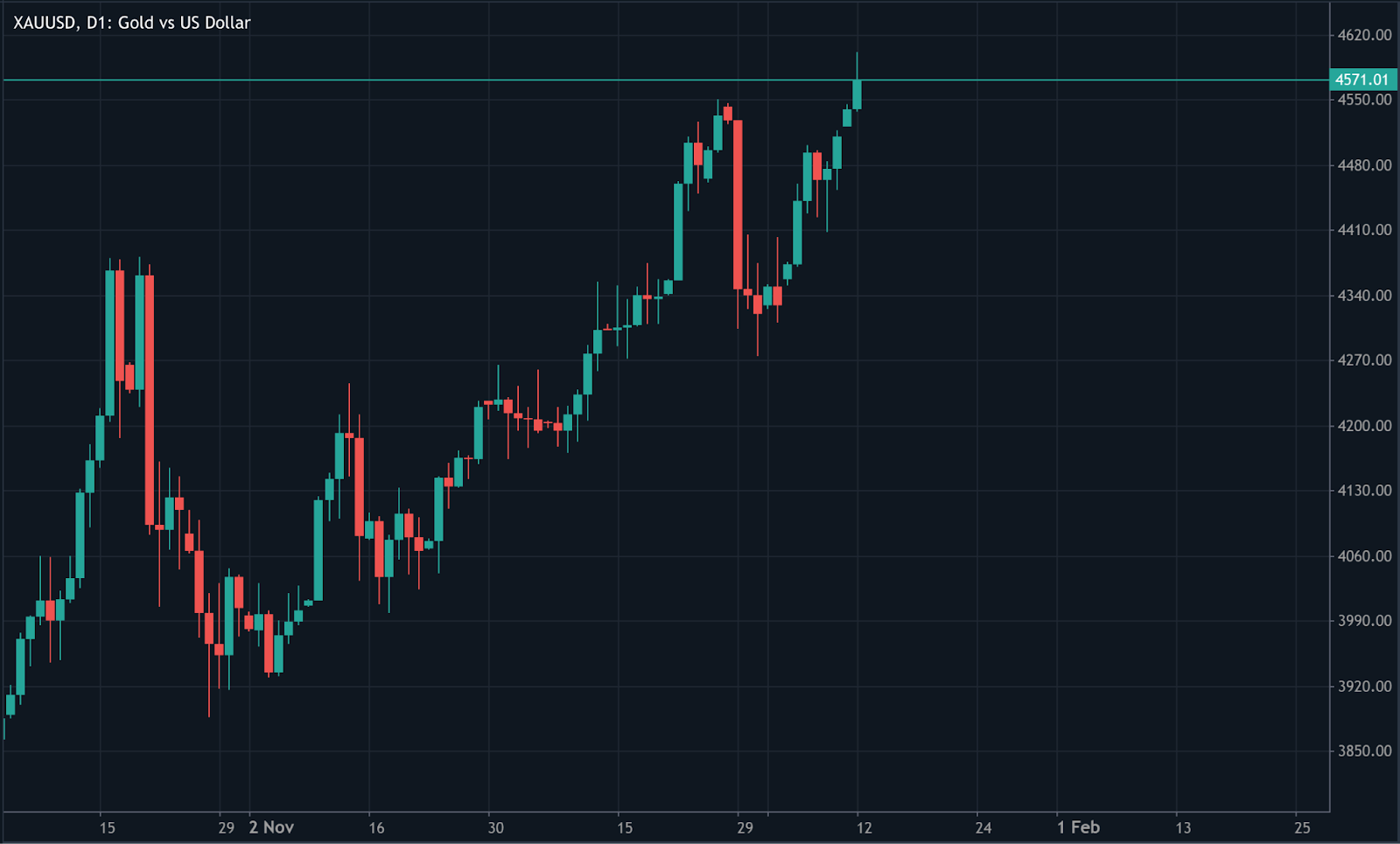
Analysts suggest gold’s recent strength reflects more than technical factors. Confidence and risk perception have taken centre stage.
Despite elevated price levels, demand has remained firm amid a growing list of macro concerns:
- Political pressure on monetary policy
- Rising geopolitical tensions, including developments involving Iran and increased Arctic activity by European nations
- Uncertainty surrounding the timing of future interest-rate adjustments ahead of key US inflation data
Historically, gold has drawn attention during periods when institutional stability is questioned, a pattern that has resurfaced in recent sessions.
Silver: same tailwinds, sharper edges
Silver has moved in the same direction as gold, though with more pronounced fluctuations.
Its price behaviour reflects a dual role. Alongside safe-haven demand, silver is influenced by industrial use, which links it to broader economic narratives. This combination can amplify price movements during periods of uncertainty.
Analysts note that silver often experiences sharper short-term swings, particularly when speculative interest increases or fades, distinguishing it from gold’s typically steadier profile.
The stakes: Autonomy vs. allegiance
What began as a dispute over spending has evolved into a broader institutional test.
Maybank strategist Fiona Lim noted in The Straits Times that sustained pressure on the Fed could signal an effort to reshape leadership when Powell’s term ends in May. That prospect has added another layer of uncertainty for markets.
Ray Attrill, head of FX strategy at National Australia Bank, told Reuters that Powell’s public response suggests a shift in approach. By addressing the issue directly, Powell appears to be placing emphasis on market reaction as a counterweight to political pressure.
Key takeaway
Analysts say the investment landscape has shifted. The Federal Reserve is no longer focused solely on managing inflation and employment, but also on preserving its independence.
Saxo Markets analysts have described the situation as an unusually open confrontation between the Fed and the White House, one that has introduced levels of volatility rarely seen in recent decades. How the standoff resolves remains uncertain, but its impact is already being felt across global markets.
Gold technical outlook
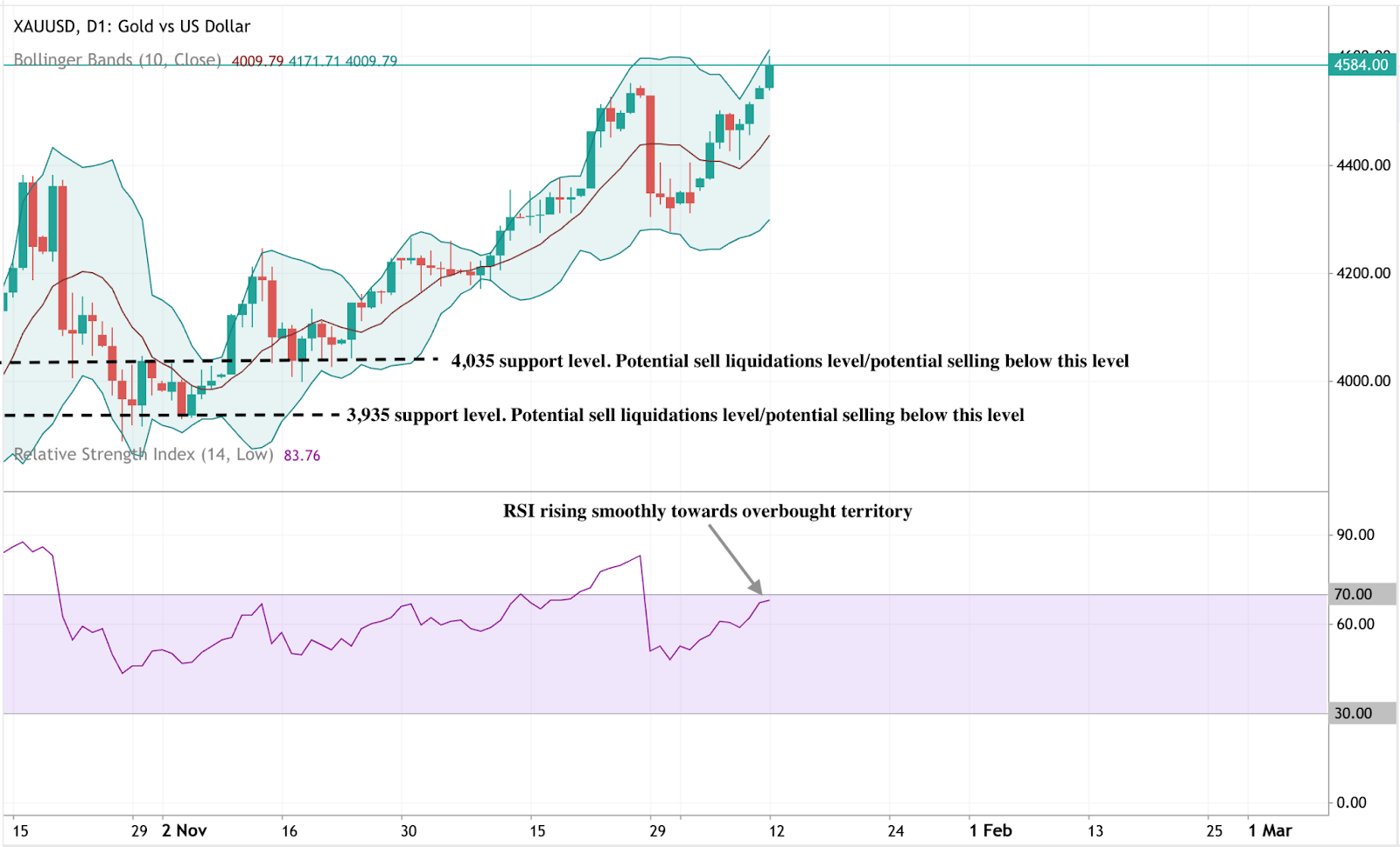
Gold is extending its bullish advance, pushing into fresh highs near the upper Bollinger Band and reinforcing the underlying trend’s strength. The rally remains well-supported by momentum indicators, with the Relative Strength Index rising smoothly toward overbought territory, signalling strong buying pressure rather than an exhausted move.
While the pace of gains suggests the risk of near-term profit-taking is increasing, the broader structure remains firmly constructive. As long as price holds above the $4,035 support zone - and more importantly above $3,935 - any pullback could be corrective rather than trend-breaking.
Sustained strength above current levels could maintain the upside bias, while consolidation would allow momentum to reset without undermining the broader bullish narrative. There is always a risk that price action will surprise and do the unexpected; traders should be cautious. You can monitor these levels with a Deriv MT5 account.
Disclaimer:
The performance figures quoted refer to the past, and past performance is not a guarantee of future performance or a reliable guide to future performance.
FAQs
Why is Jerome Powell clashing with the Trump administration?
What triggered the investigation into the Federal Reserve?
Why did gold and silver jump on the news?
Why did the US dollar and stocks fall?
Is this good for gold and silver going forward?


