Contents
Article
Gold retreats as US jobless claims jump: Warning sign or distortion?
February 6, 2026
Article
Gold retreats as US jobless claims jump: Warning sign or distortion?
February 6, 2026
Article
Gold retreats as US jobless claims jump: Warning sign or distortion?
February 6, 2026

Gold prices eased after US jobless claims climbed to 231,000, their highest reading in almost two months and well above market expectations. Ordinarily, signs of labour market weakness would support gold’s defensive appeal. Instead, spot prices slipped more than 2% on the day, underscoring how positioning and policy expectations continue to outweigh headline data.
The reaction matters because employment indicators remain central to the Federal Reserve’s policy framework. With job openings now sitting at five-year lows and hiring momentum still muted, investors are reassessing whether gold is pausing after a powerful rally or failing to price in a more fragile labour backdrop.
What’s driving Gold and US jobless claims?
The increase in initial jobless claims was notable for its size but questionable in its clarity. Claims rose by 22,000 in a single week, marking the largest weekly gain since early December and landing far above economists’ forecasts of 212,000, according to official data.
Weather played a major role. Severe winter storms disrupted employment across several states, with sharp increases reported in Pennsylvania, New York, New Jersey, and parts of the Midwest. Seasonal adjustment challenges around the turn of the year further distorted the data, making it difficult to isolate an underlying trend from short-term noise.
Still, beyond weekly volatility, labour demand is clearly cooling. Job openings fell to 6.54 million in December, the lowest level since September 2020, while November figures were revised meaningfully lower.
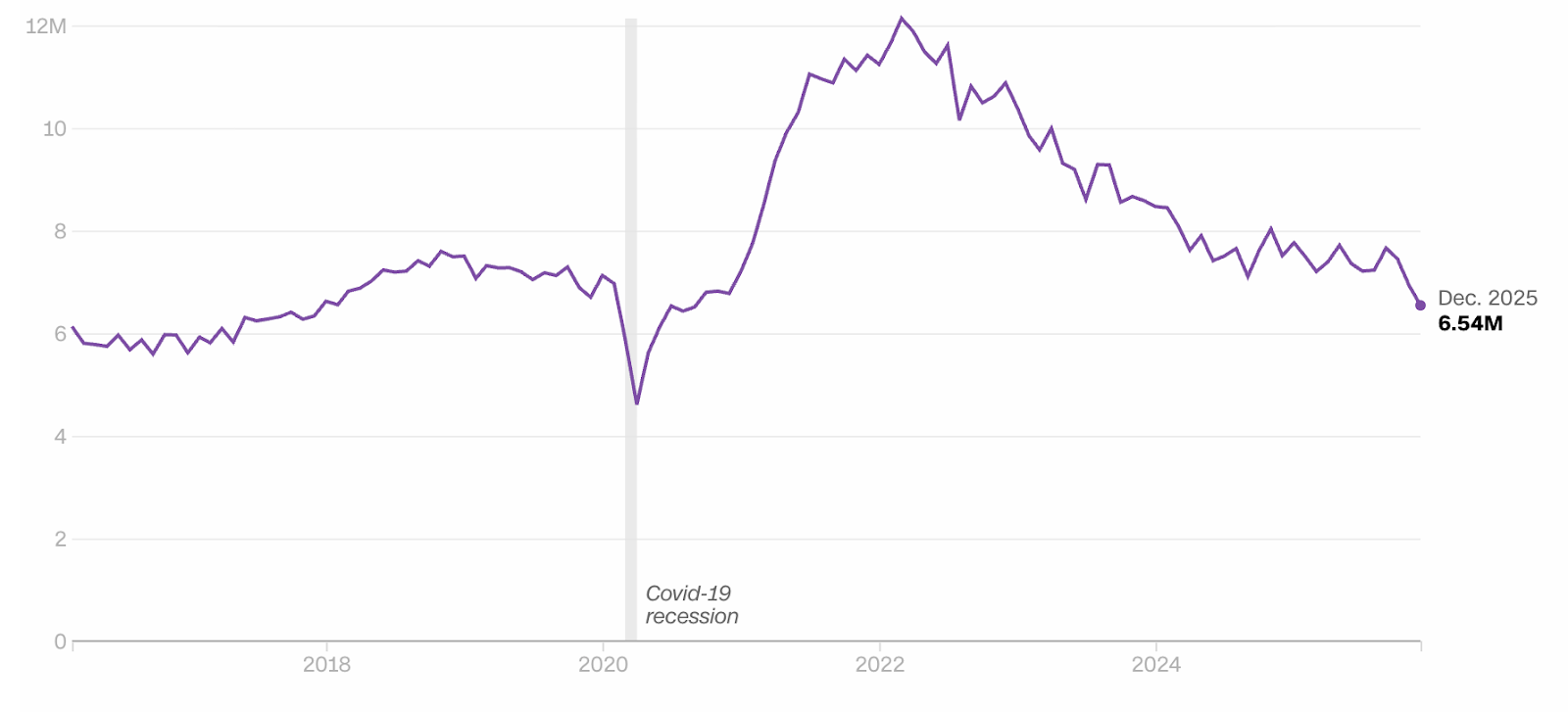
Hiring ticked higher but remained historically subdued, reinforcing the view that the labour market is slowing through reduced churn rather than mass layoffs. This “low-hire, low-fire” dynamic points to a gradual easing of momentum rather than an abrupt downturn - a distinction markets are still trying to price correctly.
Why it matters
Labour market signals shape expectations around interest rates, which helps explain gold’s restrained response. While initial claims surprised to the upside, continuing claims remain relatively contained, and the four-week average continues to suggest stability rather than stress.
As Carl Weinberg of High Frequency Economics observed, “There is no sign of the kind of layoffs we expect to see in a weakening labour market during the early days of a recession.” That assessment limits the urgency for defensive positioning.
From a policy perspective, the data does little to force the Federal Reserve’s hand. Oxford Economics’ Bernard Yaros highlighted that weather effects and data irregularities reduce the informational value of a single report, noting that nothing so far has altered the Fed’s near-term thinking. Without a shift in rate expectations, gold lacks the macro trigger that typically drives sustained upside.
Impact on Gold markets
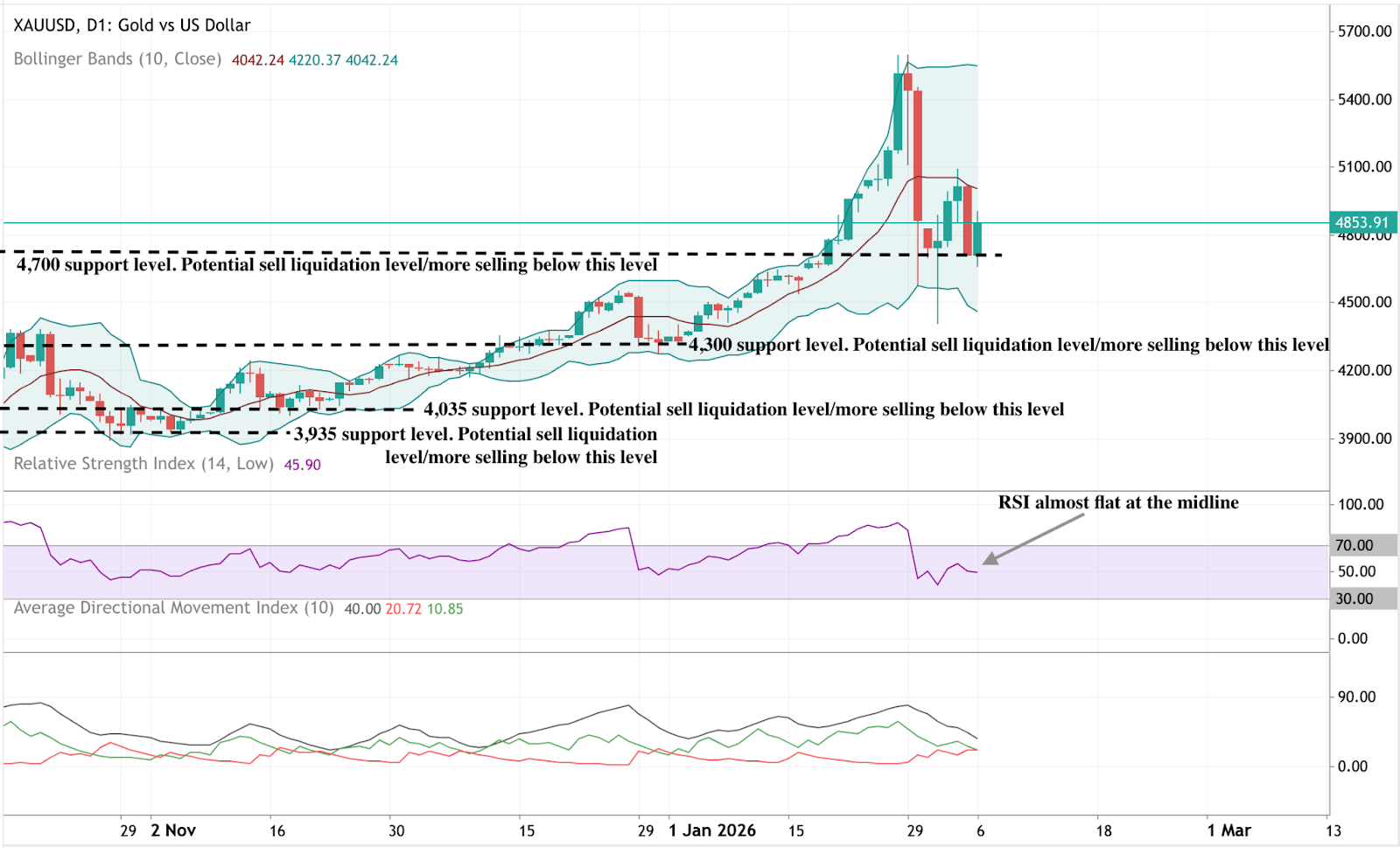
Market participants largely viewed gold’s pullback as a function of positioning rather than deteriorating fundamentals. Despite softer labour data, prices hovered near session lows around $4,860 per ounce, signalling that dollar firmness and rate stability remained the dominant influences.
At the same time, the combination of falling job openings and delayed payroll data injects an element of uncertainty that gold markets rarely ignore indefinitely. If upcoming employment releases confirm a broader slowdown - rather than temporary weather disruption - the current retracement could prove short-lived.
Historically, gold responds more decisively once trends are confirmed, particularly when confidence in monetary policy guidance erodes. For now, the market appears to be waiting for that confirmation.
Expert outlook
Most economists continue to expect a gradual improvement in labour conditions through 2026 as lower interest rates support demand, reinforced by the impact of recent tax measures. That scenario tempers near-term upside for gold, as it argues against aggressive policy easing in the months ahead.
However, risks remain skewed. Job openings are declining faster than unemployment is rising, a pattern that has often preceded more visible labour weakness. With January’s non-farm payrolls report delayed by the government shutdown, gold traders face a temporary data gap that could amplify volatility once fresh information arrives. The next clean employment signal may carry outsized weight.
Key takeaway
US jobless claims have risen sharply, but the message remains blurred by weather disruptions and seasonal effects. Gold’s pullback reflects hesitation rather than a loss of confidence in its defensive role. With labour demand softening and key data still pending, upcoming releases will be crucial. Markets will be watching for confirmation, not headlines, to define gold’s next directional move.
Gold technical outlook
Gold has entered a consolidation phase after a sharp rally into record territory, with the price oscillating around the $4,850 region following a volatile retracement. Bollinger Bands remain elevated, signalling that volatility is still a defining feature despite the recent slowdown in price action.
Momentum indicators suggest a stabilising profile. The RSI has flattened near-neutral levels after previously signalling overbought conditions, suggesting a balance between buying and selling pressure. ADX readings have eased from prior extremes, indicating a shift away from strong directional momentum toward range-bound behaviour.
From a structural perspective, price remains comfortably above earlier consolidation zones near $4,300, $4,035, and $3,935, highlighting the scale of the preceding advance and the depth of support beneath current levels.
Disclaimer:
The information contained on the Deriv Market News is for educational purposes only and is not intended as financial or investment advice. The information may become outdated, and some products or platforms mentioned may no longer be offered. We recommend you do your own research before making any trading decisions.
FAQs
Why did gold fall despite higher jobless claims?
Are US labour markets weakening?
What does falling job openings mean for gold?
Why is the payroll report delayed?
Is gold still a safe-haven asset?


