Contents
Article
Is the Gold and Silver rebound built to last?
February 3, 2026
Article
Is the Gold and Silver rebound built to last?
February 3, 2026
Article
Is the Gold and Silver rebound built to last?
February 3, 2026

Gold and silver prices have rebounded sharply after enduring one of their most dramatic sell-offs in decades, prompting markets to reconsider whether last week’s plunge marked a genuine regime shift or a temporary distortion. Spot gold climbed by as much as 4% on Tuesday to around $4,820 per ounce, while silver rallied nearly 8% to $85 after collapsing almost 30% in a single session last week - its steepest one-day drop since 1980.
The speed of the recovery has altered the market narrative. What briefly appeared to be a collapse in safe-haven appeal is increasingly viewed as an aggressive shakeout driven by crowded positioning, leverage, and short-term macro surprises. Attention has now shifted to whether this rebound reflects renewed conviction or simply the clearing of forced selling pressure.
What’s driving the Gold and Silver rebound?
Rather than fresh bullish developments, the rebound has been fuelled by the dissipation of extreme market stress. Last week’s decline was intensified by rising margin requirements and widespread liquidations as volatility surged, particularly in silver. As those pressures eased, selling activity slowed, allowing prices to find support and rebound.
Market participants also began reassessing the scale of the decline relative to underlying fundamentals. Earlier this year, both metals surged to record levels on the back of geopolitical tension, sustained central bank demand, and concerns around long-term fiscal stability. Those themes remained largely intact throughout the sell-off, suggesting prices fell faster than the macro backdrop deteriorated.
Foreign exchange dynamics offered additional relief. While the US dollar initially strengthened following Donald Trump’s nomination of Kevin Warsh as the next Federal Reserve chair, that move faded as investors priced policy continuity rather than disruption. The loss of dollar momentum reduced pressure on precious metals, helping stabilise the recovery.
Why it matters
The rebound matters because it undermines the notion that gold and silver have entered a prolonged bear market. Strategists at Deutsche Bank characterised the sell-off as a positioning reset rather than a fundamental shift, arguing that investor appetite across official, institutional, and retail segments has not materially weakened.
Gold’s strategic appeal remains intact. Central banks continue to diversify reserves, geopolitical uncertainty persists, and longer-term inflation risks have not disappeared. While speculative excess amplified the downside move, analysts suggest the underlying demand picture remains supportive beneath the surface volatility.
Silver tells a more complex story. Its smaller market size, higher volatility profile, and greater retail participation make it especially sensitive to rapid sentiment shifts. The pace of its rebound highlights how quickly prices can recover once forced selling subsides, even if price swings remain pronounced.
Impact on markets and investors
Stabilising precious metal prices has eased pressure across related sectors. Mining shares, which bore the brunt of last week’s sell-off, steadied as gold and silver recovered. Broader equity markets also remained resilient, with major indices holding close to record highs despite sharp fluctuations in commodity prices.
For investors, the episode served as a reminder of the risks embedded in crowded and leveraged trades. Margin increases played a central role in accelerating last week’s decline, particularly in silver. With conditions now calmer, market movements are likely to become more responsive to macro developments rather than mechanical liquidation flows.
Silver’s longer-term industrial narrative remains an important anchor. Demand linked to solar energy, data centres, and AI infrastructure continues to expand. A January study projected global silver demand could rise to around 54,000 tonnes per year by 2030, while supply growth is expected to lag well behind.
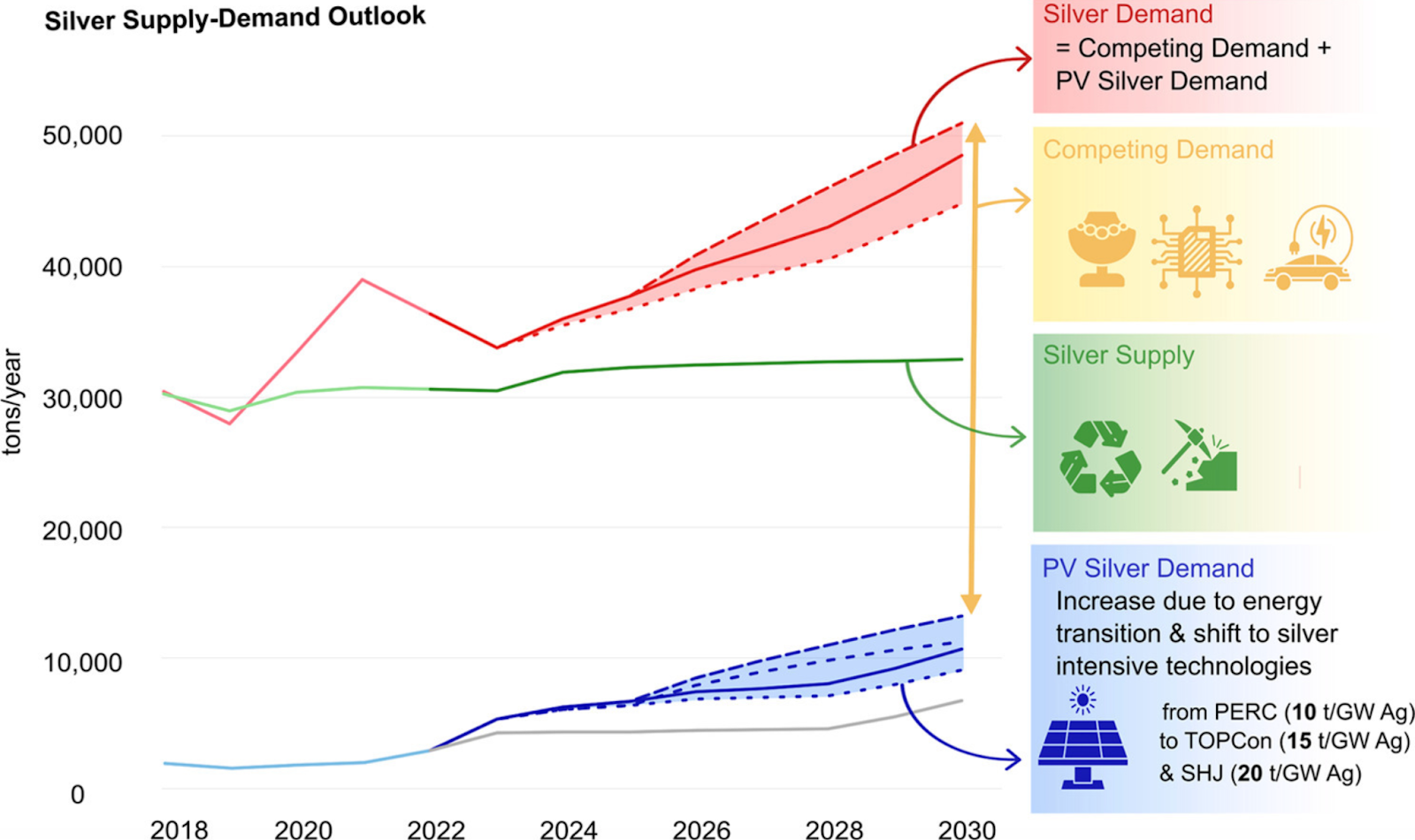
That imbalance suggests that short-term volatility does not invalidate the broader structural case.
Expert outlook
Most analysts caution against expecting a smooth continuation higher. Barclays noted that gold’s broader demand backdrop remains resilient amid policy and geopolitical uncertainty, but warned that stretched technical conditions could warrant a period of consolidation before any sustained advance.
Silver’s outlook remains inherently more volatile. eToro analyst Zavier Wong said speculative positioning intensified both the sell-off and the rebound, while cautioning against dismissing silver’s fundamental demand story. Historically, he noted, silver has tended to overshoot during strong cycles before fundamentals reassert influence.
Ultimately, the durability of the rebound will depend on external forces. Renewed strength in the US dollar or rising real yields could challenge the recovery, while stable funding conditions and calmer macro signals may allow prices to rebuild more methodically.
Key takeaway
Gold and silver have rebounded strongly following a historic sell-off, reinforcing the view that last week’s collapse was driven more by forced positioning than by weakening fundamentals. Although volatility remains elevated, the structural drivers of precious metals demand remain in place. Whether the rebound proves durable will hinge on macro stability, currency trends, and investor discipline. The next phase is more likely to involve consolidation than capitulation.
Gold and Silver technical outlook
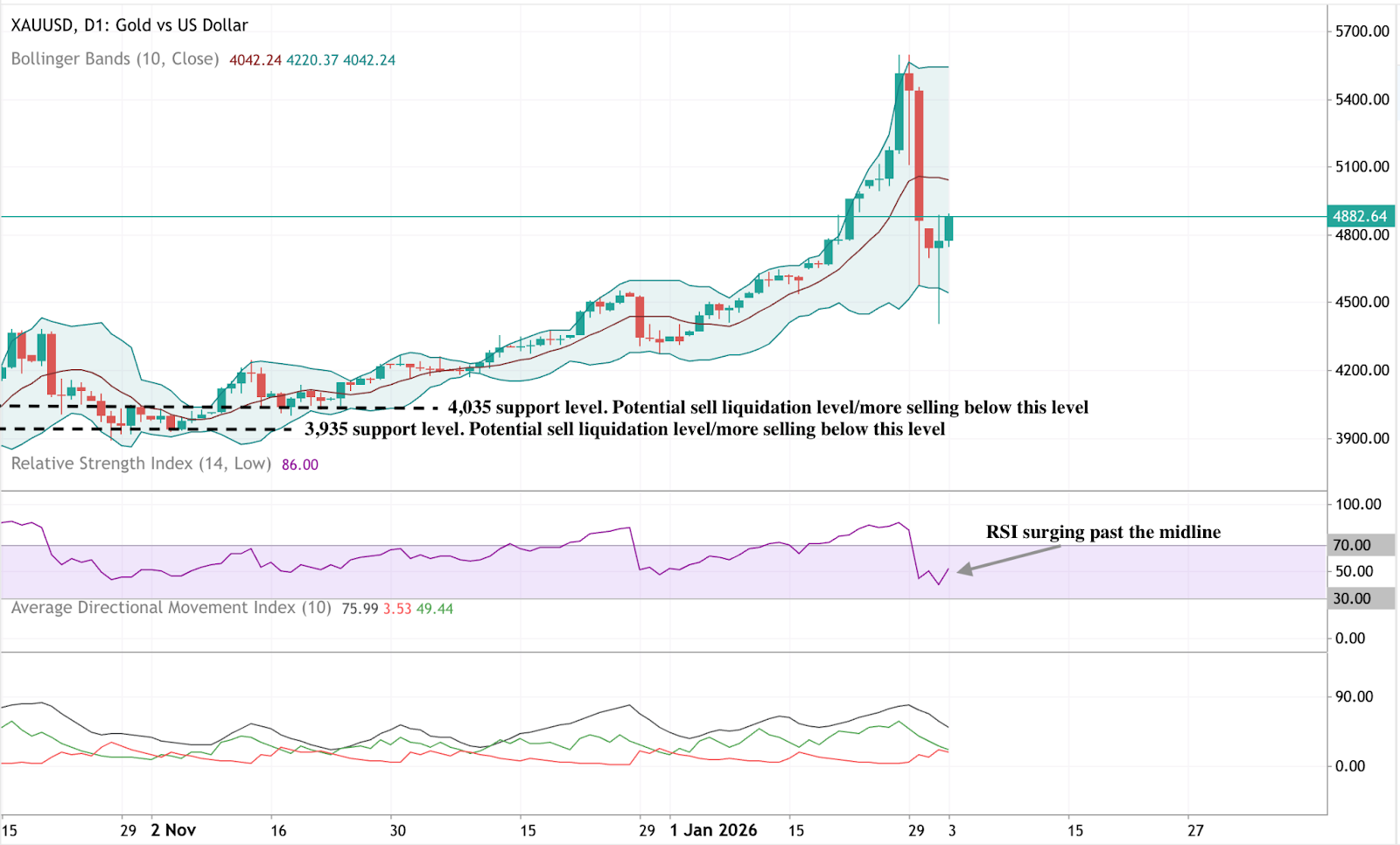
Gold remains elevated following its recent surge, with price stabilising after a sharp pullback from the upper Bollinger Band. Although price has moved back into the bands, they remain widely expanded, indicating that volatility remains elevated relative to earlier periods.
Momentum indicators show an adjustment rather than a reversal: the RSI has moved back above the midline after briefly dipping, reflecting a stabilisation in momentum following the rapid move. Trend strength remains high, as evidenced by elevated ADX readings, indicating a strong, established trend environment.
From a structural perspective, price continues to trade well above earlier consolidation zones around $4,035 and $3,935, underscoring the magnitude of the preceding advance.
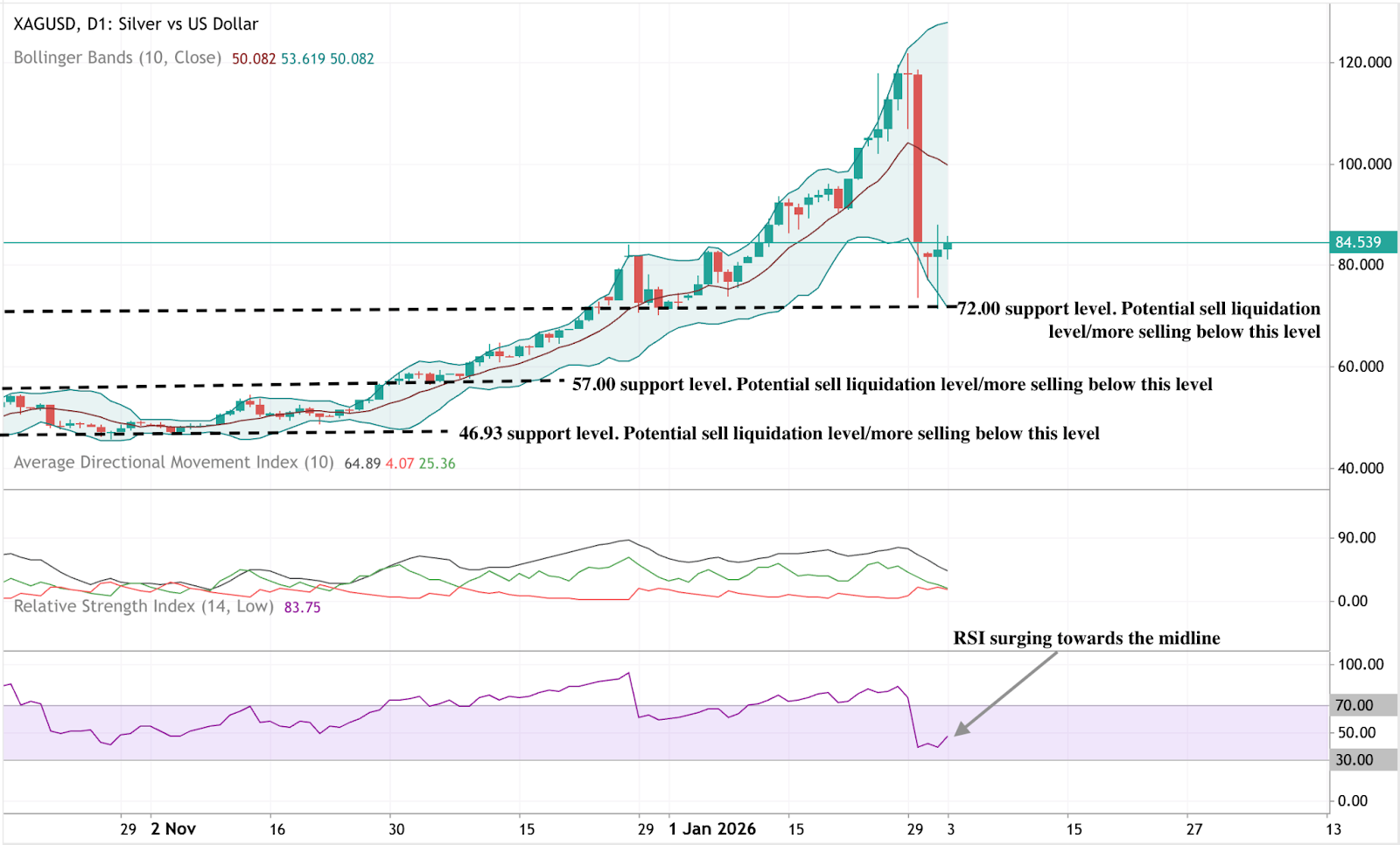
Silver has experienced a sharp pullback after an extended upside move, with price retreating from recent highs and moving back toward the middle of its broader range. Bollinger Bands remain widely expanded, indicating that volatility is still elevated following the earlier acceleration, even as price has moved back inside the bands.
Momentum indicators show a notable reset: the RSI has dropped sharply from overbought levels and is now rising back toward the midline, reflecting a moderation in momentum after the extreme phase.
Trend strength remains elevated, as indicated by high ADX readings, highlighting that the broader trend environment remains strong despite the recent retracement. Structurally, price remains well above earlier consolidation zones around $72, $57, and $46.93, underscoring the scale of the preceding advance.
Disclaimer:
The information contained on the Deriv Market News is for educational purposes only and is not intended as financial or investment advice. The information may become outdated, and some products or platforms mentioned may no longer be offered. We recommend you do your own research before making any trading decisions.
FAQs
Why did gold and silver rebound after such a sharp sell-off?
Does this rebound mean the gold bull market is back?
Why is silver more volatile than gold?
How does Federal Reserve leadership affect precious metals?
What should investors watch next?


