Contents
Article
Why Gold and Silver are surging on Trump’s Greenland gambit
January 19, 2026
Article
Why Gold and Silver are surging on Trump’s Greenland gambit
January 19, 2026
Article
Why Gold and Silver are surging on Trump’s Greenland gambit
January 19, 2026

Gold and silver pushed to fresh record highs during early Asian trading as traders and investors reacted to a sudden spike in geopolitical risk emanating from Washington. US President Donald Trump’s decision to threaten tariffs on European allies over Greenland sent shockwaves through markets, dragging equity futures lower and driving capital into traditional safe havens.
This move has little to do with inflation expectations or monetary policy shifts. Instead, it reflects mounting anxiety around trade fragmentation, diplomatic breakdowns, and the growing use of tariffs as geopolitical pressure tools. As tensions deepen across the Atlantic, precious metals are once again acting as real-time gauges of political stress rather than simple inflation hedges.
What’s driving Gold and Silver higher?
The spark behind gold’s latest surge is Trump’s warning that the US will impose 10% tariffs from 1 February, rising to 25% by June, on eight European countries unless an agreement is reached over Greenland. The list includes Germany, France, Denmark, the UK, Sweden, Norway, Finland, and the Netherlands - all close US partners and NATO allies.
Markets were less alarmed by the tariff numbers than by what they represent. Tying trade penalties directly to territorial demands marks a sharp escalation in economic coercion. Investors quickly priced in the risk of retaliation, stalled negotiations, and prolonged uncertainty - an environment where gold has historically outperformed. European leaders warned that the move risks triggering a “dangerous downward spiral” in transatlantic relations, highlighting the limited diplomatic off-ramps available.
Silver has tracked gold higher but with noticeably greater swings. Gold tends to respond immediately to fear-driven positioning, while silver reflects a blend of defensive demand and industrial sensitivity. With European officials openly discussing retaliatory measures targeting as much as €93 billion in US exports, concerns about disrupted supply chains and weaker manufacturing momentum are now filtering into silver pricing as well.
Why it matters
This rally is notable because it signals a change in what is driving precious metals. Gold has continued to climb despite resilient US labour data and shrinking expectations for near-term Federal Reserve rate cuts. Futures markets no longer expect easing before June, yet gold prices have shown little regard for higher-for-longer interest rate narratives.
That disconnect points to a deeper unease. Investors are shifting focus away from traditional macro inputs and towards political risks that are difficult to forecast or hedge. As Saxo Markets’ chief investment strategist Charu Chanana observed, the critical issue is whether this episode shifts “from rhetoric to policy”. Once deadlines are set, markets are forced to treat the threat as actionable rather than hypothetical.
Impact on markets, trade, and investors
The market response has been swift and broad-based. European and US equity futures retreated, while the US dollar weakened against the euro, sterling, and yen. That softer dollar removed a key headwind for gold, allowing prices to extend higher with little resistance.
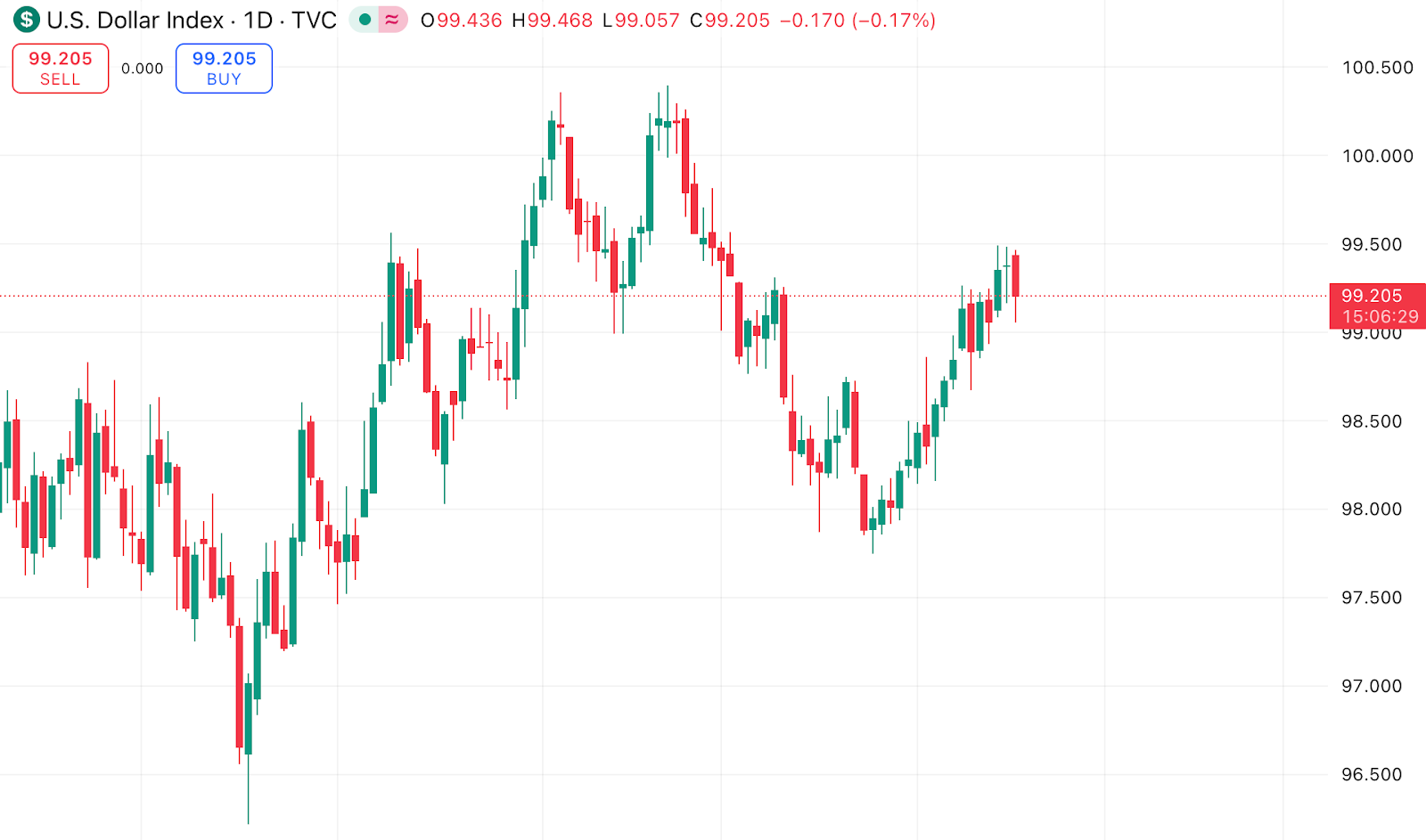
Crucially, this is happening even as US bond yields remain elevated, reinforcing that the move is driven by risk aversion rather than expectations of easier monetary policy.
Silver’s position is more nuanced. If trade tensions intensify without tipping the global economy into recession, silver could outperform gold due to tighter supply dynamics and its role in strategic industries. However, if tariffs begin to weigh meaningfully on industrial activity, silver is likely to experience sharper pullbacks on negative growth signals. That dual exposure explains the heightened volatility now evident in silver markets.
For investors, the takeaway is straightforward. Precious metals are once again being treated as portfolio insurance. Rising ETF inflows and increased derivatives activity point to growing institutional participation, while physical demand remains secondary. The emphasis is firmly on capital protection rather than consumption.
Expert outlook
Looking ahead, gold’s near-term path hinges on whether Trump’s tariff threats are enacted or softened through negotiation. 1 February has emerged as a pivotal date for markets. A move from threat to implementation could push gold further into uncharted territory, with some analysts already outlining scenarios above $4,800 per ounce should retaliation follow.
Silver’s outlook depends on how geopolitical tension interacts with economic resilience. Prolonged uncertainty combined with steady growth would favour silver on a relative basis. A sharper deterioration in trade flows, however, would likely see gold extend its leadership. Investors are also closely watching EU discussions around activating the bloc’s anti-coercion instrument - a rarely used measure that could significantly raise the stakes.
Key takeaway
Gold’s record-breaking rally is being driven by political shock rather than economic deterioration. Trump’s Greenland-linked tariff threats have reignited trade war fears and funnelled capital into hard assets. Silver is joining the move, though with greater sensitivity to growth risks. Whether this surge has further room to run now depends on a single question: do these threats become policy, or does diplomacy step back in?
Silver technical outlook
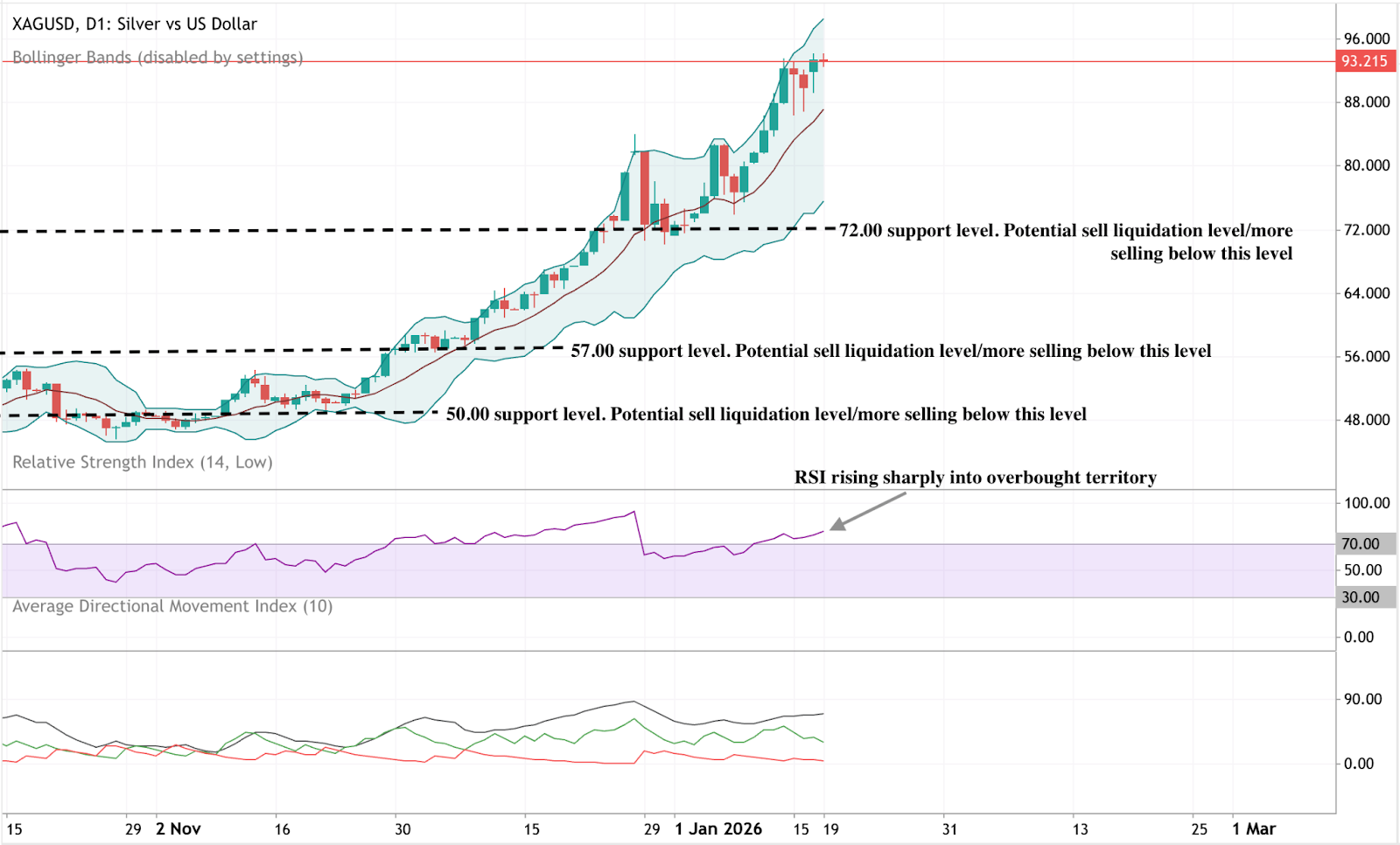
Silver has surged to around $93, delivering a near 38.7% gain in just 30 days, with trading volume estimated at roughly 15 times normal levels. This ranks among the most aggressive silver rallies seen in decades, and places the price firmly in extension territory typically associated with late-stage or blow-off conditions. Gold’s parallel strength reinforces the broader precious metals momentum backdrop.
Trend strength remains exceptionally strong. ADX readings near 52 point to a mature, powerful trend, while momentum indicators are stretched across timeframes. RSI sits above 70 on the daily, near 86 on the weekly, and above 90 on the monthly, reflecting intense upside pressure but also rising exhaustion risk.
Price continues to trade near the upper Bollinger Band, with expanding volatility - a classic parabolic signature. Meanwhile, the nearest structurally significant support zone sits near $73, more than 20% below current levels, highlighting how extended the move has become. Historically, when ADX reaches these extremes, momentum breaks tend to result in sharp pullbacks rather than orderly consolidations.
Gold technical outlook
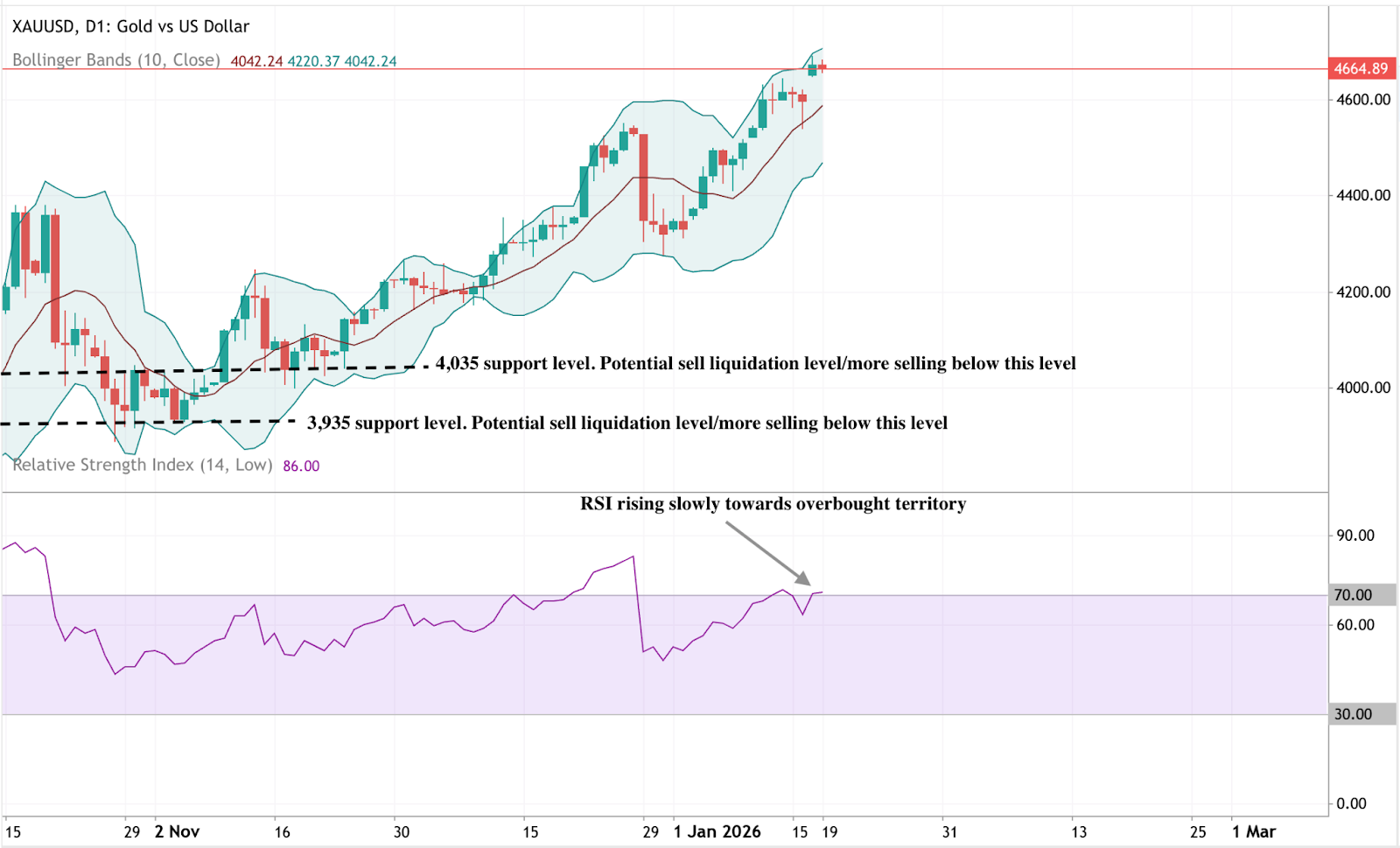
Gold remains near recent highs following a strong upside extension, with price pressing against the upper Bollinger Band. This signals sustained bullish momentum, but also elevated short-term stretch. Volatility remains expanded, suggesting strong participation rather than low-conviction drift.
Momentum indicators show a more measured profile than silver. RSI continues to rise toward overbought territory but is no longer accelerating sharply, suggesting consolidation rather than an immediate reversal. Structurally, the broader trend remains intact, with price holding comfortably above the $4,035 and $3,935 zones, keeping the bullish bias firmly in place.
Disclaimer:
The information contained on the Deriv Market News is for educational purposes only and is not intended as financial or investment advice. The information may become outdated, and some products or platforms mentioned may no longer be offered. We recommend you do your own research before making any trading decisions. The performance figures quoted refer to the past, and past performance is not a guarantee of future performance or a reliable guide to future performance.
FAQs
Why is gold rising despite higher interest rates?
How are Trump’s Greenland tariffs affecting markets?
Is silver a safe haven like gold?
Could Europe retaliate against the US?
What should traders watch next?


