Contents
Article
Is Amazon’s massive AI spend a red flag or a buying opportunity?
February 6, 2026
Article
Is Amazon’s massive AI spend a red flag or a buying opportunity?
February 6, 2026
Article
Is Amazon’s massive AI spend a red flag or a buying opportunity?
February 6, 2026

Amazon’s plan to pour $200 billion into AI-related infrastructure would have been headline-grabbing at any point. It simply landed at the most unforgiving time. Risk appetite was already fading, technology stocks were under pressure, and US stock futures were pointing lower after another punishing session on Wall Street.
By the time Amazon released its results, both the S&P 500 and the Nasdaq had slipped into negative territory for 2026, leaving investors in no mood to tolerate surprises. So when Amazon shares dropped more than 10% after hours - following a narrow earnings miss and a capital spending forecast that dwarfed expectations - the response was swift.
Rather than applauding long-term ambition, the market treated it as another stress point in an already fragile tape. The debate now centres on whether that reaction reflects a real warning or a bout of short-term fear overwhelming longer-term fundamentals.
What’s driving Amazon’s AI spending surge?
Amazon’s projected $200 billion investment for 2026 represents a clear escalation rather than a routine expansion. The spending targets data centres, custom silicon, robotics, logistics automation, and low-Earth-orbit satellite infrastructure, pushing well beyond the roughly $125 billion deployed in 2025. The scale alone forced investors to reassess assumptions around cash flow and return timelines.
Management has been clear that the build-out is demand-driven. AWS revenue climbed 24% year on year to $35.6 billion, marking its strongest growth in more than three years as customers accelerated adoption of both traditional cloud services and AI workloads. Andy Jassy framed the challenge as one of supply rather than demand, noting that new capacity is being absorbed as quickly as it comes online. Amazon’s message was simple: infrastructure is being built because customers are already there.
That argument, however, struggled to gain traction in a market already positioned defensively. Amazon’s sell-off weighed on broader tech sentiment and triggered reassessment across risk assets. Bitcoin slid to its weakest levels since 2024, silver retreated after a retail-driven surge, and crypto-linked equities disclosed fresh losses tied to the digital asset pullback. This was a market looking to reduce exposure, not reward nuance.
Why did the market react so sharply?
Viewed in isolation, Amazon’s earnings were solid. Revenue exceeded forecasts at $213.4 billion, while AWS and advertising both beat expectations. The earnings-per-share miss - $1.95 versus $1.97 - was marginal and would typically have passed without much reaction.
This earnings season, however, is operating under different rules. Investors are scrutinising cash generation rather than topline growth, particularly as AI infrastructure spending balloons across the sector. Amazon’s trailing twelve-month free cash flow fell to $11.2 billion even as operating cash flow rose 20% to $139.5 billion. The pressure is not operational weakness but capital intensity, with AI investment already reshaping valuation metrics.
Forward guidance deepened concerns. First-quarter operating income is expected to fall short of consensus, with management pointing to around $1 billion in additional year-on-year costs linked to infrastructure expansion and satellite projects. Against a backdrop of weakening labour data - falling job openings and rising layoffs - the timing left little room for reassurance.
Broader market fallout adds to the pressure
Amazon’s decline formed part of a wider pattern rather than a single-stock event. While some companies, including Reddit and Roblox, rallied on strong earnings and upbeat outlooks, those moves stood out as exceptions. The prevailing tone across equities remained cautious, with investors increasingly selective about where they were prepared to take risk.
Macroeconomic uncertainty is amplifying that caution. The nonfarm payrolls report, delayed to next week following the resolution of the US government shutdown, now carries extra weight. Recent indicators have already pointed to softening labour conditions, and any further deterioration could reinforce concerns that corporate investment - including AI spending - is running ahead of economic momentum.
In that climate, Amazon’s decision to double down on long-term infrastructure looks less like bravado and more like resolve. The market is not questioning Amazon’s ability to spend. It is questioning whether this is the right phase of the cycle to ask investors to wait for returns.
Is this a familiar Amazon playbook or something new?
Amazon’s history offers plenty of precedent. The company has repeatedly invested ahead of demand, endured scepticism, and emerged with advantages competitors struggled to match. Prime, fulfilment automation, and AWS itself were all built during periods when spending appeared excessive.
AI alters the equation mainly through scale. This time, Amazon is not alone. Microsoft and Alphabet are investing aggressively as well, reducing the benefit of being early and extending the time required for competitive moats to fully form. When everyone is building at once, payback periods naturally lengthen.
Even so, Amazon is not just a consumer of AI hardware. Its in-house chip development through Annapurna Labs has become a meaningful strategic asset. Custom processors such as Trainium and Graviton now generate a combined annual revenue run rate above $10 billion, easing reliance on external suppliers and supporting future margin expansion. That internal capability may become more valuable once industry-wide spending begins to normalise.
Expert outlook: Warning sign or opportunity?
From a balance-sheet perspective, this does not resemble a warning signal. Amazon reported $77.7 billion in net income for 2025 and maintains significant financial flexibility. The greater risk lies in perception - allowing markets to view AI spending as unchecked ambition rather than structured, demand-led expansion.
Short-term caution is understandable. Free cash flow remains under pressure, sentiment is fragile, and macro risks are rising. Volatility is likely to persist until there is clearer evidence that AI spending is peaking or translating into stronger cash generation.
For longer-term investors, the recent sell-off reframes the discussion. If AWS demand remains resilient and new infrastructure achieves high utilisation, today’s spending could support years of operating leverage. Amazon is effectively asking investors to fund capacity now for dominance later - a trade that has paid off before, even if it rarely feels comfortable while unfolding.
Key takeaway
Amazon’s AI spending surge is not a sign of a weakening business. It reflects a market increasingly unwilling to tolerate delayed payoffs in a risk-off environment. Amazon is choosing to invest through uncertainty rather than retreat from it. Whether that proves to be a warning or a buying opportunity will depend on execution, cash flow recovery, and how quickly AI demand turns into visible returns. The coming quarters will reveal whether the sell-off was an act of discipline or a case of short-sighted fear.
Amazon technical outlook
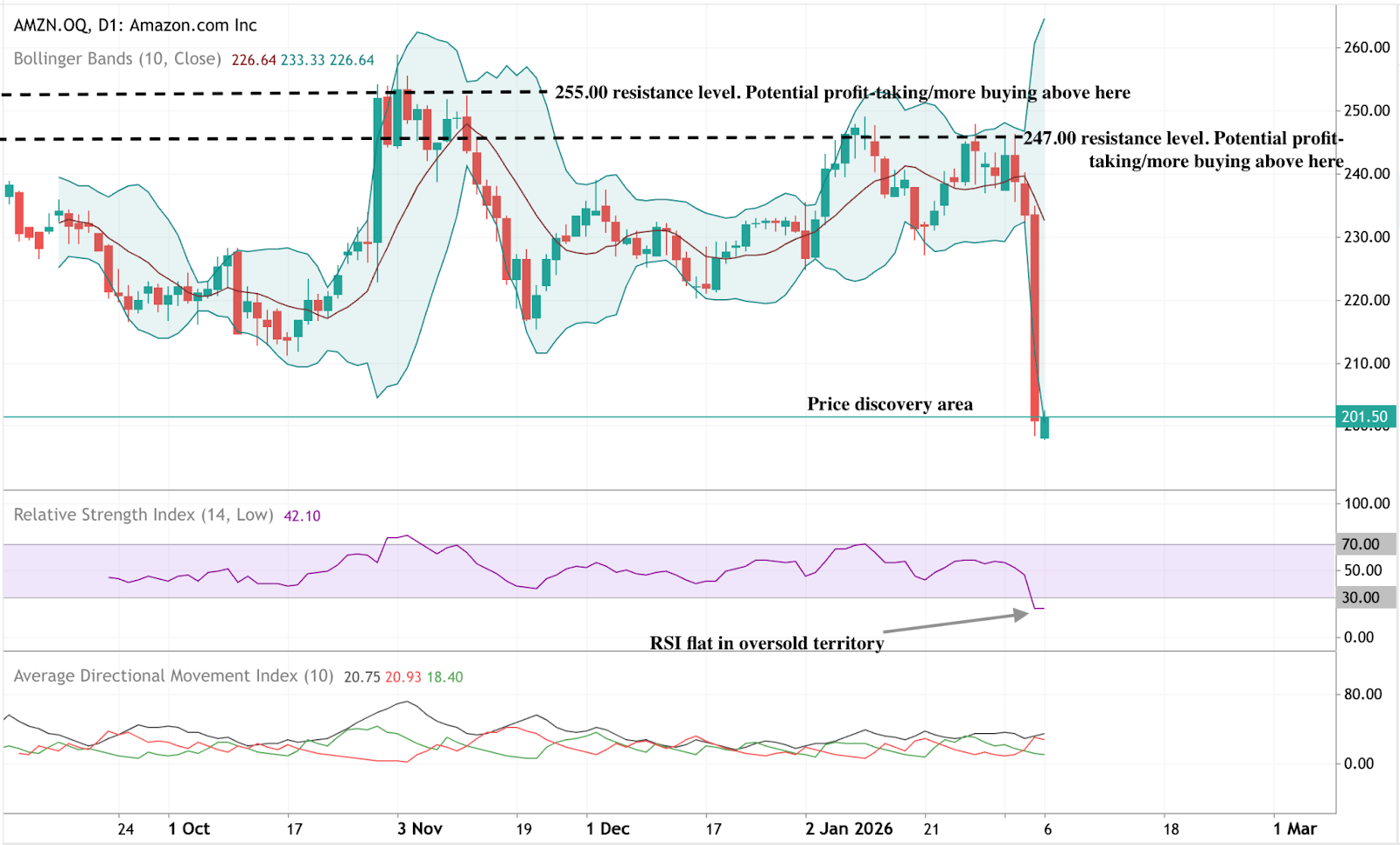
Amazon has seen a sharp downside break, with the price falling out of its recent range and moving into a lower price discovery area. Bollinger Bands have widened noticeably, highlighting a surge in volatility following a prolonged period of tighter price action.
Momentum indicators underline the force of the move. The RSI has slipped into oversold territory and remains pinned at low levels, suggesting sustained downside pressure rather than an immediate rebound. Trend strength measures show limited conviction, with ADX staying relatively muted despite the magnitude of the decline.
From a structural perspective, price has moved decisively below former resistance zones around $247 and $255, placing current action firmly outside the previous trading range.
Disclaimer:
The information contained on the Deriv Market News is for educational purposes only and is not intended as financial or investment advice. The information may become outdated, and some products or platforms mentioned may no longer be offered. We recommend you do your own research before making any trading decisions.
FAQs
Why did Amazon shares fall after earnings?
Is Amazon’s AI spending a sign of financial stress?
How important is AWS to Amazon’s long-term outlook?
Why are investors more nervous about AI spending now?
Is Amazon’s share price weakness a buying opportunity?


