Contents
Article
Nvidia’s record quarter met with muted applause
November 24, 2025
Article
Nvidia’s record quarter met with muted applause
November 24, 2025
Article
Nvidia’s record quarter met with muted applause
November 24, 2025
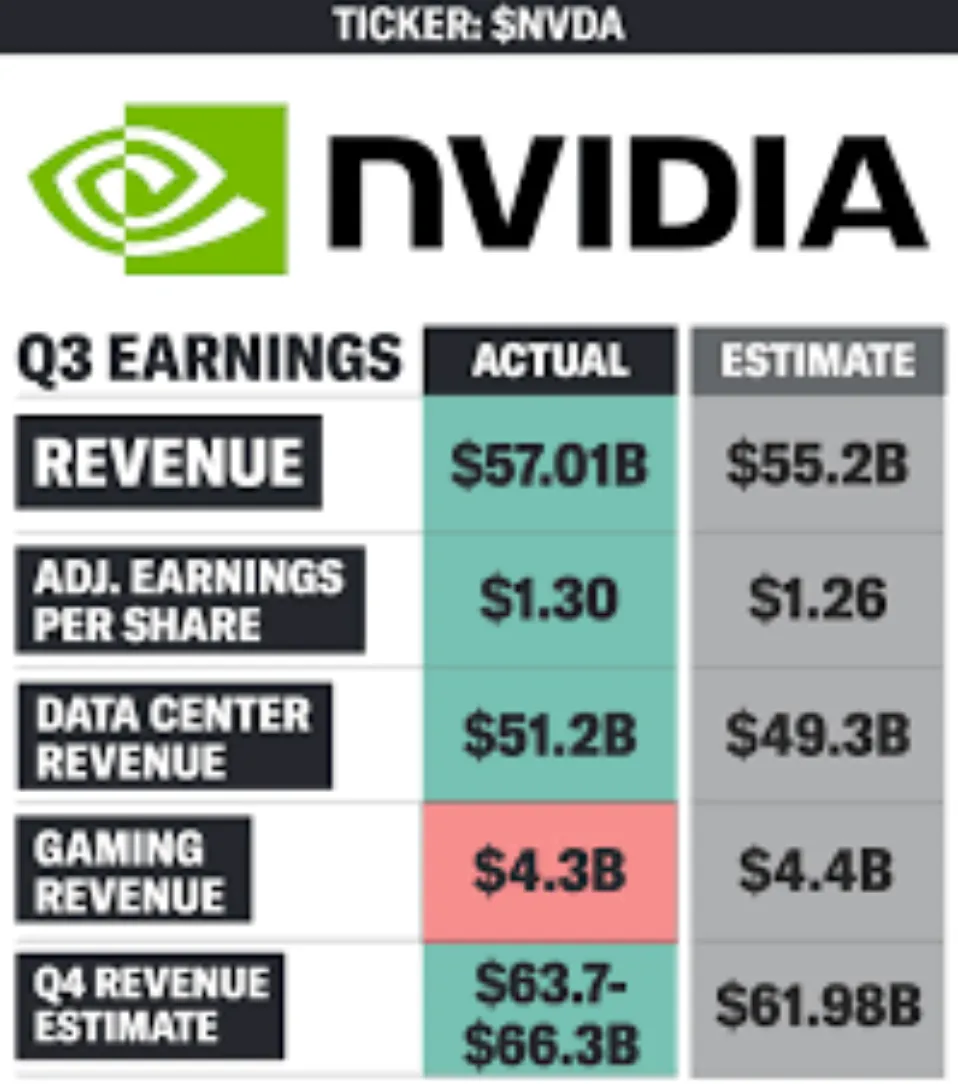
When Nvidia Corporation unveiled third-quarter revenue of $57 billion, up 62% from the same period last year, it appeared to be another unstoppable performance from the AI chip titan. Yet despite the numbers and an upbeat forecast of $65 billion for the next quarter, investors barely flinched.
In a leaked internal meeting, CEO Jensen Huang candidly admitted, “the market did not appreciate it.” The comment captured a strange reality: Nvidia continues to smash records, but market enthusiasm has cooled - a symptom of how the AI hype cycle has inflated expectations to nearly impossible levels.
What’s driving Nvidia’s blowout quarter
According to reports, the core of Nvidia’s success still lies in data-centre revenue, the beating heart of the AI economy. That division alone brought in roughly $51 billion, representing a 66% year-over-year increase and a 25% rise from the previous quarter.
Flagship platforms, such as Blackwell, continue to dominate enterprise demand, while new chip cycles are fueling another round of record forecasts. Nvidia’s trajectory now sets the pace for global capital investment in AI computing, cloud infrastructure, and high-end robotics.
At the same time, the company faces the paradox of its own success: when investors expect perfection every quarter, even extraordinary results can disappoint. As one analyst put it, “Nvidia has become a victim of its own brilliance - growth like this no longer surprises anyone.”
Why it matters
With 7.3 % of the S&P 500’s total weighting, Nvidia isn’t just another stock - it’s the pulse of the AI trade. Its lacklustre post-earnings reaction hints that markets may be reassessing not the company’s fundamentals, but the entire AI investment narrative.
Analysts have called this moment “a referendum on belief.” When the sector’s leader delivers record results and the market shrugs, it suggests fatigue may be setting in. Huang summed it up succinctly: deliver a bad quarter, and you’re blamed for deflating the bubble; deliver a great one, and you’re accused of fuelling it.
The dynamic underscores a broader pivot: the age of boundless optimism around AI is giving way to a phase where investors prize consistency and execution over hype.
Impact on the tech & AI ecosystem
Nvidia’s report briefly lifted sentiment across the semiconductor landscape, boosting AMD, Broadcom, and several memory suppliers. But as the session wore on, those gains faded, showing how quickly optimism now evaporates.
According to experts, if extraordinary numbers can’t spark rallies, it signals that much of the AI build-out is already priced into valuations. Markets may now reward efficiency, supply-chain mastery, and margin stability instead of pure growth.
For large hardware buyers, this transition could mean better availability but tighter pricing power. Nvidia’s next test will be maintaining profitability while scaling production - evolving from visionary disruptor to disciplined operator. For traders, that subtle shift in tone is precisely what makes NVDA such an intriguing instrument on Deriv MT5, where volatility creates both opportunity and risk.
Expert outlook
Analysts outline two plausible trajectories. In the bullish case, Nvidia continues to execute flawlessly - scaling production, launching the next generation of Rubin and Blackwell chips, and navigating regulatory headwinds. In that scenario, its leadership in AI infrastructure could extend deep into the decade.
The alternative is a valuation reset, where investors begin to question whether such explosive growth can persist indefinitely. As a Bernstein analyst remarked, “At some point, perfection becomes impossible to price.”
For now, traders are watching forward guidance, order-book disclosures in Asia, and any signs of competitive erosion. The stock’s $500 billion market-cap swing in recent weeks reminds us that sentiment around AI remains one of the most volatile forces in global finance.
Nvidia technical insights
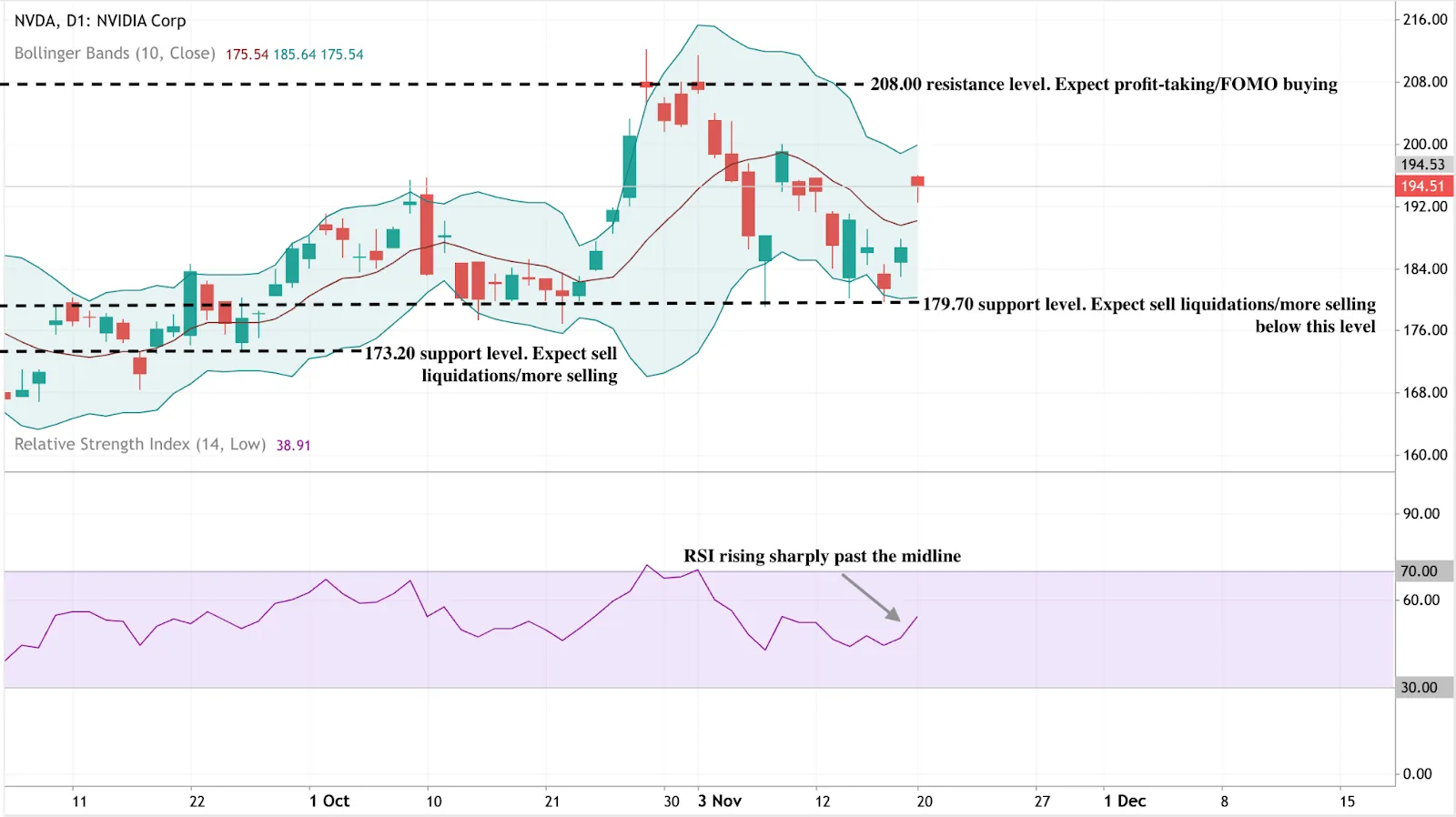
At the time of writing, NVDA trades near $194.50, bouncing from the lower Bollinger Band after testing support at $179.70. The bands (10, close) are widening slightly - an early sign of renewed volatility - and price action is edging toward the midline, suggesting a potential move toward the upper band.
The $173.20 zone acts as the next key support, while $208.00 forms a near-term resistance level where both profit-taking and momentum buying could collide. The RSI has turned sharply higher, crossing above 50, signalling renewed bullish energy.
Traders using the Deriv calculator can simulate profit and loss scenarios under different volatility assumptions to refine their strategies - a practical companion to chart setups on Deriv MT5, especially when managing trades around key resistance and support levels.
Key takeaway
Nvidia remains the cornerstone of the AI infrastructure boom — unmatched in scale, execution, and influence. But the market’s muted applause marks a new chapter. Investors are no longer paying for potential; they’re pricing for proof.
In this climate, results matter less for their magnitude and more for their momentum. For traders, Nvidia’s chart signals near-term upside potential, but the broader narrative speaks to something deeper - an industry moving from fascination to fundamentals, and a market where excellence is simply expected.
Disclaimer:
The performance figures quoted are not a guarantee of future performance.
FAQs
Why did Nvidia’s stock barely move after record earnings?
Is Nvidia’s growth story coming to an end?
Does this signal weakness across AI stocks?
Which price levels matter most for NVDA traders?
What risks could unsettle Nvidia’s dominance?


