Contents
Article
Precious metals pull back: Pause in the rally or peak for Gold and Silver?
January 30, 2026
Article
Precious metals pull back: Pause in the rally or peak for Gold and Silver?
January 30, 2026
Article
Precious metals pull back: Pause in the rally or peak for Gold and Silver?
January 30, 2026

After a blistering January rally that drove gold close to $5,600 per ounce and lifted silver by more than 60% on the month, precious metals have abruptly lost momentum. Gold fell nearly 4% during Asian trading, while silver retreated more sharply from its record highs, prompting questions over whether the surge has finally run its course.
At this stage, the pullback looks more like a pause than a decisive turning point. Recent weakness has been driven largely by profit-taking and shifting expectations around US monetary policy, rather than a deterioration in the macro backdrop. With markets focused on President Donald Trump’s imminent decision on the next Federal Reserve chair, gold and silver appear to be digesting uncertainty rather than breaking trend.
What’s driving the pullback in precious metals?
The catalyst behind the decline has been political rather than economic. President Trump is expected to soon announce his nominee to succeed Federal Reserve Chair Jerome Powell, with former Fed governor Kevin Warsh widely viewed as the leading candidate. Warsh’s past support for more aggressive rate cuts and criticism of current Fed policy has injected fresh uncertainty into the outlook for US monetary policy.
That uncertainty initially strengthened gold’s appeal as a hedge, helping push prices to fresh records. However, once positions became heavily skewed, the same uncertainty began to weigh on sentiment. As the US dollar rebounded from recent lows and traders anticipated clarity, profit-taking accelerated. After a near-25% rise in gold in a single month, the market was increasingly vulnerable to even modest shifts in expectations.
Why it matters for gold and silver investors
The significance of the pullback lies in what it reveals about the rally's nature. Much of the move in gold and silver was driven by capital flows rather than incremental changes in fundamentals. The metals became vehicles for broader concerns over US fiscal stability, tariff risks, and repeated political pressure on the Federal Reserve.
As Julius Baer strategist Carsten Menke observed, momentum-led markets rarely require a major shock to reverse direction. “It does not need much for a correction,” he noted, underlining how quickly sentiment can shift once positioning becomes stretched. For investors, the key issue is whether the current correction is a healthy reset or the first sign that confidence is starting to fracture.
How silver’s volatility is shaping the broader metals market
Silver has once again amplified the broader metals move. After surging to a record high near $121.66, prices pulled back towards $113, snapping a seven-day winning streak. Even with the retreat, silver remains on track for monthly gains exceeding 60%, highlighting the scale and speed of the earlier advance.
This volatility reflects silver’s hybrid role. In addition to acting as a safe haven, silver is closely tied to industrial demand, making it more sensitive to changes in risk appetite. As US equity markets weakened and investors reduced exposure across assets, silver absorbed a disproportionate share of the selling pressure, weighing on sentiment across the precious metals complex.
Is this a pause or a peak?
Despite the sharp correction, the broader case for gold remains largely intact. Losses in futures markets have been more contained than in spot prices, suggesting that investors are trimming positions rather than exiting outright. With inflation pressures lingering and markets still pricing in a potential rate cut by mid-year, the environment of lower real yields remains supportive over the medium term.
The challenge lies in the near-term direction. Continued strength in the US dollar or a reduction in political pressure on the Fed could temporarily cap upside momentum. However, renewed stress in equity markets or any escalation in geopolitical tensions would likely reignite demand for safe havens. Viewed through that lens, the pullback appears more consistent with consolidation than a definitive peak.
Key takeaways
The recent decline in gold and silver reflects a market that moved ahead of clarity rather than one that has lost its underlying support. Profit-taking, a firmer dollar, and uncertainty around US monetary leadership have interrupted an exceptional rally. Whether prices stabilise or extend lower will depend on interest-rate expectations, currency moves, and the broader risk environment in the weeks ahead.
Gold technical outlook
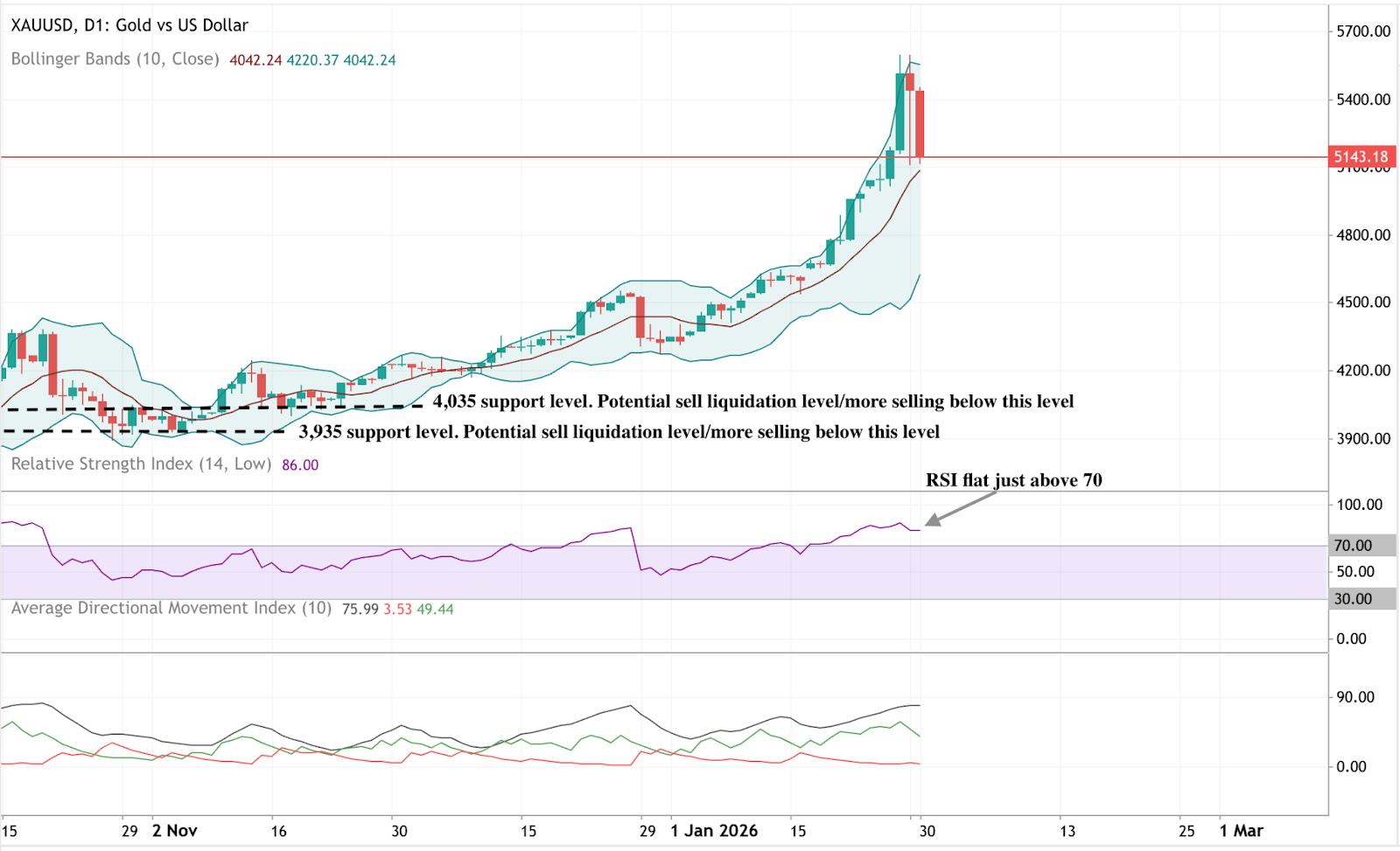
Gold has eased from recent highs after a rapid acceleration, with prices pulling back from the upper Bollinger Band amid elevated volatility. The bands remain widely expanded, signalling that the market is still operating within a high-volatility regime despite the recent slowdown.
Momentum indicators remain stretched. The RSI is holding just above 70, indicating that overbought conditions persist even as upside momentum begins to flatten. Trend strength remains elevated, with ADX readings signalling a mature and well-established trend. From a structural perspective, price remains comfortably above earlier consolidation areas around $4,035 and $3,935, reinforcing the magnitude of the prior advance.
Silver technical outlook
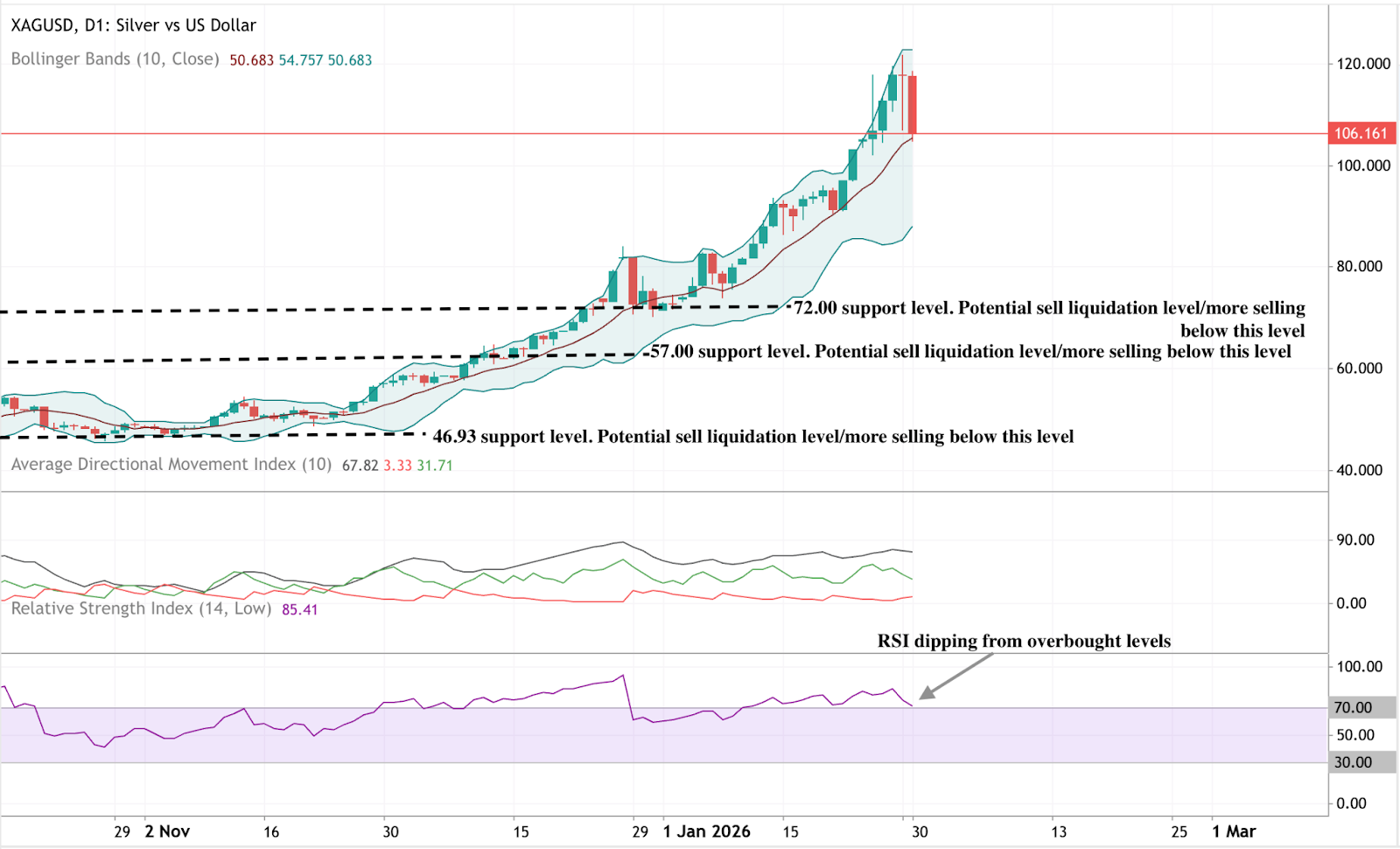
Silver has retreated from recent highs after an extended upside move, with prices pulling back from the upper Bollinger Band while remaining within a broadly elevated range. The Bollinger Bands remain widely expanded, confirming that volatility remains significantly above historical norms.
Momentum indicators suggest a cooling rather than a reversal. The RSI has eased from overbought territory, suggesting moderating upside pressure, while ADX readings remain elevated, indicating a strong, mature trend structure. Price continues to hold well above earlier consolidation zones around $72, $57, and $46.93, underscoring the scale of the preceding rally.
Disclaimer:
The information contained on the Deriv Market News is for educational purposes only and is not intended as financial or investment advice. The information may become outdated, and some products or platforms mentioned may no longer be offered. We recommend you do your own research before making any trading decisions." is present but requires tailoring. The performance figures quoted refer to the past, and past performance is not a guarantee of future performance or a reliable guide to future performance.
FAQs
Why are gold and silver prices falling now?
Does the pullback mean the gold rally is over?
Why is silver more volatile than gold?
How does the Fed chair decision affect precious metals?
What should traders watch next?


