Contents
Article
Why Tesla’s record high rests on shaky foundations
December 18, 2025
Article
Why Tesla’s record high rests on shaky foundations
December 18, 2025
Article
Why Tesla’s record high rests on shaky foundations
December 18, 2025
%20(1)%20(1).png)
Tesla’s share price has climbed to fresh record levels, yet according to analysts, the rally is sitting on increasingly uncertain ground. Even with the stock up more than 20% this year, the company’s core electric vehicle business continues to contract, profitability is under strain, and regulatory headwinds are becoming more pronounced.
That tension is now coming into focus in California, where regulators are threatening a 30-day sales suspension unless Tesla changes how it promotes Autopilot and Full Self-Driving. At the same time, investors appear to be treating Tesla less as an automaker and more as a future-facing company with a focus on AI and robotics. That gap between perception and reality explains both the strength of the rally and the risks beneath it.
What’s driving Tesla’s record high?
Tesla’s latest surge owes more to expectations than earnings. Investors are once again backing Elon Musk’s long-standing vision of Tesla evolving into a robotaxi and robotics powerhouse. Confidence picked up after Musk revealed that Tesla has been testing fully driverless vehicles in Austin without safety drivers, a development bulls interpret as a meaningful step towards commercial autonomy.
What stands out is how this optimism persists despite deterioration in the underlying business. Vehicle deliveries fell 13% in the first quarter, while automotive revenue declined by 20%. A short-lived recovery followed in the third quarter as US buyers rushed to beat the expiry of tax credits, but demand softened again once incentives ended. Even so, the share price continued to rise, suggesting that the market is valuing Tesla based on its future ambitions rather than its present performance.
Why it matters
For analysts, California’s intervention cuts straight to the heart of that valuation. The state’s Department of Motor Vehicles ruled that Tesla misled consumers by using labels such as “Autopilot” and “Full Self-Driving Capability” for systems that still require active driver supervision. Tesla has been given 60 days to revise its language or face a temporary suspension of vehicle sales in the state.
This is not a minor dispute over wording. California is Tesla’s largest US market and home to one of its manufacturing facilities. More importantly, regulatory trust underpins Tesla’s narrative of autonomy. As one US auto analyst put it, it is difficult to justify a trillion-dollar vision for self-driving technology if regulators are openly questioning whether the product lives up to its promise.
Impact on the EV and AI trade
The regulatory pressure arrives as Tesla’s competitive position weakens. Lower-cost EVs from BYD and Xiaomi in China, alongside increasingly attractive European offerings from Volkswagen, are eroding demand. In the US, cheaper versions of the Model 3 and Model Y have eaten into sales of higher-margin models, contributing to November deliveries falling to their lowest level in four years.
At the same time, Tesla’s stock has become more sensitive to movements across the wider AI sector. The recent pullback followed weakness in AI-linked shares after delays in major data-centre financing raised concerns about the pace of AI investment. As a result, Tesla is now exposed not just to EV cycles, but also to shifts in sentiment around artificial intelligence.
Expert outlook
Opinion on Wall Street remains split. Mizuho recently raised its price target on Tesla to $530, citing improvements in Full Self-Driving (Supervised) as a potential catalyst for expanding robotaxi operations in cities such as Austin and San Francisco. Supporters argue that Tesla’s camera-based approach could scale more efficiently than rival systems that rely heavily on lidar.
Others see growing risks. Federal safety regulators continue to investigate crashes involving Autopilot, while a Florida jury recently ordered Tesla to pay $329 million following a fatal 2019 accident. At the same time, competitors such as Nissan, working with Nvidia-backed Wayve, are developing comparable driver-assist systems at significantly lower price points. Tesla’s once-clear technological edge is becoming less certain.
Key takeaway
Tesla’s record high reflects confidence in a future that is still taking shape. Optimism around robotaxis has overshadowed weakening EV fundamentals and increasing regulatory scrutiny. California’s warning underlines how exposed that narrative has become. The next phase will depend on regulatory outcomes, tangible progress in real-world autonomy, and whether revenues can eventually justify today’s valuation.
Tesla technical insights
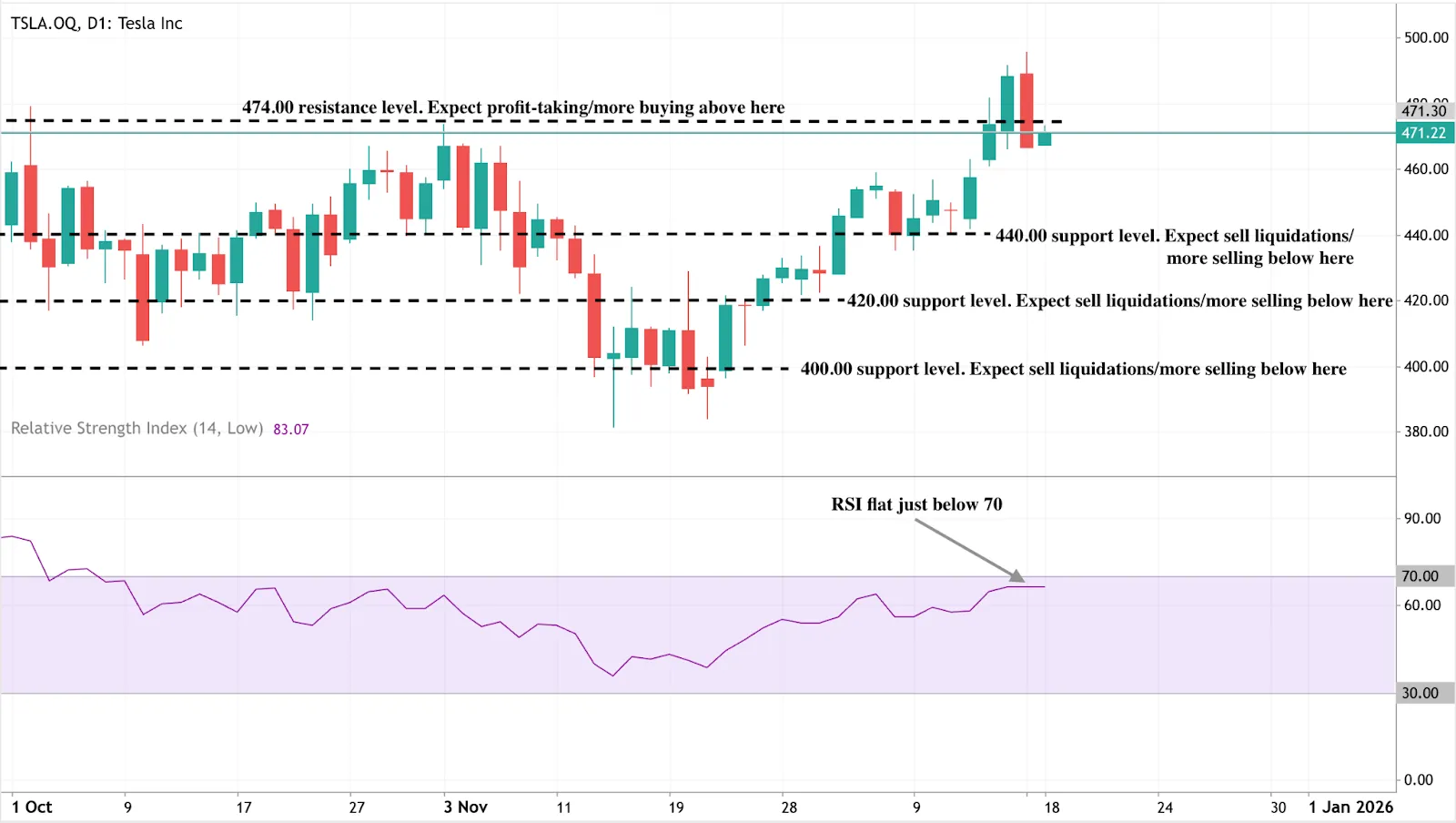
On the daily chart, Tesla’s price is consolidating just below the key $474 resistance zone, an area that has repeatedly capped upside attempts. The latest rejection from this level points to near-term profit-taking, although a sustained break and hold above $474 could reignite upside momentum.
Support is layered below, with $440 acting as the first key level, followed by $420 and the broader $400 demand zone. A decisive move below $440 would likely trigger sell-side pressure and increase the risk of a deeper pullback towards these lower levels.
Momentum indicators suggest both strength and fatigue. The RSI is flattening just under the 70 level, indicating bullish momentum remains intact, while also signalling limited upside without a fresh catalyst. In the near term, this setup favours consolidation unless buyers can reclaim and defend resistance.
Disclaimer:
The performance figures quoted are not a guarantee of future performance.
FAQs
Why did Tesla stock hit a record high despite falling sales?
Why is California threatening to ban Tesla sales?
Is Tesla actually operating driverless robotaxis today?
How important is California to Tesla’s business?
Does Nissan pose a serious threat to Tesla’s autonomy lead?


