Contents
Article
Why USD/JPY is gradually losing its carry trade cushion
December 15, 2025
Article
Why USD/JPY is gradually losing its carry trade cushion
December 15, 2025
Article
Why USD/JPY is gradually losing its carry trade cushion
December 15, 2025

USD/JPY is losing its carry trade cushion as the long-standing forces that kept the yen structurally weak begin to fade. Japan’s prolonged period of near-zero interest rates is approaching a turning point, while the yield advantage that once made the yen an attractive funding currency is steadily shrinking. Confidence among large Japanese manufacturers has risen to its highest level since 2021, strengthening expectations that the Bank of Japan will lift its policy rate to 0.75% at its December meeting.
At the same time, the US dollar’s yield dominance is no longer absolute. Federal Reserve expectations have stabilised, but they are no longer rising with the same consistency. As the interest rate gap narrows and the cost of currency hedging increases, the conditions that fuelled persistent yen selling are losing traction. That matters because USD/JPY has long been one of the market’s most dependable carry trades - and those positions tend to unwind slowly, but decisively, once the logic behind them weakens.
What’s driving USD/JPY?
The primary driver behind the change in USD/JPY is the Bank of Japan’s increasing confidence that inflation and wage growth are becoming more entrenched rather than fleeting. Inflation has remained above the 2% target for more than three years, and the latest Tankan survey shows firms now expect prices to rise by 2.4% over one-, three- and five-year horizons. That consistency suggests inflation expectations are becoming anchored, a critical milestone for Japanese policymakers.
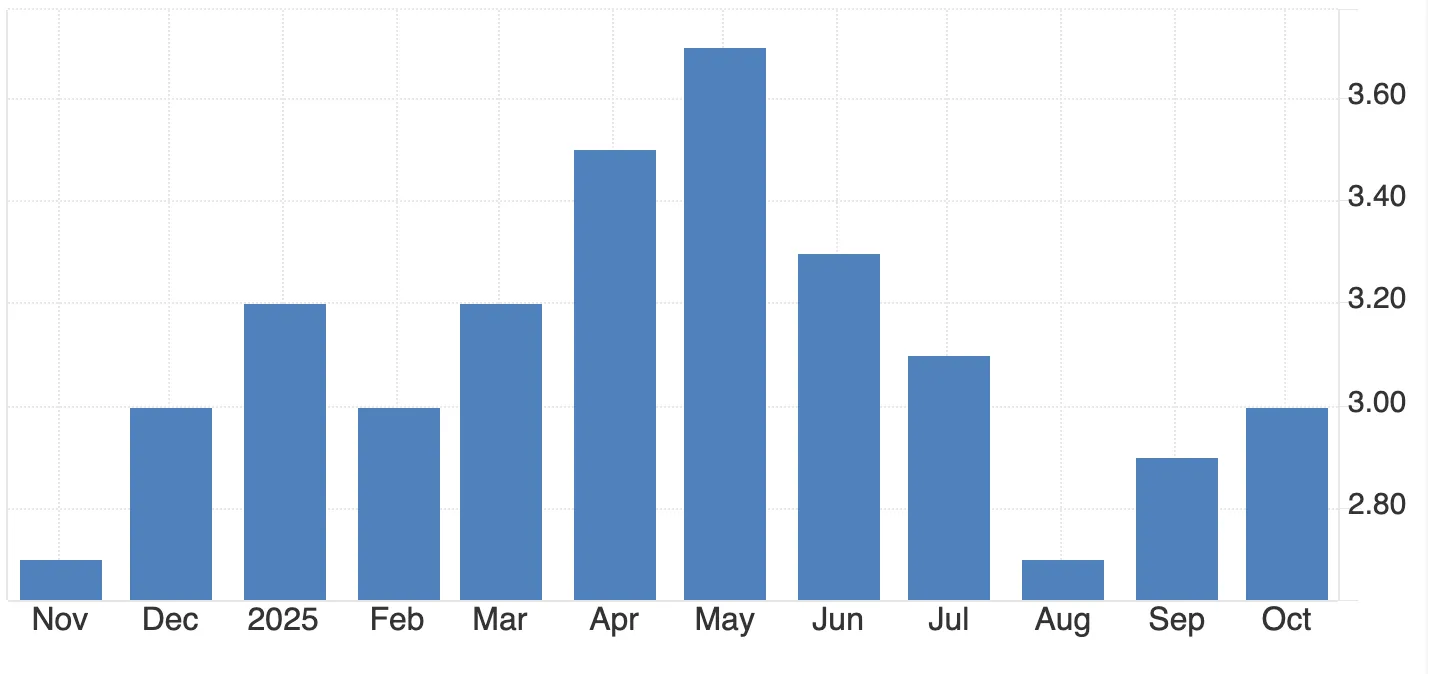
This represents a clear break from the deflationary mindset that shaped Japanese economic policy for decades. Corporate behaviour supports that shift. Large firms plan to raise capital expenditure by 12.6% in the current fiscal year, while labour shortages are now the most severe since 1991, a period associated with Japan’s asset bubble. A tighter labour market supports wage growth, which the BoJ has repeatedly highlighted as essential for sustaining higher interest rates without undermining demand.
Why it matters
For currency markets, this move goes beyond a simple rate adjustment. It signals a shift in credibility. The yen has long been treated as a funding currency, routinely sold when global risk appetite improved. That behaviour relied on confidence that Japanese interest rates would remain anchored near zero indefinitely. The latest Tankan results, combined with firmer messaging from Governor Kazuo Ueda, are challenging that assumption.
Economists argue that labour market conditions are now reinforcing the BoJ’s policy objectives. Capital Economics notes that acute labour shortages help preserve the “virtuous cycle” between wages and prices, allowing the central bank to tighten policy without derailing growth. If investors come to accept that Japan’s neutral rate sits closer to 1.5–2.0%, USD/JPY levels above 150 appear increasingly difficult to justify.
Impact on markets and the carry trade
The most direct impact is being felt in the global yen carry trade. For years, investors borrowed cheaply in yen to fund higher-yielding US and international assets, often leaving currency exposure unhedged as the yen weakened steadily. That strategy thrived on negligible funding costs and a predictable monetary backdrop.
Those foundations are now shifting. As Japanese Government Bond yields rise and markets price further BoJ tightening into 2026, the cost of maintaining unhedged yen positions increases. Rather than triggering an abrupt exit, this environment encourages a gradual reduction in exposure. As positions are trimmed and hedges added, underlying demand for the yen builds, placing persistent downward pressure on USD/JPY even if US yields remain relatively high.
Expert outlook
Attention is increasingly focused on what follows the December BoJ meeting. A quarter-point rate increase is largely priced in, leaving forward guidance as the key market catalyst. If policymakers frame the move as part of a broader path towards a neutral rate rather than a one-off adjustment, the yen’s repricing could gather pace.
Governor Ueda’s post-meeting press conference will be closely watched for signals that policy normalisation extends well into 2026. On the US side, the outlook is more balanced. The Federal Reserve’s latest dot plot shows only one rate cut pencilled in for 2026, a firmer stance than markets anticipated earlier in the year.
Even so, political pressure and slowing growth indicators limit the extent to which policy can remain restrictive. With key US labour and inflation data due this week, short-term volatility may increase, but the broader trend continues to favour a gradual erosion of USD/JPY’s carry-driven support.
Key takeaway
USD/JPY is no longer shielded by the carry trade dynamics that shaped its performance for years. A firmer inflation backdrop, tightening labour conditions and a more confident Bank of Japan are steadily weakening the structural case for a persistently weak yen. While the adjustment is unlikely to be abrupt, the direction is becoming clearer. Future moves will hinge on the BoJ's guidance, wage trends, and incoming US macro data to confirm whether this shift is durable.
USD/JPY technical insights
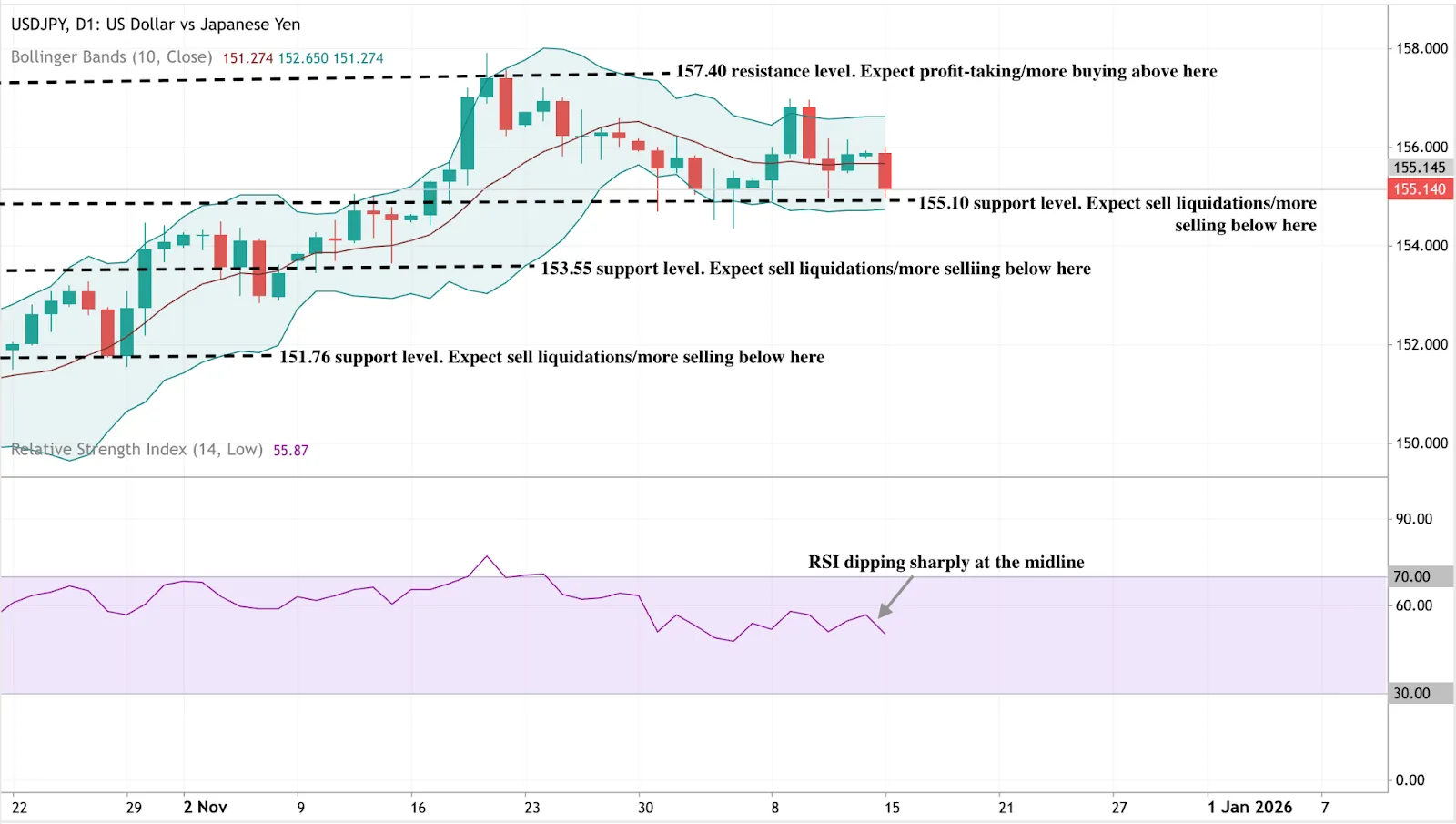
At the time of writing, USD/JPY is trading near 155.14, easing back from recent highs after failing to sustain momentum above the 157.40 resistance level. This zone remains a key upside barrier, where profit-taking typically emerges unless buyers can force a decisive breakout. On the downside, immediate support lies at 155.10, followed by 153.55 and 151.76. A break below these levels would likely trigger sell-side liquidations and deepen the corrective move.
Price action indicates that the pair is drifting back towards the middle of its Bollinger Band range, signalling a loss of bullish momentum following the earlier rally. This suggests USD/JPY may enter a consolidation phase unless buying interest re-emerges quickly. The RSI, currently near 56, is sliding towards its midline, highlighting fading momentum and increased caution among buyers. While this does not yet confirm a trend reversal, it does point to rising near-term downside risks if support at 155.10 fails to hold.
Disclaimer:
The performance figures quoted are not a guarantee of future performance.
FAQs
Why is USD/JPY falling despite high US interest rates?
What role does the Tankan survey play in yen moves?
Is the BoJ likely to keep raising rates after December?
Does Japan’s fiscal spending limit yen strength?
Could USD/JPY return to 140?


