Contents
Article
Bitcoin slides 40%: Why analysts aren’t bracing for an 80% crash
February 5, 2026
Article
Bitcoin slides 40%: Why analysts aren’t bracing for an 80% crash
February 5, 2026
Article
Bitcoin slides 40%: Why analysts aren’t bracing for an 80% crash
February 5, 2026

Bitcoin has dropped roughly 40% from its October high, unsettling markets and reigniting fears of another deep crypto downturn. The most recent leg lower saw prices fall 11% in a single week as investors moved sharply into risk-off mode, pulling digital assets down alongside volatile US equities. For many market participants, the speed of the decline has felt eerily familiar.
Those concerns are rooted in Bitcoin’s four-year cycle, which historically ended with drawdowns of 70% to 80%. This time, however, analysts at K33 argue the parallels may be misleading. They point to a market that has already endured heavy deleveraging and now includes a broader base of long-term holders. The debate has shifted from whether Bitcoin is under pressure to whether this pullback marks a necessary reset rather than the start of a full-blown collapse.
What’s driving Bitcoin’s latest sell-off?
Bitcoin’s weakness has tracked a wider shift in global sentiment. Equity markets have become increasingly unstable, with technology stocks leading losses as investors reassess growth assumptions and stretched valuations. As correlations tighten, crypto assets have mirrored these moves, reinforcing Bitcoin’s sensitivity to macro-driven risk aversion.
Leverage has played a decisive role in accelerating the sell-off. Over a short period, more than $1.7 billion in leveraged long positions were wiped out across crypto markets, intensifying downside momentum.
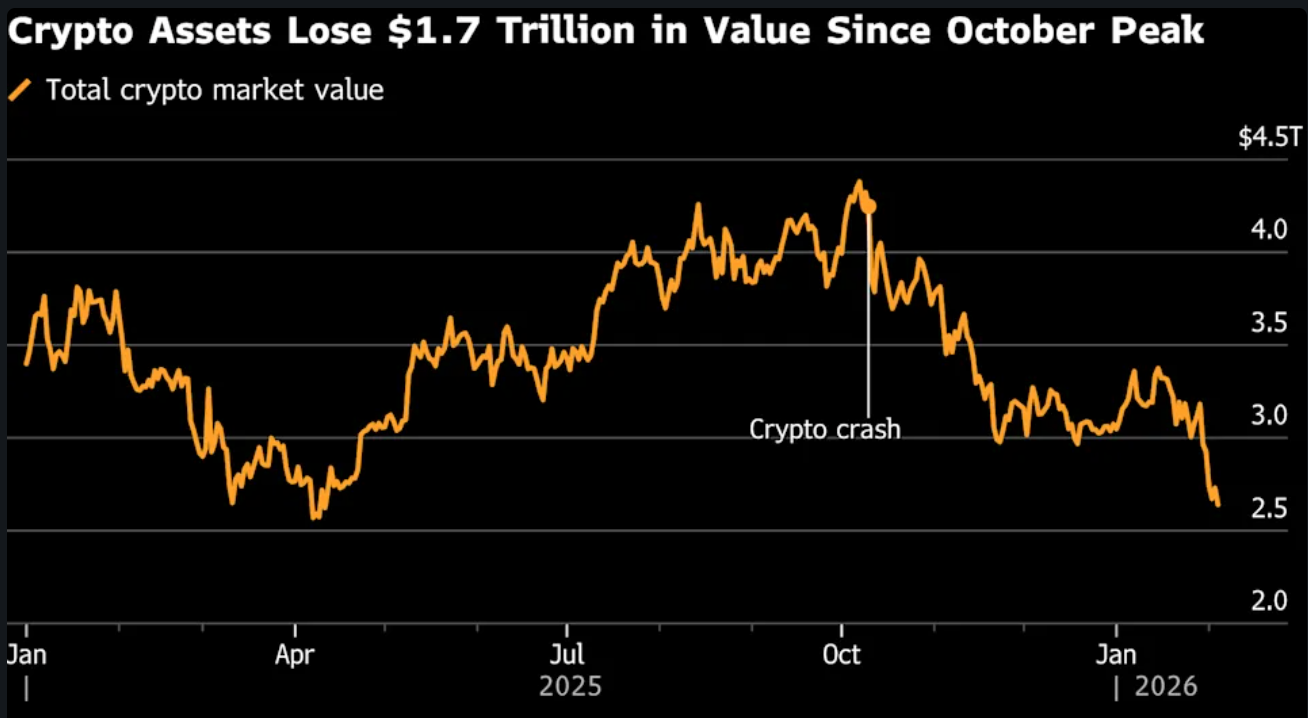
At the same time, funding rates turned sharply negative, reflecting a rapid exit from bullish positioning. While such conditions often coincide with heightened stress, they have also historically emerged once speculative excess has already been cleared from the market, rather than at the start of prolonged declines.
Why it matters
Sharp drawdowns tend to have an outsized psychological impact, particularly on less experienced investors. Bitcoin’s history of severe post-rally crashes has conditioned the market to expect extreme outcomes once prices begin to slide, and that expectation alone can amplify selling pressure.
K33 argues that the conditions underpinning past crashes are largely absent today. The deep bear markets of 2018 and 2022 were driven by forced liquidations tied to systemic failures, including the collapse of Terra-Luna and FTX. Those episodes triggered margin calls and disorderly selling across the market. “The structure that produced 80% crashes simply isn’t present today,” K33 noted in its latest analysis.
Impact on crypto markets and equities
The sell-off has not been confined to Bitcoin. Shares linked to the crypto sector have also come under heavy pressure as investors reassess risk exposure across the industry. Strategy, the largest corporate holder of Bitcoin, fell more than 5% in a single session and is now down close to 70% over the past six months.
Mining stocks fared even worse. Firms that had diversified into high-performance computing and AI-related services were unable to sidestep the downturn. HUT 8 closed 8% lower, Core Scientific slid nearly 9%, and IREN dropped 17%. As Nansen’s Aurelie Barthere noted, “The correlation between crypto and US equities is turning positive again as they sell off simultaneously,” underscoring Bitcoin’s renewed sensitivity to broader market volatility.
Expert outlook
K33 highlights the $74,000 level as a critical support area. A sustained move below that threshold could see prices drift toward the 2021 high near $69,000, or even toward the long-term average near $58,000. While those levels may appear severe, analysts emphasise that Bitcoin has already absorbed substantial liquidation pressure without signs of broader systemic strain.
The growing role of spot Bitcoin ETFs has also altered the market’s composition. Long-term allocators, including pension-linked capital, now represent a meaningful share of demand. That shift has helped reduce the reflexive selling that characterised earlier cycles. While volatility is likely to persist, analysts increasingly view the current move as a structural correction rather than the end of the cycle.
Key takeaway
Bitcoin’s 40% pullback has revived memories of previous cycle crashes, but today’s market looks materially different beneath the surface. Forced selling has largely played out, leverage has been reduced, and institutional participation has become more deeply embedded. Price swings may remain sharp in the near term, yet the evidence points toward a recalibration rather than a collapse. Attention now turns to ETF flows, broader equity stability, and whether key support levels continue to hold.
Bitcoin technical outlook
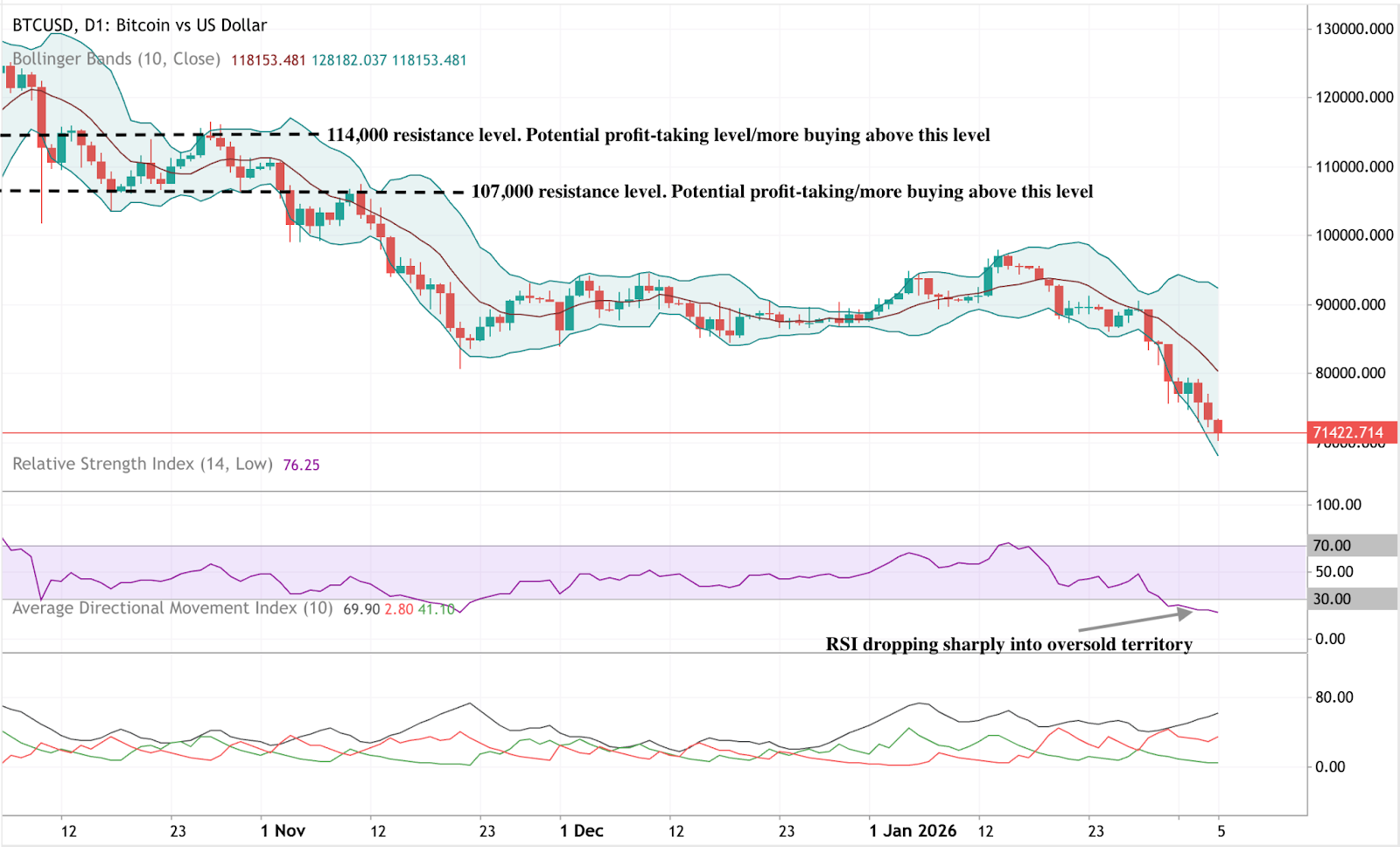
Bitcoin has continued to drift lower, pressing toward the bottom of its recent trading range after breaking down from an extended consolidation phase. Price remains below the lower Bollinger Band, with the bands still widely expanded, reflecting elevated volatility and strong downside momentum following the recent acceleration lower.
Momentum indicators remain stretched, with the RSI falling deep into oversold territory, suggesting an abrupt deterioration in short-term momentum rather than a gradual trend rollover.
Trend strength remains pronounced, as elevated ADX readings suggest an active and established trend environment despite the recent directional shift. From a structural perspective, Bitcoin now trades well below the former consolidation zone around $90,000, with prior resistance levels near $107,000 and $114,000 sitting far above current price action.
Disclaimer:
The information contained on the Deriv Market News is for educational purposes only and is not intended as financial or investment advice. The information may become outdated, and some products or platforms mentioned may no longer be offered. We recommend you do your own research before making any trading decisions. The performance figures quoted refer to the past, and past performance is not a guarantee of future performance or a reliable guide to future performance.
FAQs
Why is Bitcoin falling right now?
Is Bitcoin heading for an 80% crash?
What is Bitcoin’s four-year cycle?
Why are crypto stocks falling faster than Bitcoin?
What levels should traders watch next?


