Contents
Article
Gold and silver rally as the debasement trade gains momentum
December 5, 2025
Article
Gold and silver rally as the debasement trade gains momentum
December 5, 2025
Article
Gold and silver rally as the debasement trade gains momentum
December 5, 2025

Analysts note that gold and silver are advancing at a pace that suggests something deeper than the usual flight to safety. Their climb has evolved into a defining example of the “debasement trade” - the idea that unstable political conditions, growing fiscal strains, and weakening major currencies are eroding real wealth.
Silver futures have surged more than 100% this year, while gold has risen over 60%, underscoring how strongly capital is rotating into hard assets.
Copper’s break to record highs above $11,400 per tonne reinforces this sentiment, yet it is gold and silver that embody the market’s unease over policy volatility. Their rise reflects a powerful combination of supply shortages, tariff risks, and expectations of looser monetary policy. Together, these forces are shaping one of the most consequential shifts in asset preference seen in years.
What’s driving gold and silver higher?
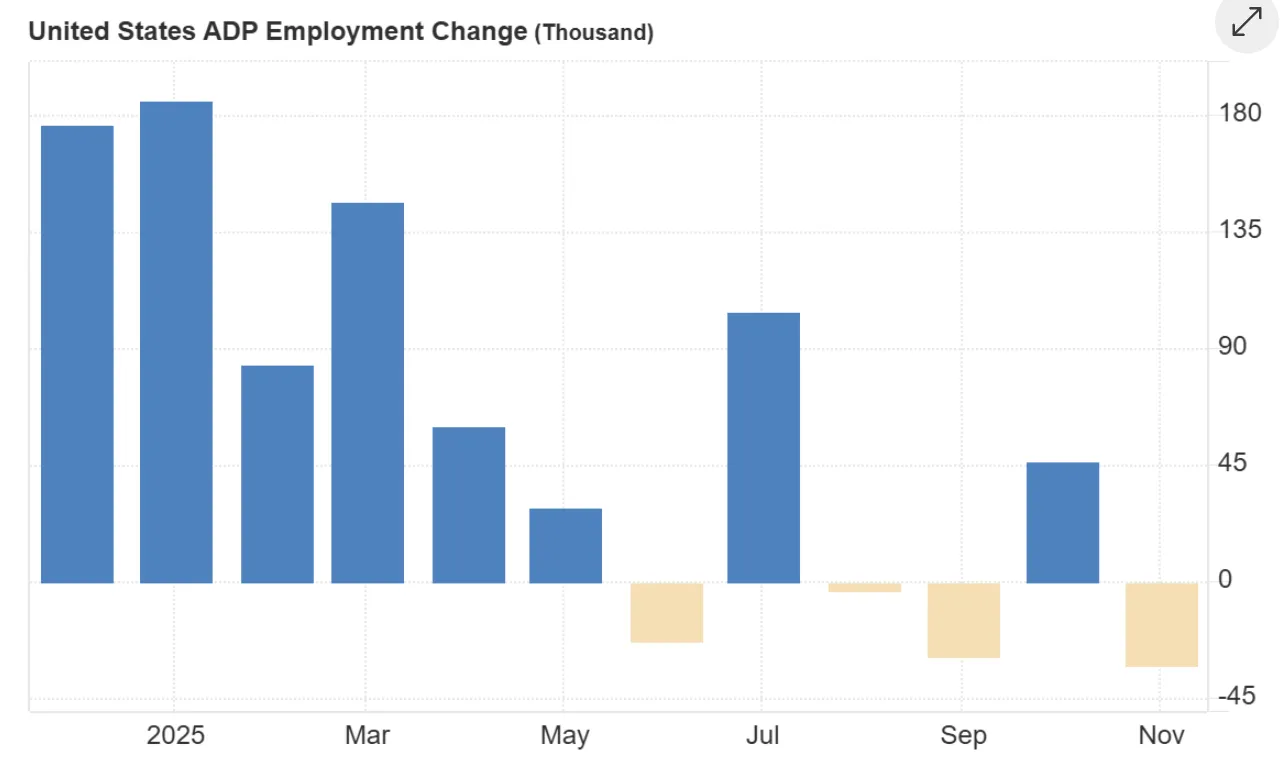
The backdrop pushing metals upward has grown firmer as economic signals weaken. The US labour market shed 32,000 jobs in November - the first negative three-month trend since mid-2020 - adding weight to fears that growth is slowing.
Markets now see a 25-basis-point rate cut as almost certain, pressuring the dollar and making non-yielding assets more attractive. Treasury bills yielding below the Federal Reserve’s target rate have deepened the sense that monetary conditions are easing again.
A more structural story is unfolding beneath these cyclical shifts. Analysts note that silver’s rally is being driven by genuine physical demand rather than speculation, with India importing an extraordinary 60 million ounces in October - four times its intake a year earlier.
Industry executives say this is the first time in decades that the physical market is dictating price action. Gold is experiencing a similar dynamic, with central banks purchasing 53 tonnes in October as countries such as Poland and Brazil diversify their reserves. With supply tightening and demand accelerating, both metals are being driven by both long-term forces and short-term sentiment.
Why it matters
The surge in gold and silver extends beyond commodities, as it reflects a diminishing trust in major currencies. Bloomberg reports that the US dollar has lost nearly 10% of its value since President Trump took office, while the yen and the euro have also weakened.
Investors are growing wary that unpredictable policy decisions - from steep tariffs to prolonged budget stand-offs - could undermine currency stability. As a result, gold and silver are becoming core hedges at times when traditional currency tools feel less reliable.
Some analysts caution against overstating the degree of debasement, noting that the global appetite for US debt remains strong. One strategist observed that “if investors were truly abandoning the dollar, Treasury yields would be the first place you’d see it.” Still, that hasn’t slowed inflows into metals, largely because gold and silver offer insulation from political risk - something even a stable bond market cannot fully provide.
Impact on markets and investors
Silver’s rapid ascent is reshaping market behaviour. Investors who once traded bars and coins tactically are now holding them for the long term, tightening supply just as industrial demand accelerates. Manufacturers across solar technology, electronics, and automotive production are securing multi-year supply contracts to safeguard against escalating costs and the risk of shortages, amplifying the squeeze in the physical market.
Gold’s strength is reverberating through currency and bond markets as traders recalibrate for a softer interest-rate environment. Although stronger jobs data offered the dollar a brief lift last week, most observers expect looser financial conditions and persistent geopolitical risks to keep support under gold. President Trump’s comments on the unclear prospects for Ukraine peace negotiations added further uncertainty, reinforcing the appeal of haven assets.
Expert outlook
Analysts broadly expect gold and silver to remain well-supported into early next year, although both will be sensitive to incoming inflation data and shifts in Treasury yields. The delayed US PCE report is a key milestone; a hotter-than-expected reading could strengthen the dollar and temporarily press gold lower. Even so, the prevailing expectation is that policy will continue to ease, which has historically been a positive backdrop for precious metals.
Reports suggest that silver’s trajectory is heavily shaped by a growing structural deficit, now expected to reach around 95 million ounces in 2025. Slow mine development and limited recycling capacity leave the market exposed to further squeezes. India’s demand remains a critical variable that could intensify existing shortages. Gold, meanwhile, is poised to benefit from ongoing central bank purchases and geopolitical uncertainty - factors that strengthen the case for higher prices, even if short-term pullbacks occur, according to analysts.
Key takeaway
Gold and silver are rising on a mix of currency concerns, political unpredictability, and tightening supply. What was once considered a niche “debasement trade” has entered the mainstream as investors seek assets resilient to policy shocks. Silver’s deepening supply gap and persistent central-bank buying of gold offer a structural foundation for further gains. Inflation data and the Federal Reserve’s next steps will play a decisive role in determining how firmly the rally continues into 2026.
Gold and silver technical insights
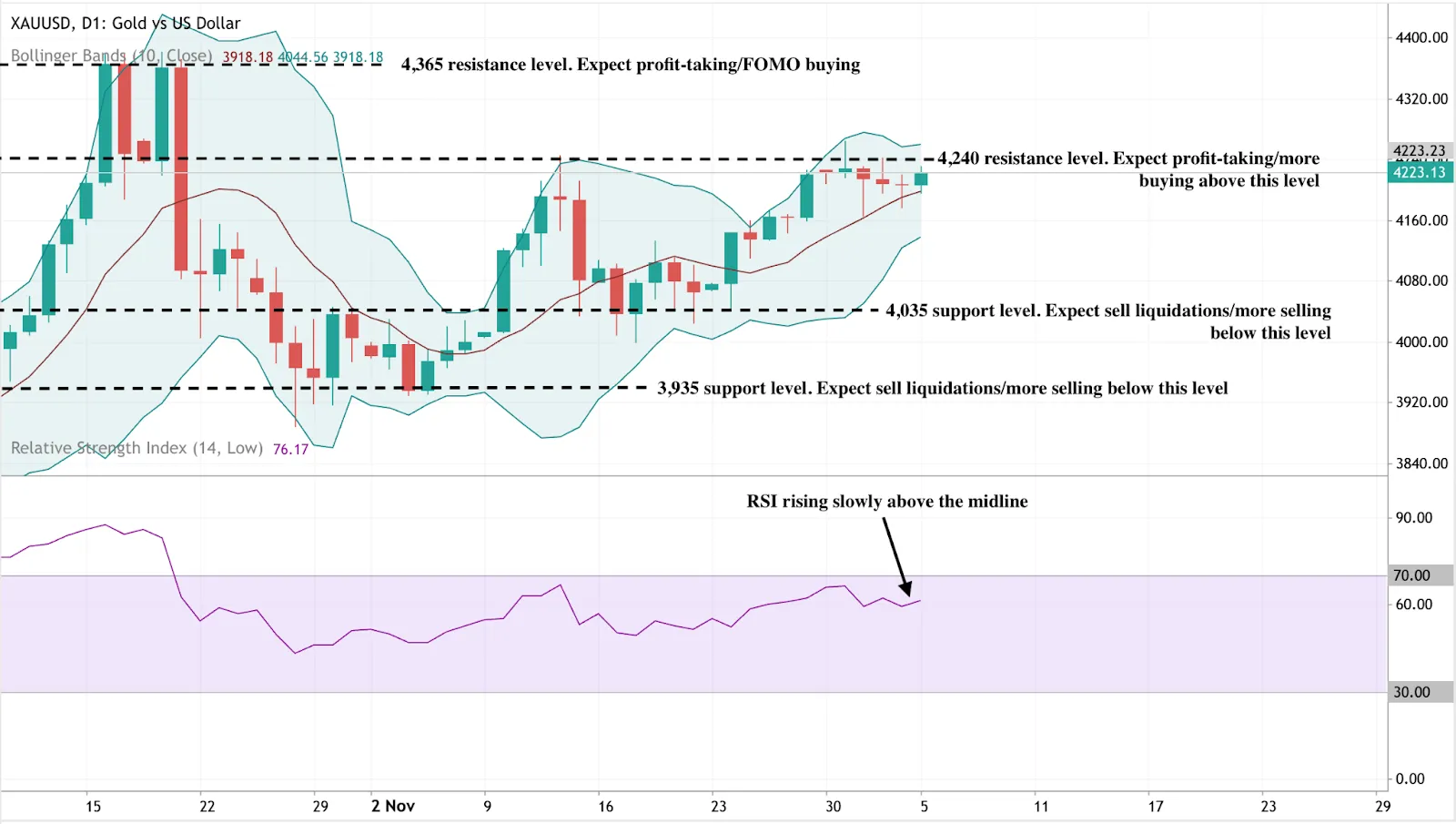
At the start of writing, Gold (XAU/USD) is trading near $4,223, consolidating just under the $4,240 resistance zone. This level - and the higher barrier at $4,365 - often draws early profit-taking or sharp bursts of buying if bullish momentum accelerates. Should the price slip lower, support at $4,035 and $3,935 becomes key; breaks below these areas could trigger forced liquidations and deepen any correction.
Price action remains broadly constructive, with gold trading in the upper half of its Bollinger Band range. This suggests buyers retain control, even as momentum slows. The recent compression in daily candles indicates indecision rather than reversal, with markets waiting for fresh catalysts before committing to a new breakout.
The RSI, currently at 76, indicates sustained bullish momentum but is edging into overbought territory. This supports the existing uptrend but implies limited upside unless gold can break convincingly above $4,240.
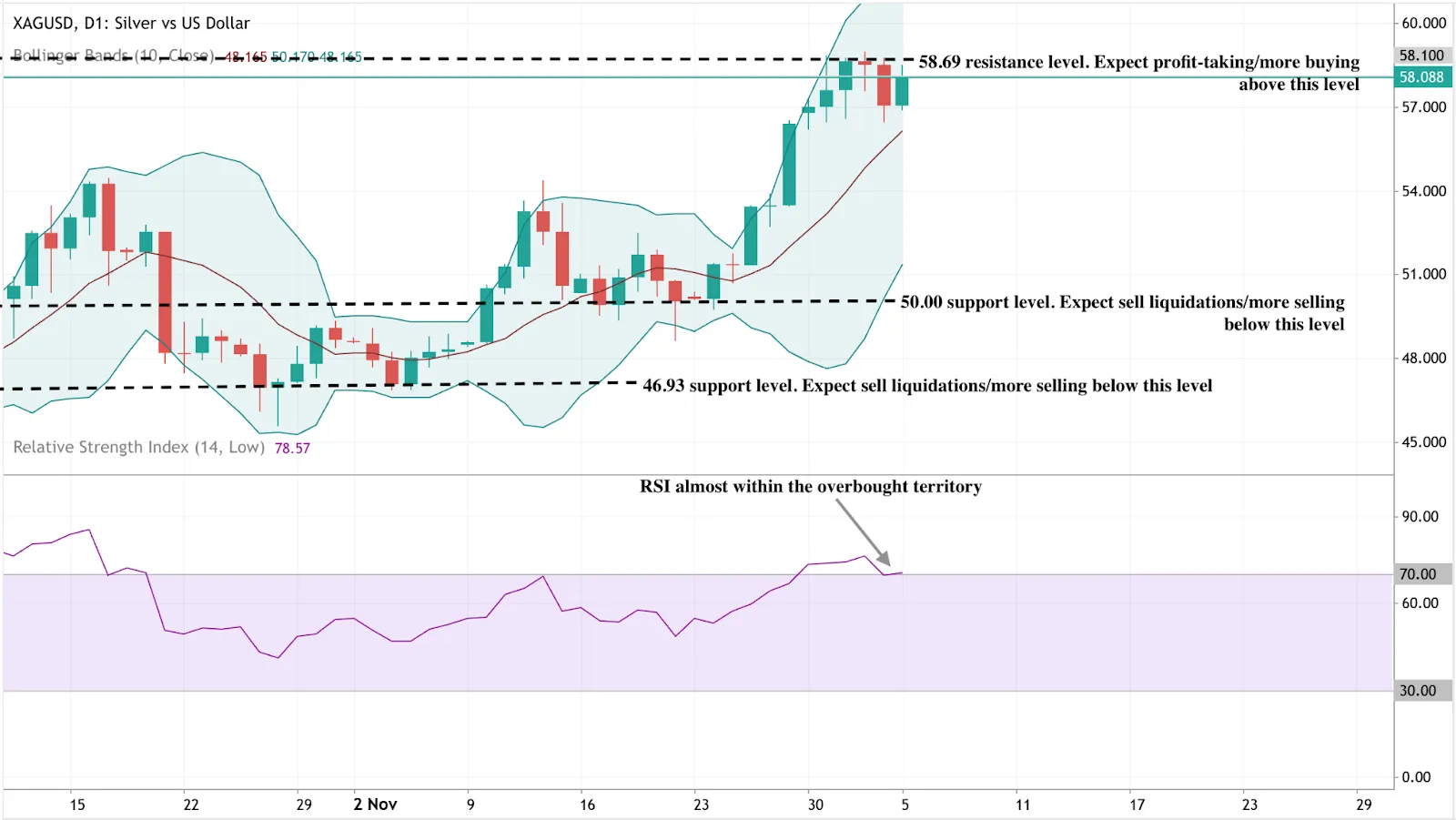
At the start of writing, Silver (XAG/USD) is trading close to $58.08, consolidating just under the $58.69 resistance level. This area often prompts early profit-taking, although a convincing breakout could re-energise the rally. Support levels at $50.00 and $46.93 remain crucial; slipping below either would likely trigger sell-offs and extend any corrective phase.
Silver continues to press against the upper Bollinger Band after a sharp advance, reflecting sustained buy-side interest. With volatility heightened, traders often rely on precise tools such as the Deriv trading calculator to size positions and assess risk as the market accelerates.
The RSI, currently near 78.5, highlights strong but stretched momentum. It underscores the broader uptrend but also hints that silver may require a decisive break above $58.69 to maintain its trajectory and prevent a temporary pullback.
Disclaimer:
The performance figures quoted are not a guarantee of future performance.
FAQs
What does the debasement trade mean?
Why are gold and silver rising so quickly?
How do tariffs influence precious metals?
Will a Fed rate cut push gold even higher?
Is silver’s rally sustainable?


