Contents
Article
Why Gold is surging again: Can the rally hold?
December 23, 2025
Article
Why Gold is surging again: Can the rally hold?
December 23, 2025
Article
Why Gold is surging again: Can the rally hold?
December 23, 2025
%20(1).webp)
Gold is back on the front foot as investors adjust to a market environment shaped by heightened geopolitical tension and a changing interest-rate outlook. Spot prices have returned to record territory above $4,460 per ounce, pushing year-to-date gains close to 70%. The renewed momentum follows US efforts to clamp down on Venezuelan oil shipments, reviving concerns around energy security and global trade stability.
At the same time, expectations around US monetary policy have shifted in gold’s favour. Analysts point to falling real yields and growing conviction that the Federal Reserve will begin easing policy next year. As the cost of holding non-yielding assets declines, gold has regained its appeal as both a defensive hedge and a portfolio stabiliser. The key issue now is whether these supportive forces can persist or whether the rally is starting to look stretched.
What’s driving gold?
The latest move higher has been sparked by renewed geopolitical strain centred on Venezuela. The seizure of a sanctioned oil tanker by the US Coast Guard, alongside attempts to intercept additional vessels linked to Venezuelan crude exports, has unsettled markets. Although Venezuela’s oil output is far below historical levels, the episode has raised broader questions about supply routes and enforcement risks.
Investor reaction highlights the continued sensitivity of markets to geopolitical flashpoints involving strategic commodities. President Donald Trump’s reference to a naval “blockade” has added to the sense of uncertainty rather than easing concerns. Gold has historically responded strongly to such environments, not because of immediate economic damage, but due to the unpredictability they inject into global markets.
Monetary policy has reinforced this backdrop. US real interest rates, a crucial driver of gold demand, have fallen to their lowest levels in over three years. Futures markets continue to signal expectations for at least two Federal Reserve rate cuts in 2026, following signs that inflation pressures are easing and labour-market conditions are cooling. As yields retreat, gold’s relative attractiveness strengthens, particularly for investors seeking diversification.
Why it matters
Gold’s rally carries significance beyond short-term price action. It reflects a broader shift in how investors assess risk across asset classes. After rebounding from its October pullback, gold has once again emerged as one of the year’s standout performers. UBS strategists note that prices are now consolidating at elevated levels, underscoring gold’s role as a defensive cornerstone rather than a tactical trade.
This strength also speaks to deeper concerns around financial stability. Ongoing geopolitical tensions, uncertainty over future US monetary leadership, and rising unease about long-term debt dynamics have encouraged investors to gravitate towards assets perceived as neutral and resilient. Gold’s liquidity and long-standing store-of-value credentials make it particularly attractive during periods when confidence in fiat currencies comes under pressure.
Impact on markets and investors
Strong institutional and central bank demand continues to shape gold’s underlying structure. UBS estimates that central banks will add between 900 and 950 metric tonnes of gold this year, a level close to historical highs. This consistent accumulation has helped dampen downside volatility and establish a solid base above $4,300 per ounce.
Currency movements have added further support. A softer US dollar has made gold more accessible to non-US buyers, reinforcing demand from overseas investors. For many, gold has played a dual role - offering protection against currency weakness while also acting as a hedge against geopolitical risk.
Silver’s performance has amplified the broader precious metals narrative. With prices approaching $70 per ounce and year-to-date gains of around 140%, silver has significantly outpaced gold. When both metals advance together, it often reflects widespread risk aversion alongside speculative interest, rather than a narrow flight to safety.
Expert outlook
Most analysts expect gold to pause and consolidate rather than reverse sharply. UBS suggests the market is absorbing recent gains after a powerful advance, supported by falling real yields and steady institutional inflows. The drop in US real interest rates to their lowest levels since mid-2022 has reduced the opportunity cost of holding gold, keeping the broader trend intact.
That said, risks remain. A sudden easing of geopolitical tensions or a rebound in real yields could trigger short-term pullbacks. Even so, many portfolio managers view such dips as opportunities rather than warning signs. With some projections pointing towards $5,000 per ounce in 2026, gold’s strategic relevance appears firmly re-established.
Key takeaway
Gold’s renewed strength reflects a convergence of geopolitical uncertainty, declining real yields, and sustained institutional demand. Analysts increasingly see the rally as the result of deliberate repositioning rather than panic-driven buying. As central banks remain active buyers and rate cuts loom, gold’s role within diversified portfolios continues to evolve. Upcoming inflation data, Federal Reserve guidance, and geopolitical developments will likely determine the next phase of the move.
Gold technical insights
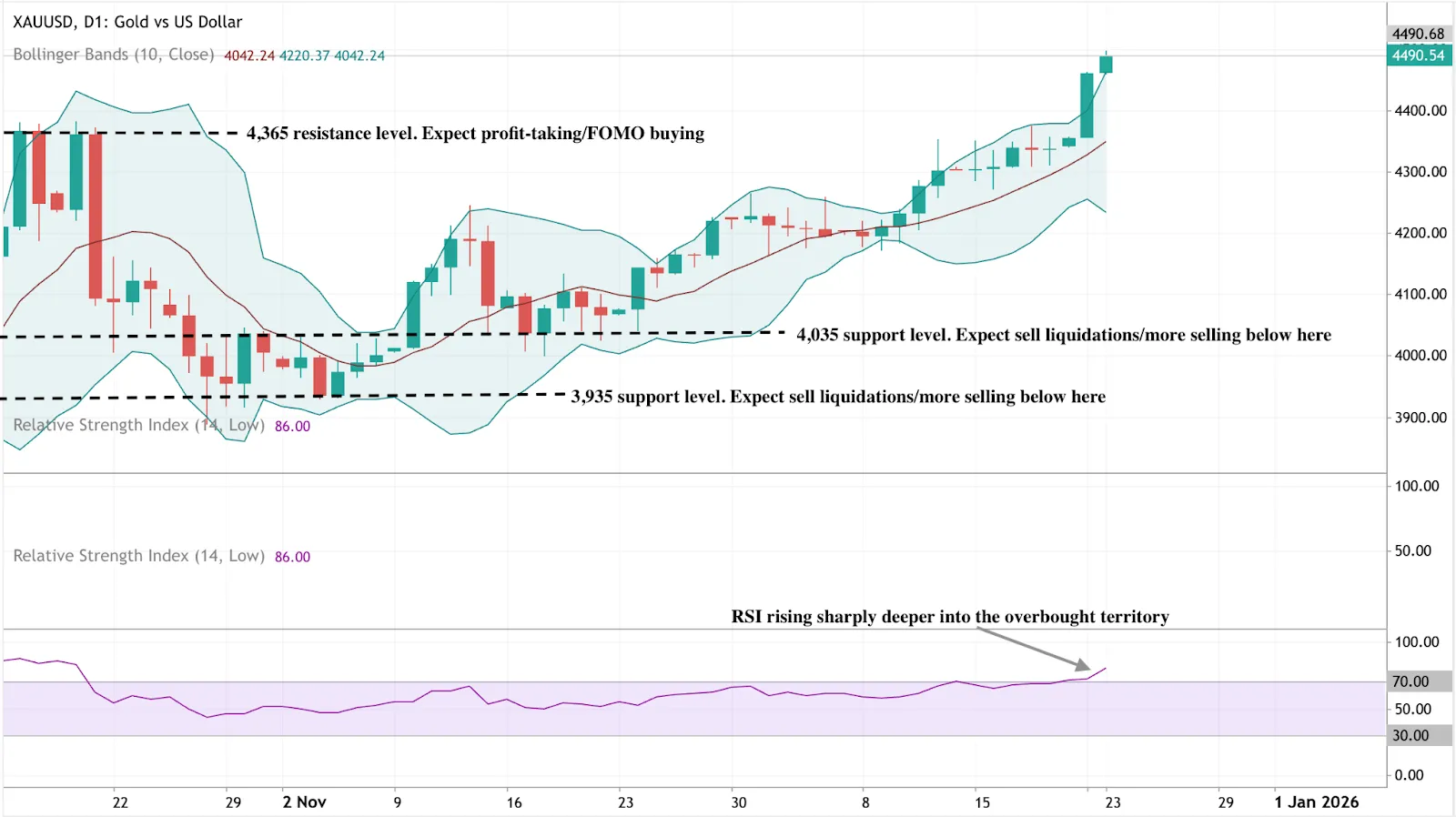
Gold remains firmly bullish, with price action pushing along the upper Bollinger Band - a signal of strong upside momentum and increasingly FOMO-driven participation. The widening of the bands points to rising volatility, currently skewed in favour of buyers.
On the downside, the $4,365 area now acts as a near-term reaction zone, while $4,035 and $3,935 remain the key support levels to watch. A sustained break below these areas could trigger profit-taking; however, pullbacks continue to attract buying interest for now. Momentum indicators are stretched, with the RSI deep in overbought territory, suggesting the risk of consolidation or a shallow pullback in the near term.
Disclaimer:
The performance figures quoted are not a guarantee of future performance.
FAQs
Why is gold rising again now?
How do interest rate cuts affect gold prices?
Is silver outperforming gold this year?
Are central banks still buying gold?
Could gold realistically reach $5,000 per ounce?


